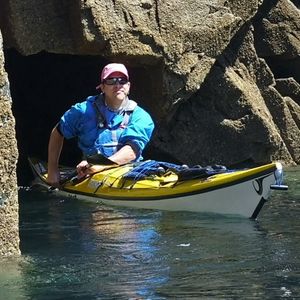

This post hasn't turned out as I expected. I set out, as I often do, to draw a picture - and you'll find that picture below. I thought I'd be telling you something interesting about that picture based on long and well-established theory, but I found that the theory wasn't as old as I expected - and as well as being closer in time, some of the key protagonists came to feel closer in space too - so I've ended up telling you more about them...
What shape is a wave? You thought it wouldn't be that hard a question - humans have been wave watching for millennia and the physics of the divide between water and air can't be that hard. Can it?
An orderly mind and an orderly theory
It was good to have a quiet day, but the various bits of admin had taken over somewhat, so it's late when I decide to head out for an evening jog, and later still when I decide to turn and head for home. I find myself running up the lane towards the classical columns that frame the front door of the old Cambridge Observatory. The second ever director, who would have lived in the part of the building to the right of the columns, was Sir George Biddell Airy.
Airy was an ambitious man, who gave up the prestigious Lucasian professorship (previously held by Isaac Newton, and later by Stephen Hawking) after a year because the job running the observatory was better paid. He was famously caustic, obsessed with order, and hyper-organized. In his first few months at the observatory, he organised everything into labelled boxes. Some boxes were left over, each given the label 'empty box'. His friends jokingly stated that:
‘if Airy wiped his pen on a piece of blotting-paper, he would endorse the blotting-paper with the date and particulars of its use and file it away amongst his papers’
I take a short diversion on my run to pass by The Northumberland Telescope - built by Airy, it was, at the time of building, one of the biggest in the world. Airy adjusted the tensioning of the structure so well that it still holds its precision 200 years later. But by the time the telescope was complete, the ambitious Airy had already moved on, taking up his appointment as the Astronomer Royal in Greenwich, where he focussed on precise observations of the position of the moon.
George Airy was the first to take a mathematical approach to describing ocean waves. His theory mirrors his personality - it's orderly, neat and elegant. Airy wave theory describes nice simple smooth waves with simple sine functions, familiar to anyone from school maths lessons, and indeed from my sea kayak navigation notes:
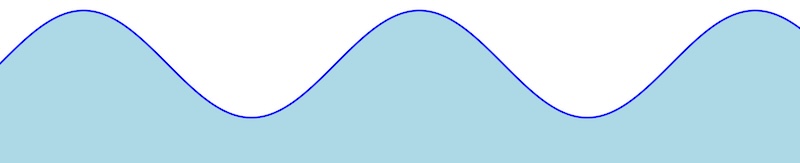 How did Airy achieve such an elegant theory? Simple really - he simply threw out any bits of the maths that threatened to cause any irregularities. The approach is a bit like drawing a map of Anglesey as a perfect circle of radius 17 km - whilst it's not a terrible approximation, such a map does leave out a fair bit of useful detail.
Anyone who's ever paddled a boat off the top of a sharp wave crest, or seen individual waves rearing up from an otherwise flat sea in shallow water knows that real waves, especially the more interesting ones, aren't like Airy's orderly sine waves. But typically, one Airy had spent a bit of time on waves, he moved on - presumably to activities better suited to this organisational temperament. Or perhaps simply more financially lucrative....
The endless equations
Most Wednesday evenings, I cycle around the south side of Cambridge to join in with the canoe club's time trial. The direct route is a busy one, so instead I meander through back streets and a graveyard set back from one of the town's busy thoroughfares. Buried somewhere here - apparently in an unmarked grave - is the final resting place of Sir George Gabriel Stokes.
Whilst Airy only held the Lucasian professorship for a little over a year, Stokes was the longest incumbent ever, keeping the job for 54 years from 1849 until he died in 1903. His work on the motion of fluids put this discipline of science on a new footing. The foundations of fluid mechanics, the 'Navier - Stokes Equations' bear his name. Viscous fluids are still said to exhibit 'Stokes Flow' and obey a simplified version of these equations, simply called the 'Stokes equations'.
Unlike many pure theoretical mathematicians of his era who worked only on paper, Stokes built complex physical apparatus to test his ideas. While studying light, Stokes realized that quinine (the bitter ingredient in tonic water) emitted a vibrant blue glow when exposed to invisible ultraviolet light, leading to the discovery of fluorescence. As secretary and, later, president of the Royal Society, Stokes entered into extensive correspondence on many fields - directing colleagues towards important research problems and checking the veracity of published results.
Stoke's daughter, Isabella Humphreys, wrote that her father
'told me that he was nearly carried away by one of these great waves when bathing as a boy off the coast of Sligo, and this first attracted his attention to waves.'
Stokes revisited Airy's mathematics, re-inserting the complicated algebra that Airy had tossed aside. The result—Stokes Wave Theory—isn't particularly elegant. It’s a mathematical grind, requiring tedious pages of algebra to push precision higher. Indeed, around 170 years later, mathematicians still seem to be working through the finer details - with more precise versions being created through the 20th century, and improvements being published as late as 2021.
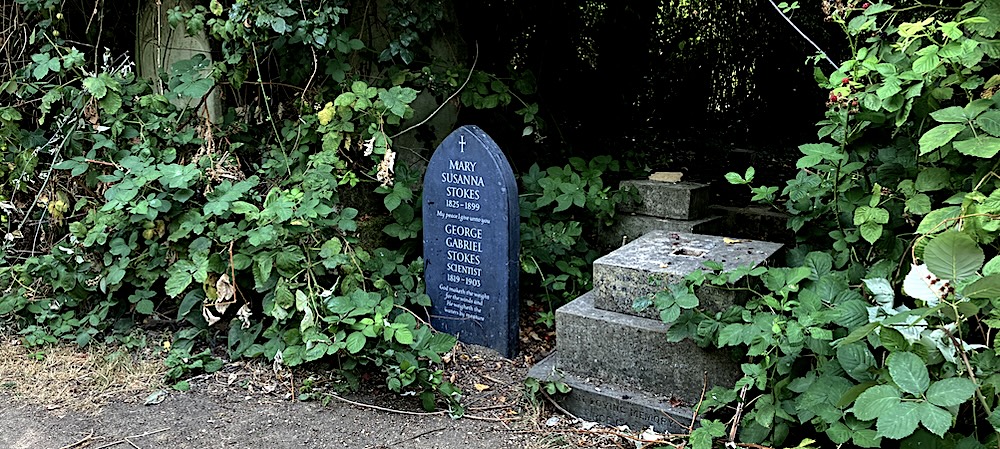
Running early for a change, I stop to search for the spot described in the cemetery's website - although given the thorny bushes that cover large areas, I'm not confident of success. However, not only is the grave easy to find using the provided GPS coordinates, it's also now marked with a modern gravestone. The epitaph, Job 28:25, is an appropriate one for a man who contributed so much to the study of fluids:
God maketh the weight for the winds and He weigheth the waters by measure.
 A catalogue of waves
So what does a wave described by a page or so of algebra look like? Well, it depends, of course, on the wave. As kayakers know, there's a huge variety of waves out there, but let's stick to describing them by two key dimensions:
How high or steep they are - formally, the ratio of the height of the wave to the wavelength. A steep wave might be a meter high and 7 meters long. A less steep one might be half a meter high and 10 meters long.
How shallow the water they're moving in is. It's usual to compare the depth of the water to the wavelength. Waves are typically affected by the seabed when the depth gets to half the wavelength - i.e. a 10m long wave starts to feel the bottom when the depth gets to 5m. We know that as it gets shallower still, waves get slower, steeper and eventually break.
In the diagram below, waves at the bottom aren't very steep, with steepness increasing towards the top. The waves on the right are in deep water, the waves on the left are in shallow water. Note that the wave heights have been exaggerated by a factor of 5 to make the shapes clearer:
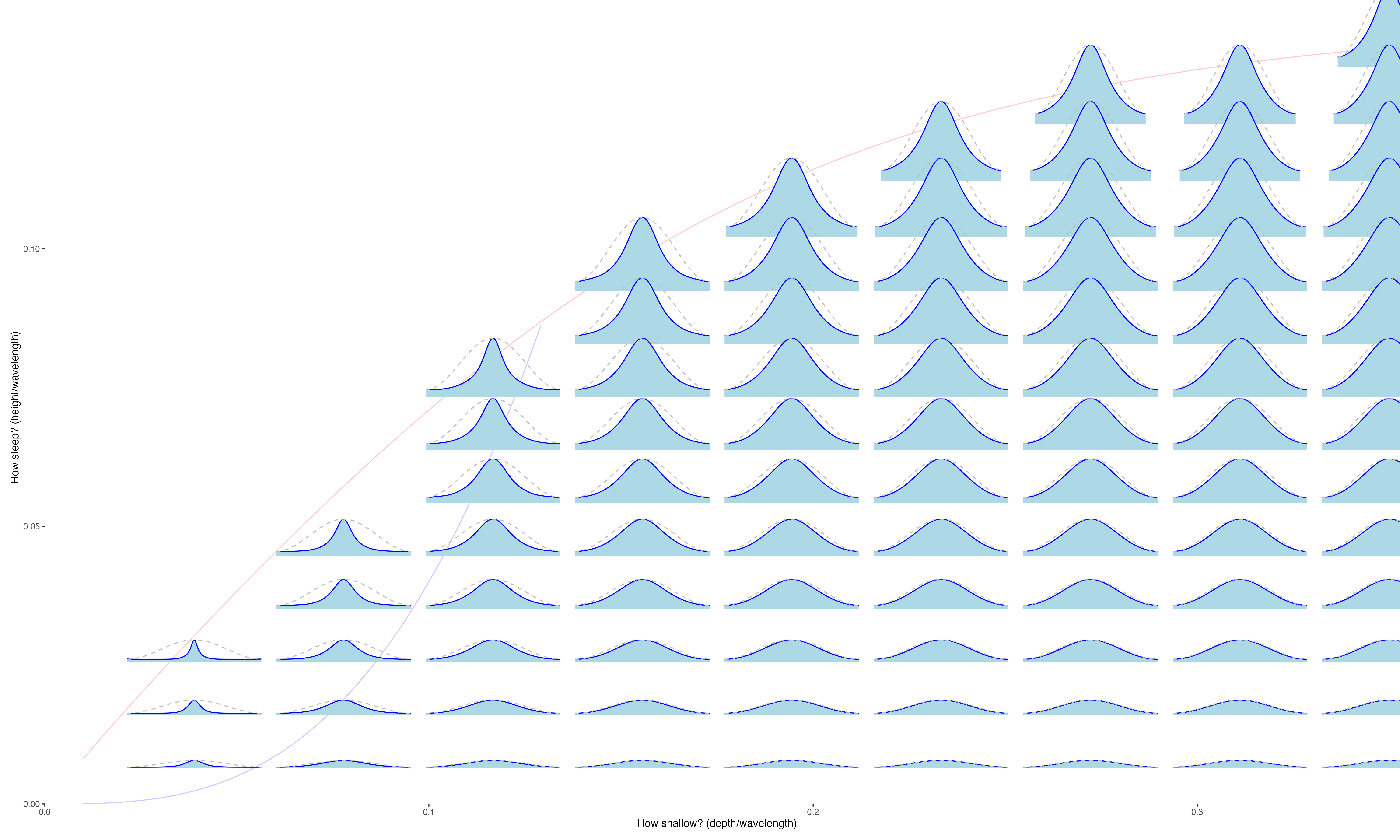 I've sketched dotted lines over the waves to indicate that smooth sine wave profile that George Airy described. You can see that for not-very-steep waves in deep water (bottom right), it's not a bad description. But as waves get steeper (moving up the diagram), they acquire a sharper peak than the simple theory and require ever more refined versions of Stoke's equations to describe accurately. Eventually, the waves get so steep that they break - that's why there's no waves in the top-left part of the diagram - they simply can't exist because they collapse into whitecaps before they get that tall.
Shallow water... in the basement
The quickest way home from the Canoe Club is through town. I turn left at the engineering department - where I spent many hours in lectures and practicals back when I was a student here - and continue up Trumpington street. The Pitt Building on the left is mostly known as the old site of the university press, but it also, for a period, housed the Department of Applied Mathematics and Theoretical Physics (DAMPT). We occasionally had tutorials in the old DAMTP rooms - although they'd moved out years ago by then, the whiteboards were still covered in scarily complex equations. Thomas Brooke Benjamin split his time between DAMTP and Engineering during his time at Cambridge in the 1950s and 60s. He helped set up a fluid mechanics laboratory in the basement of the Pitt building - despite a lack of adequate drainage, low ceilings, and cramped conditions.
After Cambridge, Benjamin moved on to become Professor of Mathematics and Director of the Fluid Mechanics Research Institute at the University of Essex, where he worked with American scientists Jerry Bona and J.J. Mahoney. The three of them worked on a rather different approach to water waves, based on equations first noted by Frenchman Joseph Boussinesq in 1872 to describe the motion of waves in shallow water. The equation was solved by Gustav de Vries in his PhD thesis in 1894, but the trio of Benjamin, Bona and Mahoney came up with a much neater approach.
You see, waves behave very differently in shallow water. Even George's Stoke's long-winded equations can't describe these sort of waves (those to the left of the faint blue line in the diagram). They're described by the wonderfully bizarre word 'Cnoidal', after one of the obscure mathematical functions that appears in their theory that happens to be commonly denoted as 'cn'. Let's look at one of these things at actual scale (no vertical exaggeration):
 We're clearly now an awfully long way from Airy's simple smooth waves (grey dashed line), with the wave forming a steep 'lump' in a plateau of nearly flat water. But of course, waves like this are familiar to any kayaker who's paddled beyond the breaking waves of a surf beach with a long period swell. Here's a nice aerial photo of this sort of thing, with sharp crests and wide, flat troughs:
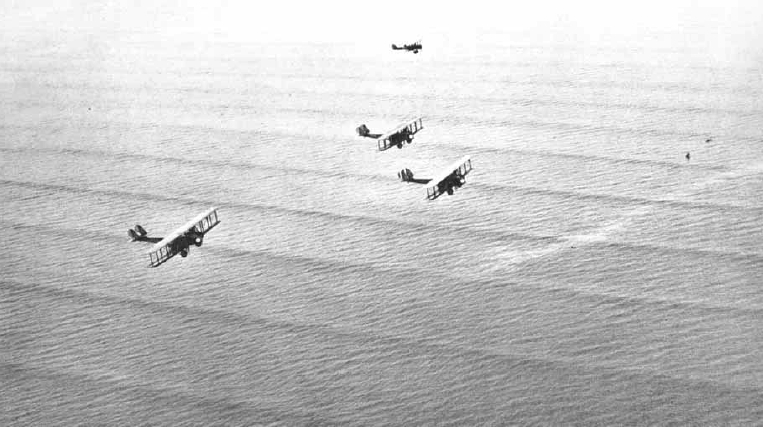 The Benjamin–Bona–Mahony equation remains an active topic of research (the number of citations of their 1972 paper increased year on year until at least 2024!) - it's helpful in understanding how the chaotic sea state under a storm resolves into a well-ordered swell and underlies some theories of the formation of rogue waves.
A 200 year old mystery
As I mentioned, there's been a few surprises along the way of writing this post. The number of Cambridge connections was a surprise - but it's easy to forget just how much academics in this town have influenced modern science. More surprising was how recent some of the relevant research is - creating that wave diagram drew on key results from the 1970s and reformulations of theory published in the 1990s and the 2010s. And it's abundantly clear that oceanographers believe they still have much to learn about waves.
But perhaps the biggest surprise is that we get to see all of this every time we go out on the sea - whenever the bow drops steeply off the back of a Stokes wave, or you find yourself out back of a surf break watching steep distinct cnoidal waves roll in towards the beach.
And if you find yourselves looking at the waves around your boat and thinking that they're remarkable or mysterious, rest assured that some of the world's top mathematicians and oceanographers would probably agree.