

I sometimes find myself sitting in the eddy behind some island or other contemplating a crossing, mildly alarmed at the speed that the flow is rushing past the eddy line. Generally, things turn out OK (assuming I didn't screw up the planning too badly...), and I remind myself that the flow past the island is probably significantly increased by the fact that the island is there.
This makes sense - if there's some obstruction in the flow of the fluid, the fluid is going to need to go faster at some point to get around it. But how larger might we expect this effect to be?
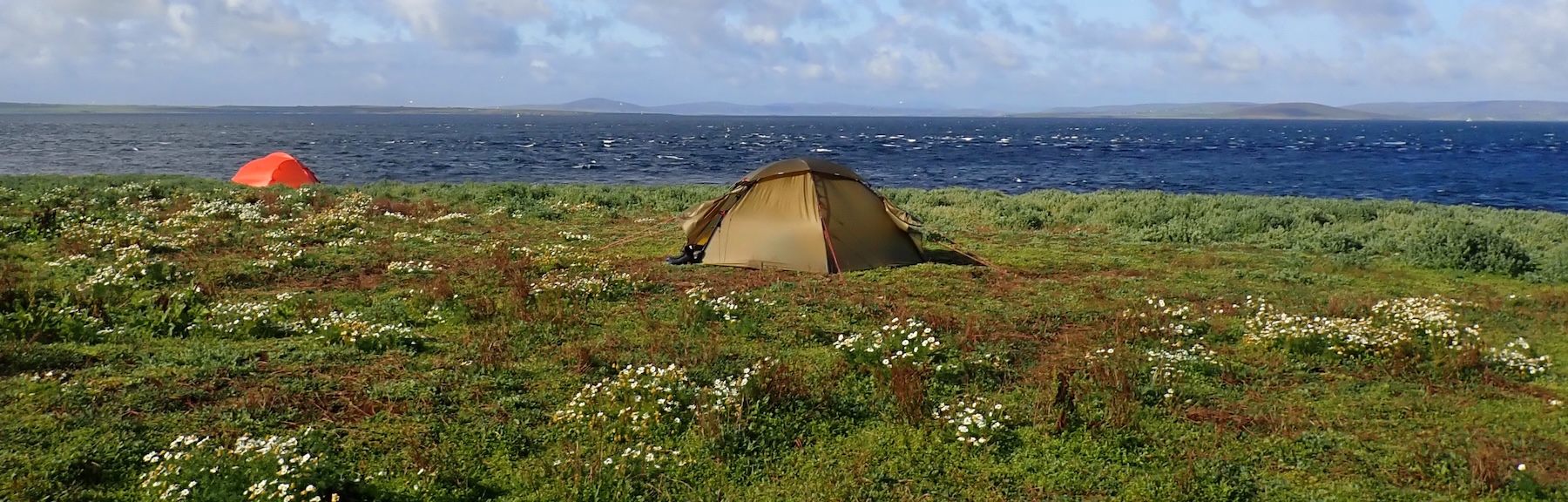 Fast tidal streams past Little Green Holm, Orkney. Note that the breaking waves seem to be concentrated in a jet of faster water near the island.
Clearly, this is going to depend on a lot of factors, like the shape of the island and the seabed around it. For a simple rule of thumb, a circular island seems like a reasonable start point. And perhaps we might begin by thinking about a circular island with sides that rise vertically from deep water.
Deep water
Let's start with a terrible model. "Potential flow" is a term used by physicists to describe idealised flow of a frictionless fluid. Whilst it's a poor model for most flows, and especially bad for modelling water round big islands, it does have the advantage that the equations aren't too hard to solve. For this reason, a remarkable amount of aircraft design was done using potential flow theory before the advent of computer simulation. What does the potential flow look like around our cylindrical island?
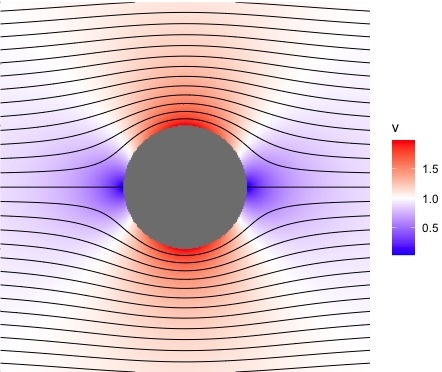 Potential flow around a cylinder - streamlines shown in black, flow speed (v, as ratio to baseline flow =1) shown as red (fast) to blue (slow)
As we'd expect, flow is slower at the front of the island as the water 'piles up' ahead of it. And we can see the flow accelerating around the side - reaching up to twice its original speed.
Any paddler will immediately see how poor this model is - there's no eddy behind the island - in fact, the flow is symmetrical front to back. And it turns out if you do the maths that the water rushing past the island in this model doesn't actually exert any force on it.
Doing better, and modelling flow a bit more like real water, requires some serious computer simulation.
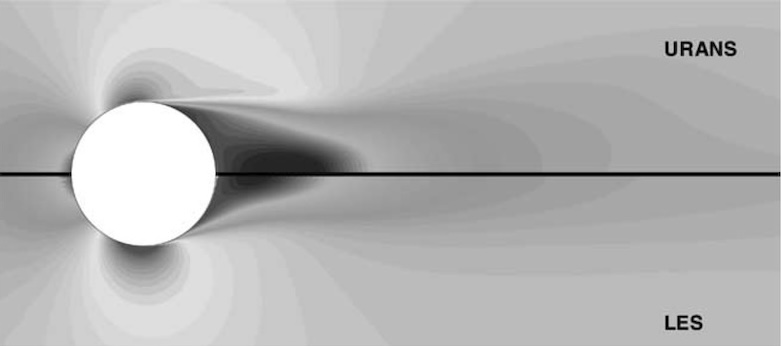 CFD Simulations of flow past a cylinder (Re=1e6), from: Catalano, Pietro, et al. "Numerical simulation of the flow around a circular cylinder at high Reynolds numbers." International journal of heat and fluid flow 24.4 (2003): 463-469. URANS and LES are two different modelling approaches. The degree to which the models disagree in some areas is surprising!
If you squint at the image, the flow field around the front of the cylinder doesn't look too different from our very simple model. Behind it, things are, as we'd expect, very different. Maximum flow speeds at the sides of the cylinder in these sorts of studies reach about 1.75 times the original flow speed. Given the unrealistic assumptions in our original model, it's surprising how close our estimate of 2 times was.
Shallows
Of course, real islands tend not to rise as vertical sided seamounts from deep water - they're typically surrounded by shallows and reefs. We might expect these to accelerate the water more as the flow gets 'squeezed' vertically as well as horizontally. Or perhaps we'd expect the flow to be slower as the friction with the seabed slows the water down?
I did manage to find one study that addressed this question, modelling an island with shallows sloping away from it.
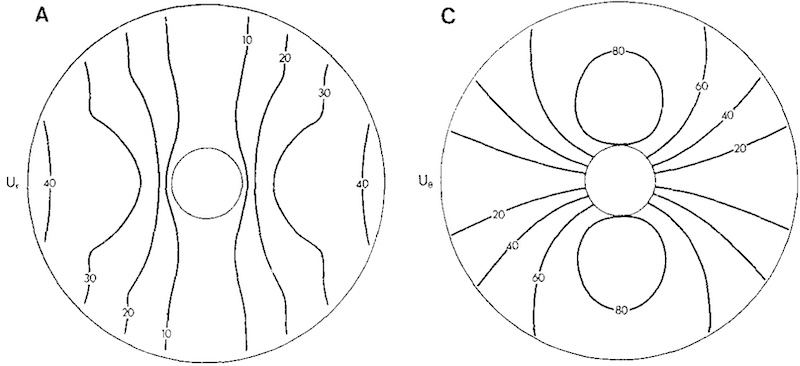 Flow speeds in cm/s, compared to an initial speed of 50 cm/s far from the island. A shows radial flow speed, C shows tangential speed. From ingree, R. D., and Linda Maddock. "Tidally induced residual flows around an island due to both frictional and rotational effects." Geophysical Journal International 63.2 (1980): 533-546.
The plots are a little hard to read, as they show the speed of the flow away from/towards the island (A) and around the island (C). But the key thing is that the maximum flow at the island shore looks like 80 cm/s (~1.6 knots), 1.6 times the initial flow of 50 cm/s (~1 knot). Note that the seabed friction clearly has an effect here, with the faster flows being some distance (a little less than one island diameter?) away from the island.
That's about the best information I could find to answer this question. There was some data (doi: 10.1016/j.csr.2021.104347) from the area around the Corryvreckan, with GPS tracks showing the speed of drifting objects floating past some islands - whilst these were consistent with the numbers above, the information isn't provided precisely enough to be sure.
Summary
So, it looks like a the flow speed increase around an island could be plausibly be in the range 60-75%. Perhaps worth knowing next time you're contemplating leaving an eddy?