

 Juvenile Stoicism
Among the stoical exercises which I cultivated, as earnestly as it was possible for a lad, was even the endurance of bodily pain. Our teachers often treated us very unkindly and unskilfully, with blows and cuffs, against which we hardened ourselves all the more as obstinacy was forbidden under the severest penalties. A great many of the sports of youth, moreover, depend on a rivalry in such endurances; as, for instance, when they strike each other alternately, with two fingers or the whole fist, till the limbs are numbed, or when they bear the penalty of blows, incurred in certain games, with more or less firmness; when in wrestling or scuffling they do not let themselves be perplexed by the pinches of a half-conquered opponent; or finally, when they suppress the pain inflicted for the sake of teasing, and even treat with indifference the nips and ticklings with which young persons are so active towards each other. Thus we gain a great advantage, of which others cannot speedily deprive us.
But as I made a sort of boast of this impassiveness, the importunity of the others was increased; and, since rude barbarity, knows no limits, it managed to force me beyond my bounds. Let one case suffice for several. It happened once that the teacher did not come for the usual hour of instruction.[Pg 50] As long as we children were all together, we entertained ourselves quite agreeably; but when my adherents, after waiting long enough, went away, and I remained alone with three of my enemies, these took it into their heads to torment me, to shame me, and to drive me away. Having left me an instant in the room, they came back with switches, which they had made by quickly cutting up a broom. I noted their design, and as I supposed the end of the hour near, I at once resolved not to resist them till the clock struck. They began, therefore, without remorse, to lash my legs and calves in the cruellest fashion. I did not stir, but soon felt that I had miscalculated, and that such pain greatly lengthened the minutes. My wrath grew with my endurance, and at the first stroke of the hour, I grasped the one who least expected it by the hair behind, hurled him to the earth in an instant, pressing my knee upon his back; the second, a younger and weaker ore, who attacked me from behind, I drew by the head under my arm, and almost throttled him with the pressure. The last, and not the weakest, still remained; and my left hand only was left for my defence. But I seized him by the clothes, and with a dexterous twist on my part, and an over precipitate one on his, I brought him down and struck his face on the ground. They were not wanting in bites, pinches, and kicks, but I had nothing but revenge in my limbs as well as in my heart. With the advantage which I had acquired, I repeatedly knocked their heads together. At last they raised a dreadful shout of murder, and were were soon surrounded by all the inmates of the house. The switches scattered around, and my legs, which I had bared of the stockings, soon bore witness for me. They put off the punishment, and let me leave the house; but I declared that in future, on the slightest offence, I would scratch out the eyes, tear off the ears, of any one of them, if not throttle him.
This event, though, as usually happens in childish affairs, it was soon forgotten, and even laughed over, was yet the cause that these instructions in common became fewer, and at last entirely ceased. I was thus again, as formerly, kept more at home, where I found my sister Cornelia, who was only one year younger than myself, a companion always growing more agreeable.
Still, I will not leave this topic without narrating some more[Pg 51] stories of the many vexations caused me by my playfellows; for this is the instructive part of such moral communications, that a man may learn how it has gone with others, and what he also has to expect from life; and that whatever comes to pass, he may consider that it happens to him as a man, and not as one specially fortunate or unfortunate. If such knowledge is of little use for avoiding evils, it is very serviceable so far as it qualifies us to understand our condition, and bear or even to overcome it.
Another general remark will not be out of place here, which is, that as the children of the cultivated classes grow up, a great contradiction appears. I refer to the fact, that they are urged and trained, by parents and teachers, to deport themselves moderately, intelligently, and even wisely; to give pain to no one from petulance or arrogance, and to suppress all the evil impulses which may be developed in them; but yet, on the other hand, while the young creatures are engaged in this discipline, they have to suffer from others that which in them is reprimanded and punished. In this way, the poor things are brought into a sad strait between the natural and civilised states, and after restraining themselves for a while, break out according to their characters into cunning or violence.


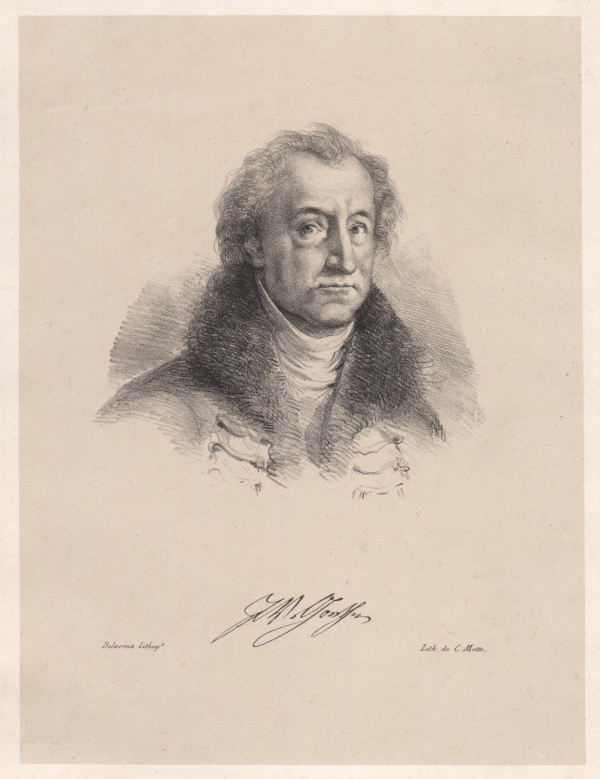
Johann Wolfgang von Goethe at age 38 - Angelica Kauffman (1787)


Thank you for your support of Lichtblick and for being a patron of humorists, writers, and the arts.
Best wishes!
~ Mathilda Ferguson

“One ought, every day at least, to hear a little song, read a good poem, see a fine picture, and, if it were possible, to speak a few reasonable words.”
~ Johann Wolfgang von Goethe