
“You don’t take a photograph, you make it.” – Ansel Adams

That thought has followed me since I first held a Kodak Instamatic at age 8 — a gift from my godmother that sparked a lifelong passion for photography.
Early Days
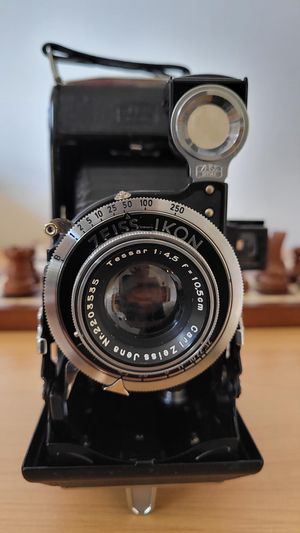
In the 1970s, I joined my high school’s analog photography club, led by our chain-smoking but deeply committed math and physics teacher, Rolf Bruns. We had a full darkroom setup — black-and-white film, photograms, enlargers, and even access to cameras like the Hasselblad and Leica. I shot with my father’s Zeiss Ikon Ikonta 521/2, equipped with a Zeiss Tessar lens and a Prontor shutter.
It was my first introduction to 120 roll film and the 6×9 format — and to the slow, intentional rhythm of analog photography.
I set up my own photo lab, where I developed film and printed in black and white using a Kaiser enlarger — one that could even handle the large 6×9 format. As my skills grew, so did my gear: from a Voigtländer Vito to a Praktica MTL3, and later a Pentax MZ. Eventually, like many others, I transitioned to digital. Photography stayed with me, but it took on a different shape. From color slides to shooting film now.
Professional Life & Chess
Then came my professional life — decades in the chemical industry and in technology, shaped by systems thinking, problem-solving, and global leadership.
During the pandemic and after retiring, I applied the same learning mindset to something completely different: correspondence chess.
I returned to the game after a long hiatus, driven by a clear mental goal: to prove that a senior can improve in chess. Over the past few years, I reached the top ranks among senior correspondence players in the U.S., earned my first title, and documented that journey through my chess blog.
The Shift Back to Film
But in 2024, something shifted.
After decades immersed in digital technology — automation, systems, cloud workflows — I realized how much I had lost touch with the essence of photography. I was surrounded by thousands of digital images, stored somewhere in the cloud, but doing nothing. Empty files. Forgotten moments. There was no process, no intention, no meaning. Just more.
So, I decided to let go.
I returned to my roots in analog photography — not out of nostalgia, but as a conscious act of digital detox. A way to slow down, to re-engage with the craft of image-making, and to make each frame count again.
After decades in tech, much of it focused on system optimization and process automation, it felt like the right time to let go. I made a conscious decision to abandon digital photography. Not entirely, but I want to refocus on composition again, rather than documenting.
Ask yourself: how many thousands of photos are sitting somewhere in your cloud storage, untouched and unseen? In the end, they often become just data — disconnected from meaning.
Why Analog Photography Is Different
Analog photography is different. It demands presence. Every shot costs you time (and money), light, focus, and intent. You have limits with a film roll — 8 with 6×9 or 12 with 6×6 format or 36 shots with a 35mm film. There’s no endless burst mode, no instant review, no algorithm making decisions for you. It’s just you, your subject, and a small window of light.
That’s why I now work one frame at a time.
It’s not just a technical limitation. It’s a mindset — to observe more carefully, to compose more deliberately, and to value the result because it was earned, not automated. You relearn to see, to embrace what you see through a photographer's eye.
The Timeless Appeal of Black & White
There’s something about black-and-white film that transforms a scene into something timeless — less a snapshot, more a narrative. Whether it’s the bold contrast of Ilford HP5 or the smooth tonal range of XP2, the Zeiss Ikon Ikonta handled each stock with grace. Even Lomography Potsdam 100, with all its quirks and occasional imperfections, added a layer of unpredictability I’ve come to value in my analog photography journey.
Behind the Scenes: Tracking and Exposure
Managing exposure with a vintage camera can be challenging — but it’s part of the appeal. To make the most of each roll, I combined analog discipline with modern tools: I used the AFILM app to log every shot and relied on David Quiles’ LightMeter app for accurate exposure readings.
This blend of old and new — classic film photography supported by digital helpers — proved to be the ideal workflow for staying present while staying precise.
Returning to analog photography has been more than just a hobby; it’s a form of digital detox. There’s an inherent slowness to it — every shot is more deliberate, every frame more precious. In an age of instant gratification, shooting with the Zeiss Ikon Ikonta reminds me to slow down and truly appreciate the art form.
My Zeiss Ikon Ikonta 521/2
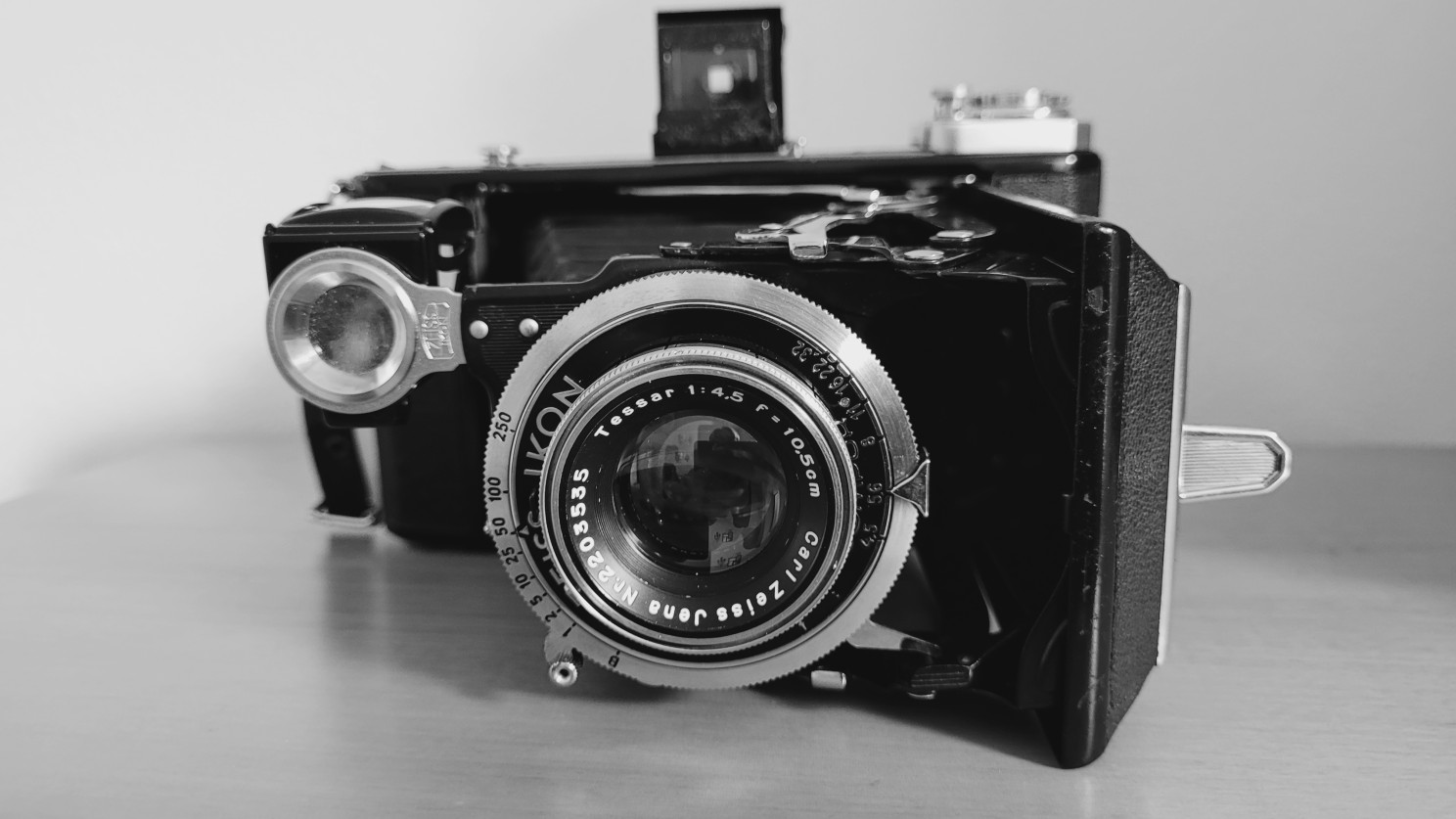
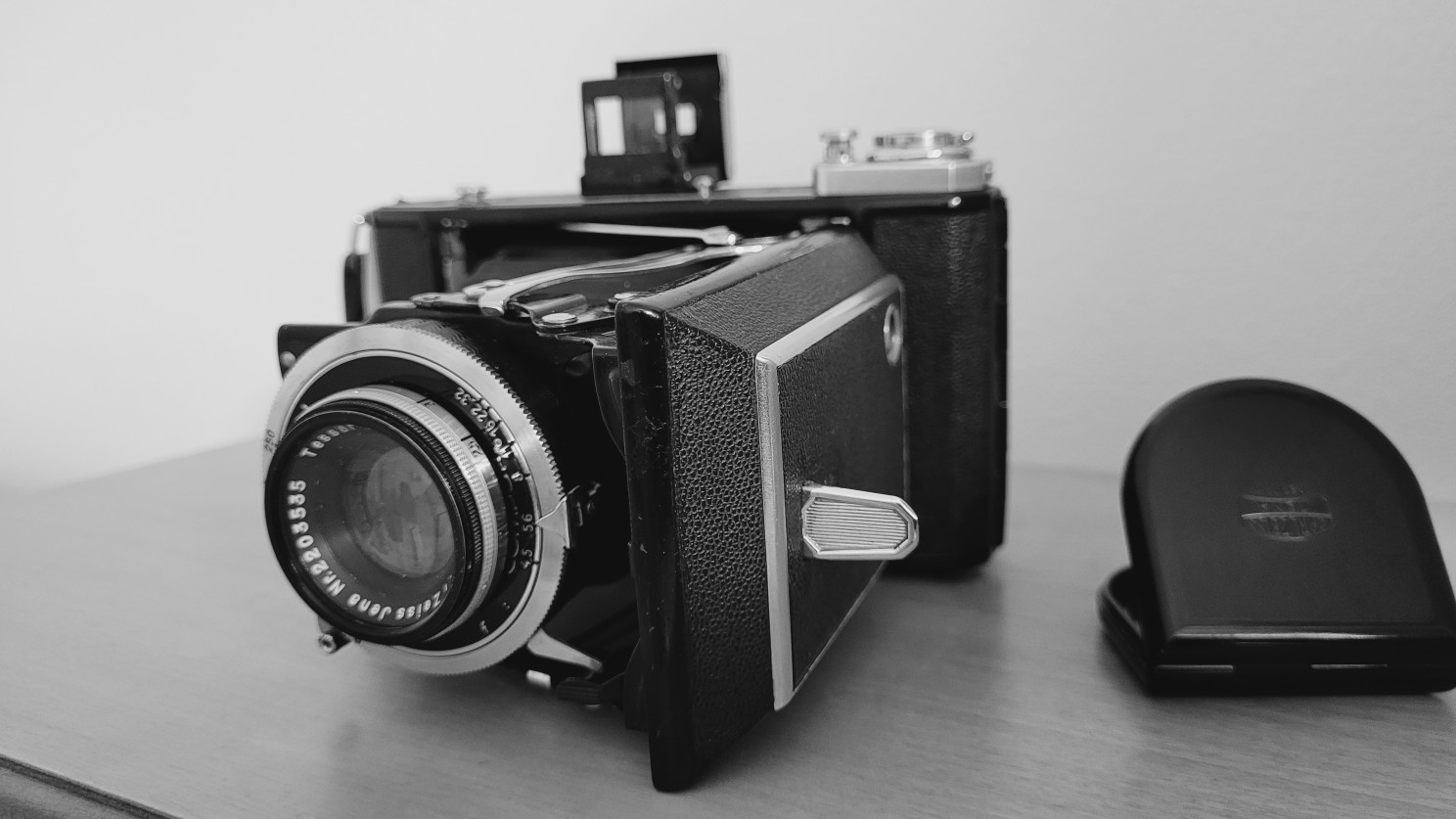
I acquired my own Zeiss Ikon Ikonta 521/2 — a folding camera manufactured in 1938, equipped with a Zeiss Tessar 4.5/10.5 mm lens. Nickname of the lens at that time: “the eagle's eye”. Fully mechanical, no electronics, no autofocus, no light meter — just film, light, and patience.
Imagine what the lens has seen over the last 87 years? The camera itself is in great shape. Other than the typical Zeiss Bumps under the leatherette. Leatherette? Yes, those were the times when cameras had no plastic but a real leather coat.
And then again, every photo has a story. At least one — the simple question of why you chose to capture it. With analog photography, the process slows you down. You observe more, think deeply about the composition, and reflect on what drew your attention in the first place.
The Result: A Zine
From My Front Door – Quiet Walks Near Home
This zine began as a way to reconnect with film — walking the woods, trails, and old farm paths near my front door in the Pacific Northwest. Most images were made on 120 film with a 1938 Zeiss Ikon Ikonta 521/2. A few 35mm frames from a Zeiss Contina IIa also found their place. The result is a quiet collection — everyday landscape scenes, photographed slowly, one frame at a time.
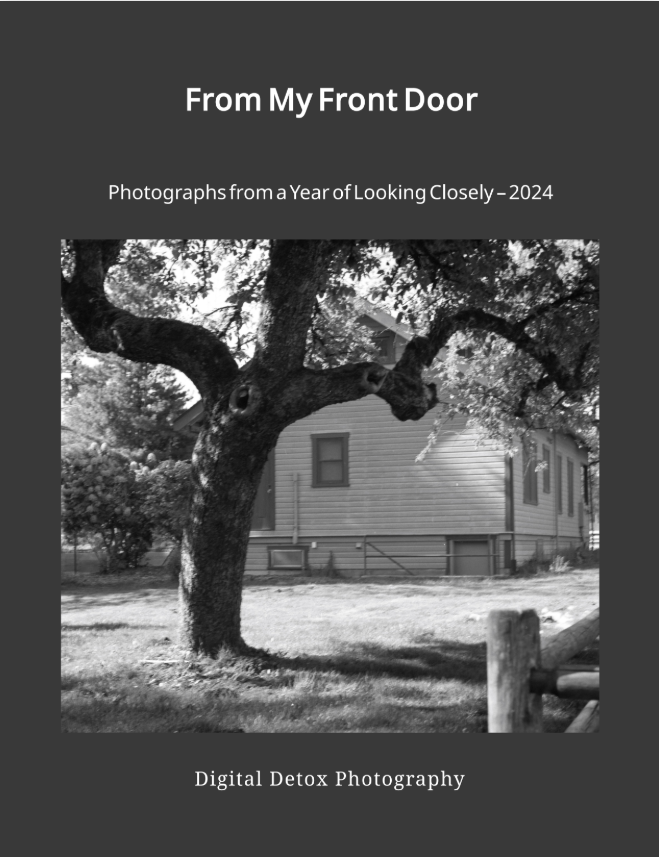
Edition details: Printed on matte 115 GSM paper with a velvety, uncoated finish. Softcover: semi-gloss, 216 GSM. US Letter, 8.5×11 in, 22×28 cm.
Number of Pages: 36
📷 A 15-page limited preview of the zine is on 🔗 My Website, and if you like my artwork and want to have your copy, it can also be ordered at 🔗 Blurb.
(And yes — I’m sure Mr. Bruns would have quietly smiled while lighting his usual Camel cigarette.)
The Camera Behind the Zine
Zeiss Ikon Ikonta 521/2
Lens: Zeiss Tessar 4.5 / 10.5cm
Camera Serial Nr.: F23627
Lens Serial Nr.: 2203535
Shutter Speeds: B, 1s, 1/2s, 1/4s, 1/10s, 1/25s, 1/50s, 1/60s, 1/100s, 1/250s (Compur Shutter)
Aperture Values: f/4.5, 5.6, 8, 11, 16, 22, 32 (tested and fully functional)
Accessories:
Yellow Filter from 1938 (Carl Zeiss Jena) with original Bakelite box
6×9 viewfinder Zeiss 437/2
Zeiss Ikon 10” shutter release cable (thumb-activated design with screw lock)
Thanks for reading! If this resonated with you, feel free to leave a comment or reach out. I’d love to hear your thoughts on analog photography, digital detox, or your own journey with film.