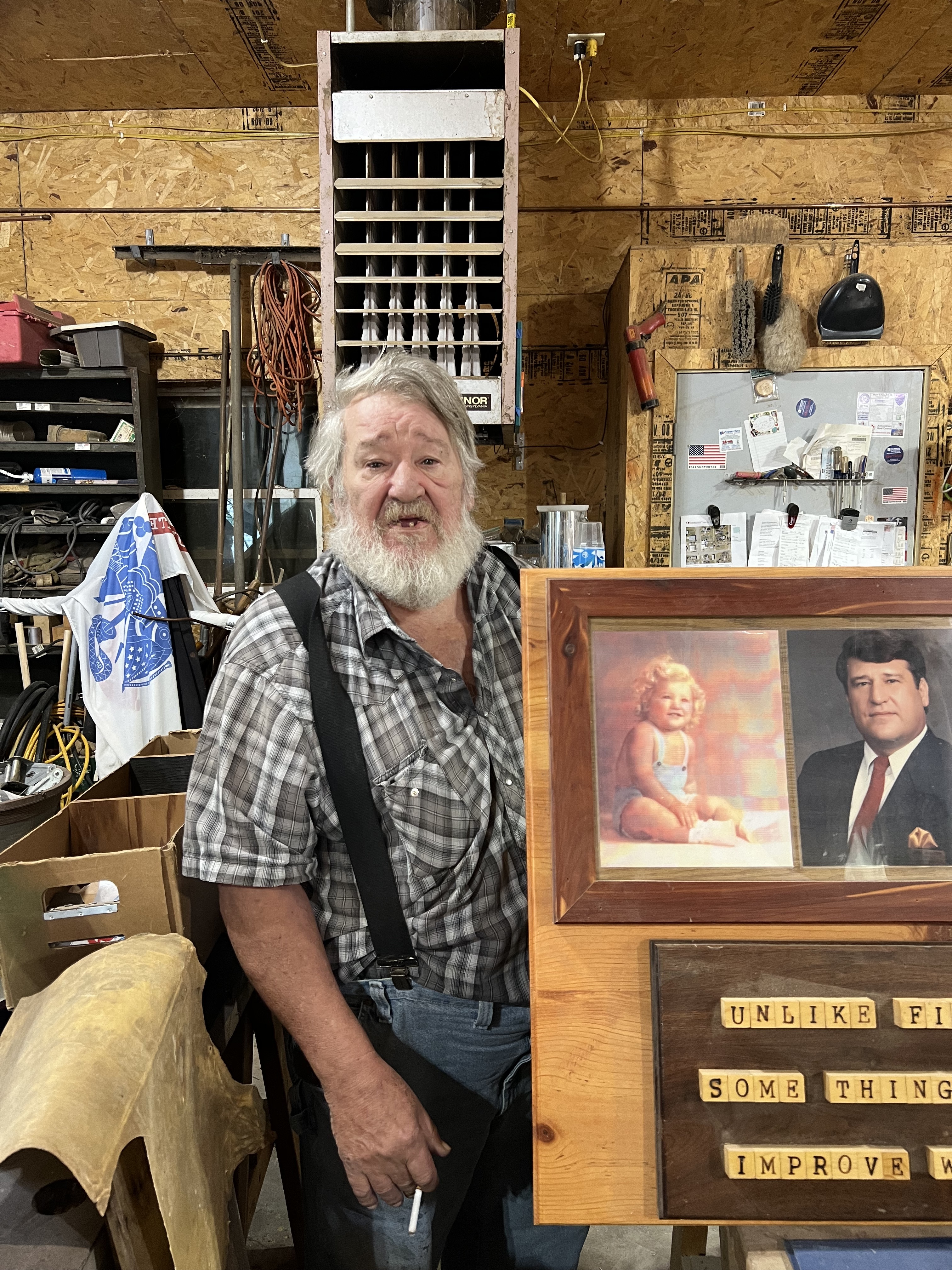
Dennis “DJ” Johnson has a sense of humor. For example, he claims that everything he touches fails. He attended the Cement Rural School, and then it closed. The same was true of Wesbury Rural School and then Volin High School. He went to Vietnam, and then America lost the war. He attended the University of South Dakota, Springfield, and then it closed. He worked at Montgomery Ward’s, and then it closed. “I am kind of like an albatross.” There may be some correlation, but there is no causation!
Dennis was born 21 February 1950 to Lewis and Anabelle (Showers) Johnson. He is particularly fond of his family history. His paternal great grandfather John Peter Johnson moved from Norway to America in 1847. He owned a “nice farm” near Pleasant, IA in 1863. In 1900, he decided he wanted to move to Minnesota to be a logger. He sold the farm land and took a couple of his children to Mille Lacs, Minnesota. Peter’s son, Henry, and his wife traveled west, however. “She died on the way near Yankton, and that’s why we are from here.”
Henry’s family farm was located in and around the old cement plant located west of Yankton. “The government took a lot of his farm ground and he was left with the hills on the north side of the highway. Not too much to farm so he purchased a place west of Volin.” He chuckled as he said, “the long motel building to the west of Captain Norm’s is half of my old man’s cattle shed!”
As a kid, Dennis explored. “I went into the cement plant and snooped around. There are three dome concrete structures. That’s where they stored the dynamite. The big pit behind the quarry, my dad sold the clay out of it to help build the Gavin’s Point Dam.”
Dennis attended the Cement School, a single room rural schoolhouse that is still located to the south of the highway. “I was the only student in my grade school. Just before we moved in 1958, I remember sitting out there and watching them build the highway. There was nothing out there at that time, no Riverside acres. The fish hatchery opened in 1960. When you hit the dam, there was nothing but the park out there.” The school closed after he moved.
The new home and 260 acres were located west of Volin and south of Lake Marindahl. He can remember in detail how his father plowed with a two-bottom plow, disced, dragged and then planted. He checked the corn by running a line. He wanted to be able to cultivate this way and the other way. “As a kid, I ran the wagon for corn picking. No hired hands. Just the two boys!” He also worked the hay rack. “I had to lift them up and then lift higher. My brother stacked them. Hot and miserable. Dad was very slow talking but sharp witted. He said, ‘They aren’t the brightest boys on earth, but they sure can work.’”
Denns attended the Wesbury rural school. It too had one room with five kids from two families. “I was in the last graduating class there in 1963. Then they closed the school.”
He graduated from Volin High School in 1968. There were nine in his class. And, of course, there is no longer a high school in Volin. It closed. Along the way, Dennis participated in sports. “I played football all four years, and three years of basketball and track.” He loved music and was a soloist in They Call the Wind Maria. I anchored the medley relay. Our eight-man football team was terrible. I cracked my tail bone one Friday night. I couldn’t lean over to take a 3-point stance. It was pouring rain and the two freshman were laying under the bleachers to stay out of rain, so I stayed in the game.”
“I never cracked a book in high school or college. I went to class most of the time and listened attentively. I bullshitted my way through essays.” He attributes that to his mother who bought him a set of encyclopedias. “After chores, I had nothing to do. I would lay on living room floor and for five years I read it back and forth. I loved history.”
A highlight of his senior year was the senior skip day. “A couple of teachers drove us to Minneapolis and we goofed off. We went to stores and the cinema. I saw Dr. Zhivago, which is still my favorite movie.” He could only remember attending one other movie. In 1958, his father took he and his sister to a movie. “Mom dropped us off and she went grocery shopping. It was the middle of winter. It was The Fly.”
Dennis’ first job after graduation was with John Harmelink. He hauled silo staves all over, from North Dakota to Oklahoma. He personally loaded the truck with staves weighing 68 or 85 pounds. “I was pretty solid.”
That fall he worked with Welfl Construction which was building the Yankton Mall. “Do you remember the winter of 1968-69? Terrible. That December I was on with another guy driving the pilons. Wide open. Froze my… Did we have snow! I don’t like the snow.” And then he thought about his brother. He said to himself, “I have done manual work all my life. I think I will just join the Marine corps.”
Doyle, Dennis’ brother, was three years older. Doyle enlisted in the Marines in about 1965, probably because of their uncle Ernie. Ernest Lloyd Johnson, who was born in 1921 and enlisted in the Marines 23 January 1942, served several years in the South Pacific. He worked at Gavin’s Point Dam and lived in Idaho.
Dennis enlisted and showed up for his physical but he failed. They said he weighed too much. “They turned around and re-scheduled me in thirty days. I lost thirty pounds by eating nothing but bread and water. I still worked construction the entire time. I went back between Christmas and New Year’s and passed.”
3 February 1969 was probably the nicest day of the 1968-69 winter. “On that day, mother took me down to the Greyhound depot near the courthouse in Yankton. It was balmy. Melting. Off I went to Omaha for a physical again and then to San Diego. It was nice weather, but the barracks in the recruit depot were right next to the San Diego airport. It took me a week to go to sleep.” While he was there, he turned nineteen.
Dennis’ advanced infantry training was at Camp Pendleton. “We lived in tents. After midnight until 800 AM it is cold. Damp air comes in from the ocean. I couldn’t steal enough blankets.”
For some reason, he was then recruited to attend the Defense Languages Institute (DLI) in Monterey, California. He was about to learn Vietnamese. His first impression, however, was the much better conditions. “One Sunday, I walked to downtown Carmel. It was beautiful with older structures and clean, but it was a ghost town. Nothing open. Didn’t even see a car. Almost eerie.”
In 1969, the DLI trained 4,887 military personnel to speak Vietnamese. Over its life, the Vietnamese language program trained 23,000 students. The goal is to speak Vietnamese at the rate of fifty words per day. But the training also included vocabulary, writing and listening. After the first three weeks of school, the students were only allowed to speak Vietnamese. Dennis did not take a language in high school. By the end, he was in class speaking nine hours a day, six days per week. “It was pretty intense. Bernie Hunhoff has a letter I wrote to my parents that is in Vietnamese.”
The DLI was divided into three companies of enlisted men. The greatest number of students was learning Vietnamese, and the next largest group was learning Russian. There was an 8-week crash course in Vietnamese for Marines. The Marines were segregated in their own barracks and several attendees said that the Marines seemed to take part in more drinking and carousing than the typical student. They all knew they were headed for Vietnam.
Dennis has a few observations about his year in Vietnam, from October of 1969 to October of 1970. He enjoyed the food. “I loved fried rice and fish. Great. Go have it made by the local man.” He tried the local spirits and didn’t like it. “I prefer Jack Daniels.” The people he met were okay, but he has no desire to return to Vietnam.
He received work furloughs, which meant he was in training elsewhere. In the Philippines, he lived in an old WW2 barracks in Olongapo. “They used open spring mattresses; you had to shake them to get the snakes out of them. Mama sans got rid of them.” He begins to laugh, “I was sent to Mt. Fuji for cold war training! The military is not the smartest people on earth.”
He said, “I loved the Marine Corps. Don’t know if liked the military. I had a summary court martial. No liquor in barracks, and three or four of us were drinking wine. A sergeant chewed our ass. I threw the wine at him and might have punched him. I received a restriction of promotion for six months and two weeks confined to barracks.”
He was paid $65.00 every two weeks. After being paid he purchased a carton of cigarettes and rationed them. “I would go downtown for a few drinks and to eat. Two days before payday I played poker. Everyone was short on money and I could bluff my way to it. Then I would send thirty dollars back to my mother in a money order. I had enough money to purchase a nice Galaxy 500 from Aldie Lowe when I got home.”
However, when the topic returns to military actions, Dennis is reticent. “I don’t want to share too much about during the war. I was like a lot of young kids. I ran around. Drank. I was king of rebel. I never watched the evening news. I didn’t even hardly know there was a war going on. I didn’t know of the Tet Offensive when they were losing 200 men a week. I wanted to be gung-ho and joined the Marines. I still have my uniform hanging over there in the house. Some things are best forgotten. I wish sometimes I didn’t have a good memory.”
And there may be more to his reluctance. On 1 November 1969, Doyle and his wife returned to their trailer at about midnight. There was a fire, which started in the kitchen. Both of them smoked. Both of them died.
Dennis was overseas at the time he died. “It took the Red Cross six days to find me. I just moved from one place to another, and the paperwork didn’t catch up. You can imagine my mother. They held the funeral for eight days so I could return. I received a two-week emergency leave. I asked for another two weeks, got no reply, and I said, ‘screw it, I’m taking it anyway.’ I got approval a day after I was to return.” When Dennis talked about his brother his eyes squint and he looks down. His lip quivers and he pauses for long periods of time. He may have passed fifty-five years ago, but Doyle and his wife remain in Dennis’ thoughts today. His picture hangs where he can see it every day.
Dennis was told, “You qualify for an early out. I said, ‘Where do I sign?!” It is odd that he was trained to speak Vietnamese and they let him go early. To this he replies, “There weren’t too many Vietnamese out there to talk to!”
“When I got out of the Marines, they weren’t throwing tomatoes at me. There wasn’t a person who acknowledged me. I sat in the airport and waited twelve hours. No one said anything. I was wearing my khaki green uniform to get the air discount. It was like I was invisible.”
“After I got home, I went downtown Robbie’s Stakeout. I was at a table with my old friends. Not one said welcome back. There was such a stigma from the anti-war effort. When I took off the uniform, I didn’t put it on again. I didn’t want the confrontation.”
The Yankton Mall opened for business 18 March 1970. So, after he re-joined his co-workers at Welfl Construction, they began the work of constructing the Vermillion Middle School. It sounds like the same story. “Do you remember the winter of 1970-71? It was so cold. I wore insulated underwear, two flannel shirts, an insulated sweat shirt with a hood, and a parka just to stay warm. They had poured a concrete stem wall and it was on the wrong side. I had to tear it up with a jack hammer and torch. Six of us were sitting around at lunch. I fired up the torch and one guy was sitting in front of it trying to keep warm. His coveralls were on fire. Never hurt him. I don’t like this cold.”
However, he saw the merits of the GI Bill. “I enrolled in college at Springfield. The GI bill paid me $350 per month. After I was married it was nearly $400. I took twenty and twenty-two hours per semester and graduated in 2 ½ years. I had lots of credits from the military, twenty-four in foreign language.” He graduated in May of 1973. He also worked part-time for Montgomery Wards and shared rent. “It was more money than I ever had.”
He still had a year and a half left on the GI Bill, and he contemplated attending law school in Vermilion. “I was six hours short of those necessary credits to get into law school. I wasn’t going to waste a semester. Glad I didn’t do it. I wanted to take up an honest profession!”
Dennis worked for Montgomery Wards for twenty years. “I lived in thirteen cities in twenty years. I was tired of the big city” so he returned to Volin. He owned a nice construction company for a while and had dozen of rentals in Volin. He opened DJ’s Steakhouse. “I got into trouble with rental houses when I took my eyes off them because I was working at the steak house.”
The last of his albatrosses is women. “I have been married five times. I always married women who had no taste in men.” That’s not true either. He and his current wife have been together for over thirty years.