

After a nasty reversal in bond yields since late December 2023, which has shifted to overdrive following worse than expected CPI and PPI numbers, the housing sector is entering a new phase – tighter supplies and weaker homebuilder profits.
Falling profits have resulted from the contraction of earnings per share and revenues reported by many of the homebuilders. Among the most notable are D.R. Horton (DHI) and Meritage (MTH). But they are not alone, as others have reported numbers which have beaten market expectations but are still well below the Q4 2022 numbers.
As a result, it looks as if homebuilders are pulling back their horns and slowing their activity, as single family housing starts abruptly declined in December and fell off a cliff January with a reported 14.8% drop month over month from December’s upwardly revised 3.3% rise (previously reported as a 4.3% decline). In addition, single family home permits rose slightly, while multiple family permits plummeted to the lowest levels since October 2020.
All of which makes you wonder how much higher bond yields climb before the housing market comes to a standstill.
Buffett Knew Something
The most recent SEC filings by Warren Buffett’s Berkshire Hathaway (NYSE: BRK/B) tell us a fair bit about where the smart money in housing may be flowing as the year progresses. Take Buffet’s clearing the closet on homebuilder D.R. Horton (NYSE: DHI), a stock in which he piled into a few quarters back, just ahead of its Q4 earnings miss.
As the price chart shows, and as I chronicled here, sounding the alarm, DHI shares have had better days. Currently, they are well off their recent highs, and may be vulnerable to more selling, as the news that Berkshire has left the building spread. In my service, Joe Duarte in the Money Options.com, we had excellent returns while we held DHI, a stock which were stopped out of a few weeks ago.
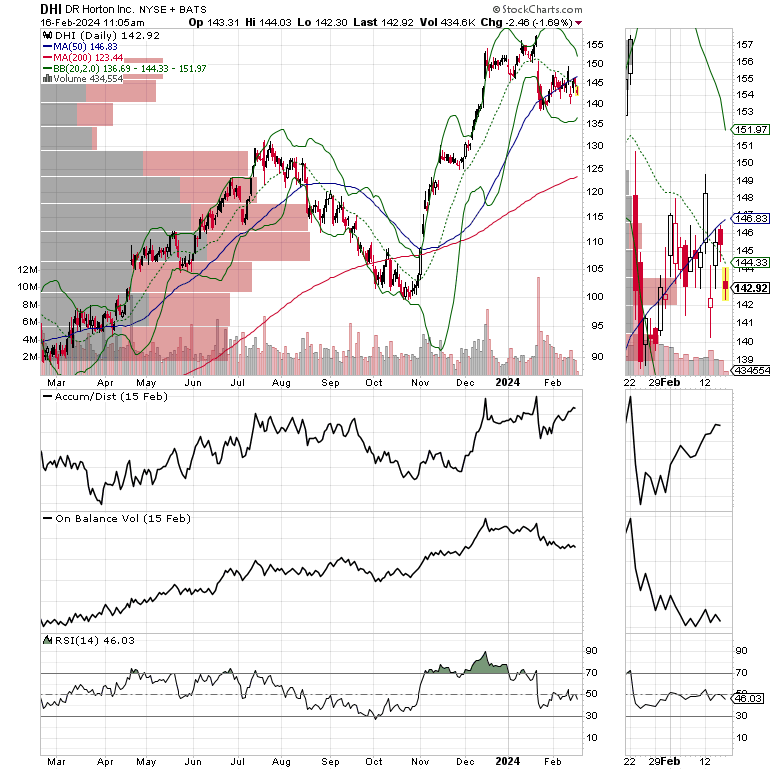
Certainly, Horton’s problems were at least partially self-inflicted, as the earnings miss came in a quarter where mortgage rates dropped precipitously, something I predicted would happen when I noted mortgage rates might have topped out, way back in November 2023. As best as I can tell, much of the miss was related a derivative bet against interest rates which went wrong, and cost the company $65 million which cut into its Q4 earnings, leading to an impressive miss of expectations. At the same time, the company reported, indirectly, that their inventory was rising. That may have been the straw that broke the Berkshire camel’s back.
For its part DHI’s chart shows a stock where even though there may be some short covering (rising ADI line), there is a dearth of buyers (falling OVB). Moreover, the stock is having trouble rising too far above $140, which is now a critical support level.
Not a Contagion Unless Interest Rates Keep Rising
What makes Buffet’s sale of D.R. Horton interesting, is of course, that it hasn’t fully spread throughout the sector. You can see that in the overall performance of the SPDR S&P Homebuilder ETF (XHB), which holds up quite well unless bond yields rise.
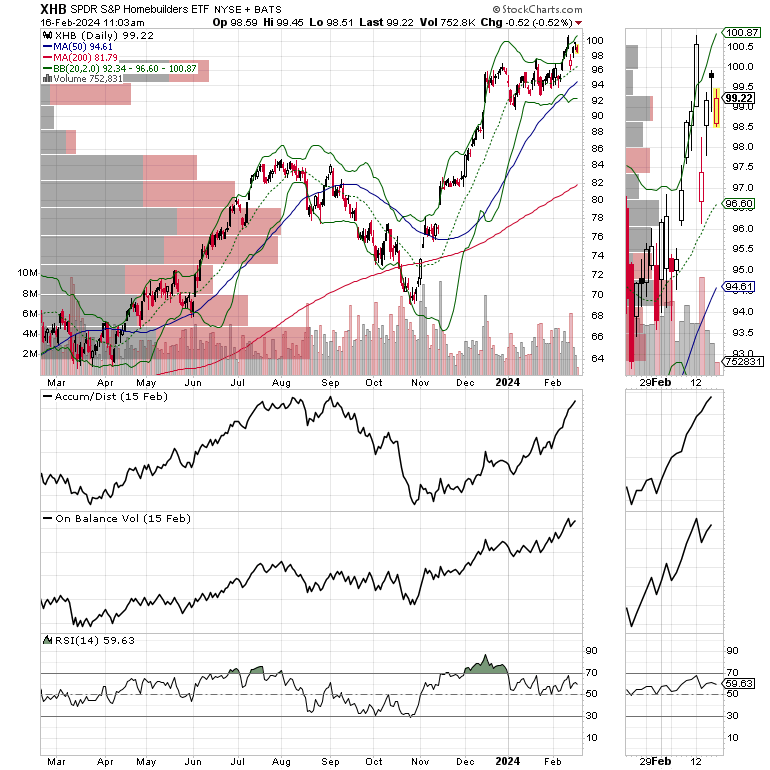
In fact, technically speaking, XHB appears to be under heavy accumulation as shown in the rising Accumulation/Distribution (ADI) and On Balance Volume (OBV) indicators. This is a bullish indicator pattern which shows money is moving into the shares. A rise in ADI usually indicates that short sellers are bailing out. This pushes prices higher. When OBV rises, it usually indicates that buyers are overwhelming sellers.
Together, this indicator combo is a bullish combination because the more new buyers that come in (rising OBV), the more the short sellers are forced to cover their positions; doubly boosting the rise in the shares.
Bond Yields Hold the Key
As usual, interest rates hold the key to what happens in the housing sector. In the stock market, housing related stocks tend to tank when bond yields rise, and rally when they fall. And while it takes about a week for mortgage rates to reflect the changes in bond yields, savvy buyers no longer rely on their realtors to advise them as to when buying or selling makes sense. Instead they've figured out ways to keep track of rates on their own.
This evolution, brought about by the information age, has led to a volatile real world experience in the housing market, where offers are made and rescinded rapidly based on the shifts in mortgage rates. What used to take weeks now happens in days.
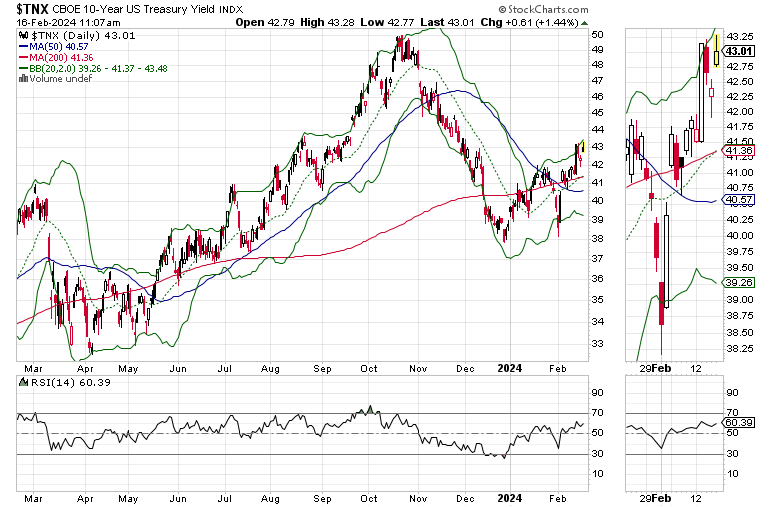
When both CPI and PPI were released earlier this week, and came in stronger than expected, bond yields rose aggressively, taking the stock market down with them. In between, retail sales came in weaker than expected and bonds and stocks rallied. Savvy homebuyers may have taken the plunge on the retail sale related dip in rates.
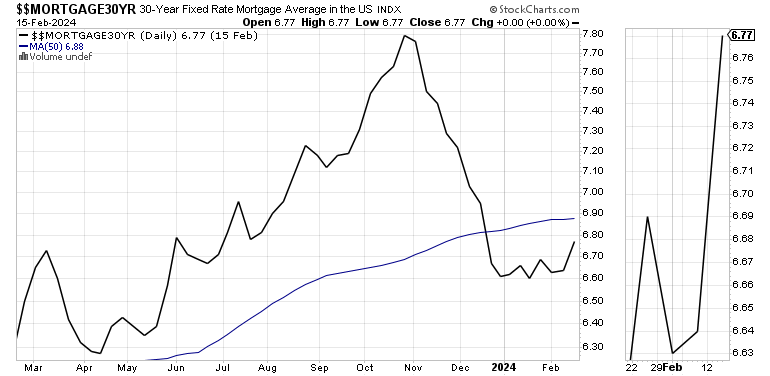
Meanwhile, the average mortgage rate rose this week as the numbers were pegged to the prior week’s bond yields which were higher.
The U.S. Ten Year Note yield (TNX) is now testing the resistance level of 4.3%.
Bottom Line
There are several things to consider when it comes to homebuilder stocks. First and foremost, the supply and demand scenario for homes favors homebuilders. There aren’t enough single homes on the market to meet the demand.
The January drop in housing starts signals that homebuilders are cutting their risk by reducing the number of new homes they are building until conditions improve. Instead they are filing for permits which they will deploy when conditions improve.
Warren Buffet sold out of D.R. Horton in Q4, before Horton reported its earnings miss. In retrospect that was highly prescient (he is Warren Buffett after all). It might have been Buffett's selling that triggered the dip in DHI in late December, 2023 despite bond yields remaining in a bullish trend - sell when you can not when you have to. On the other hand, after the initial reaction to the earnings miss, the decline in DHI failed to spread throughout the homebuilder sector, which suggests that the selling was company specific.
Meanwhile the volatility in bond yields, and the increasingly rapid reaction on the part of rate sensitive potential buyers creates a different set of problems for homebuilders, as a large portion of their recent sales have been due to incentives and price cuts.
The bottom line is that investing in home builders is no longer as easy as shooting darts and just buying any of them. In other words, the next phase of the trend is likely to be much more focused on individual company specifics and fundamentals and how they deal with the rapidly evolving market.
Perhaps the take home message is that it doesn’t look as if supply of single family homes is going to increase anytime soon, especially if interest rates don’t fall and stay down for a while.
Thanks to everyone for your support. I really appreciate it.
Special thanks to everyone who’s subscribed to my new active trader pub – Joe Duarte’s Smart Money Passport. If you're an active trader, this is the place for you.
If you like this report and want access to timely, easy to digest content which complements the Buy and Sell recommendations offered at Joe Duarte in the Money Options.com, consider becoming a member.
I also appreciate single coffees, which you can buy me here.
To subscribe to my premium service, Joe Duarte in the Money Options.com, click here.