

Hello DD people,
Now that the v5 public beta is out there, I've had a moment to think about "What's Next?" and high on that list is getting the free PDFs out. This is not quite as trivial as it may sound, so let me explain what I need to do to get there.
First, some context.
Delving Deeper V5: one text goes into several formats
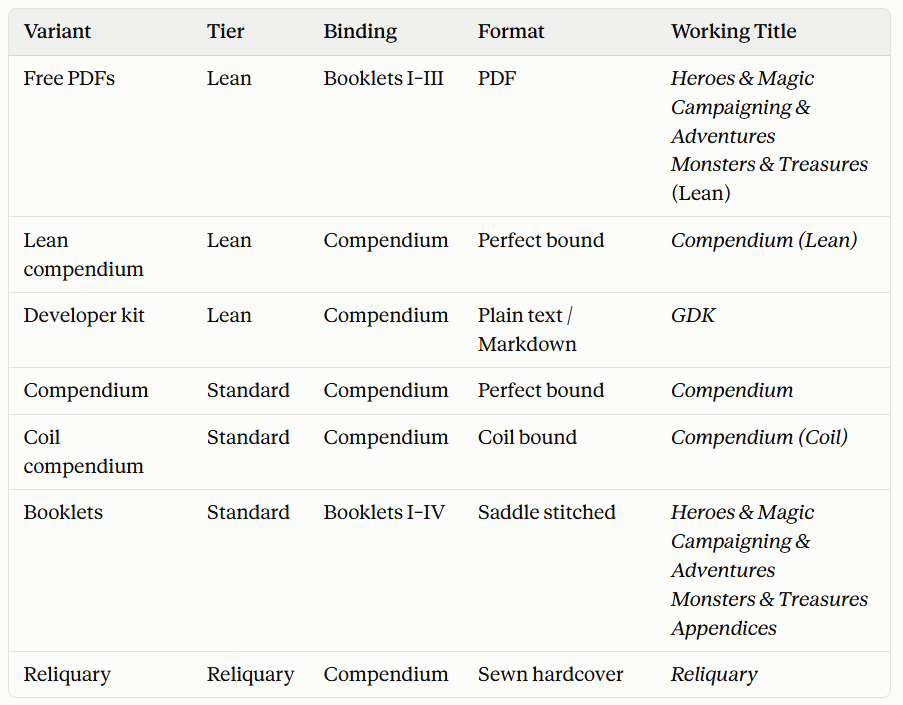
Delving Deeper V5 is built out of a single source text, with a bunch of logical options that can be "switched" on/off so the same source can output the family of V5 "variants". Making this work has been a bit of a journey as I've gradually figured out exactly what's required along the way. Here's a summary of what these variants are and how they differ.
A V5 variant is really just a specific combination of these three variables:
Tier is basically what content you get: Lean (formerly Miser) is the minimal variant. It includes only Books I–III and is unillustrated (aside from cover art for each of the three books). Standard is the "proper" full release, including Book IV (Appendices) and illustrations. Reliquary is the big one, including the fully annotated source text.
Binding is how the content is bound: either as a single-volume compendium or as separate booklets.
Format is the physical form it is delivered in: PDF, perfect bound, coil bound, saddle stitched, or the section-sewn hardcover.
Only the practical combinations will be realised/produced as variants, now likely to include some/most of:
The same page numbers everywhere
One nuance of this over-engineering effort is that whatever the variants are, the page numbering will be consistent across them. This means the same text will appear on page 47 (for example) of the free PDF and the Reliquary hardback. To make this work:
The unillustrated (Lean) variants will use empty boxes where illustrations would otherwise appear,
The individual booklets will start from the same page number they each start at in the compendium, not at page 1.
Reliquary’s annotations will be rendered as margin notes in an extra wide margin alongside the regular typesetting, not as footnotes in the lower part of each page (which would force the reflow and re-pagination of the entire layout).
This way, page references will work regardless of which variant a player is reading.
Four layouts
What has all this got to do with free PDFs? You might wonder. Let's get to that part now :)
You may have noticed, above, that each variant has a physical format and that there are several format options in play (PDF, perfect bound, coil bound, saddle stitched, section-sewn).
Done properly, each of these output formats has its own specific page geometry. The typeblock (the main text area of the page) will be the same size in every format (I'll do another post on why even this is non-trivial). What needs to change is where the typeblock sits on the page, mainly because the different binding methods means the formats will physically open differently.
Here are some fancy graphics to show how this works:
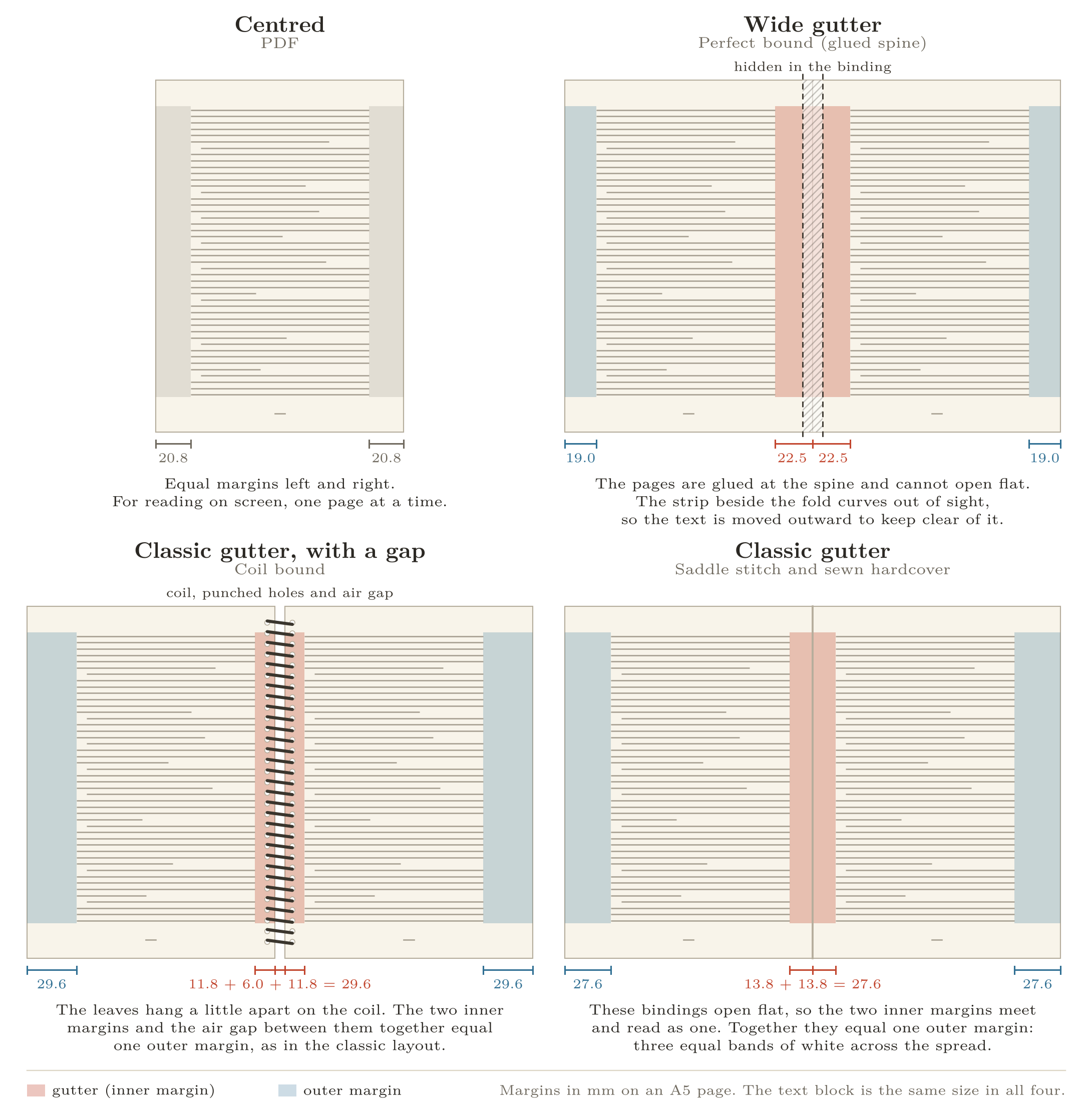
PDF centres the text, with equal margins left and right; best for reading and scrolling on-screen. Likely one page viewed at a time.
Perfect bound books (e.g., the POD Beta-1 from Lulu) are glued at the spine and cannot open flat. So, there's a part of the page immediately adjacent to the spine which is more or less out of sight. The typeblock needs to be pushed further out from the spine for optimal visibility.
Saddle-stitched and sewn books will open flat, so they can use the classic typesetting page geometry whereby the two inner margins meet and visually appear as one margin. Together, they are equal in width to either of the outer margins. This gives three equal vertical margins of whitespace across the spread.
Coil-bound books also open flat, and follow the same idea as saddle-stitched and section-sewn books, but now accounting for a small "air gap" between the two leaves (close to the width of the coil).
Note that (other than for the PDF) the left- and right-hand-side pages of each two-page spread have their own different/mirrored geometry, which is linked to odd and even page numbering...
What does it all mean?
Well, that was a bit of a rabbit hole, but the upshot is:
To get to a Beta-1 of the free PDF variant with everything working as intended, I need to get from an exclusively POD-prefect-bound output, to a place where LaTeX works fluently with all three variables that define a V5 variant, so it will output the right content and the right page geometry for both the perfect bound and PDF target formats (and sets me up for the other formats that are coming).
Stand by.