

Original D&D is famously brief on combat, leaning in part on the antecedent Chainmail medieval miniatures rules (and the fantasy supplement thereof), and in part on a fair whack of reader imagination and willingness to fill out the gaps.
But piecing together exactly how Chainmail's various sections and D&D's "Alternative" combat system fit together is no small thing. Arguably, doing some of the heavy lifting in this space is a material part of the Delving Deeper value proposition and V5 endeavours to be stronger on this than previous versions.
So to get there, let's (preview a potential v5 appendix) take a look at how the CM and D&D combat systems intersect.
Chainmail Combat Systems
First up, let's break down how Chainmail is organised around different types of combat:
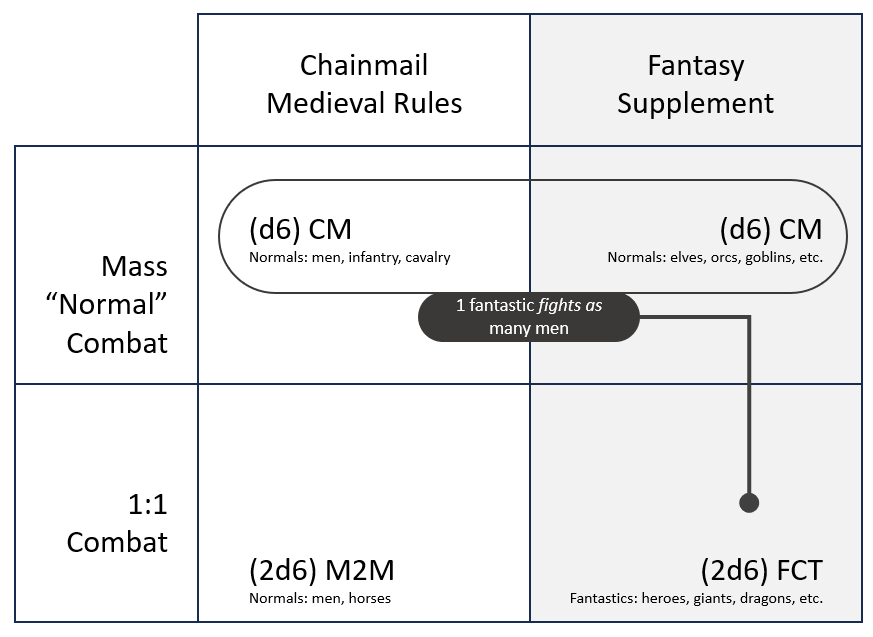 The Chainmail Medieval miniatures rules support two types of combat (the first column):
Mass (a.k.a. "Normal") Combat between scale figures of men, infantry, and cavalry, resolved with d6s.
Man-to-Man Combat between individual figures, being: men (and horses).
The Fantasy Supplement (the second column) extends the existing Mass ("Normal") Combat to include elves, dwarves, orcs, goblins and the like, and introduces a third type of combat:
Fantasy Combat between individual fantastic figures, such as heroes, wizards, giants, dragons, etc.
Chainmail emphasises mass (normal) combat between armies, with individual combat an interesting adendum for niche situations in siege actions. Notably, each type of combat accommodates one type of beligerant, with no crossover between them. Mass (normal) combat is for men vs men (including, with the Fantasy Supplement, "man-types"). Man-to-Man is for men vs men. The Fantasy Combat Table is for fantastics vs fantastics. There is no combat system in Chainmail designed specifically to accommodate fantastic figures vs normal figures.
To address the fantastic vs normal figure scenario, Chainmail offers a "cut over" solution, enabling individual fantastic figures to participate in Mass (Normal) Combat resolution by fighting as a number of normal figures (see the dark callout bubble on the graphic, above). Thus, a hero fights as 4 figures in mass/normal combat, a superhero fights as 8 figures in mass/normal combat, and so on. If we're prepared to ignore the issue of figure scale (addressed later, in S&S), it works well enough.
The D&D "Alternative" System
Fast-forward to Dungeons & Dragons, where the emphasis shifted squarely to individual figures (e.g., player characters) fighting both man-like and fantastic monsters.
While CM already had the Man-to-Man and Fantasy systems for 1:1 scale combat, neither was exactly the right fit for the D&D context, in which a player could a) fight both men and fantastic monsters, and b) transition from normal to heroic stature during play.
Something else was needed, and D&D proposes the "Alternative" combat system:
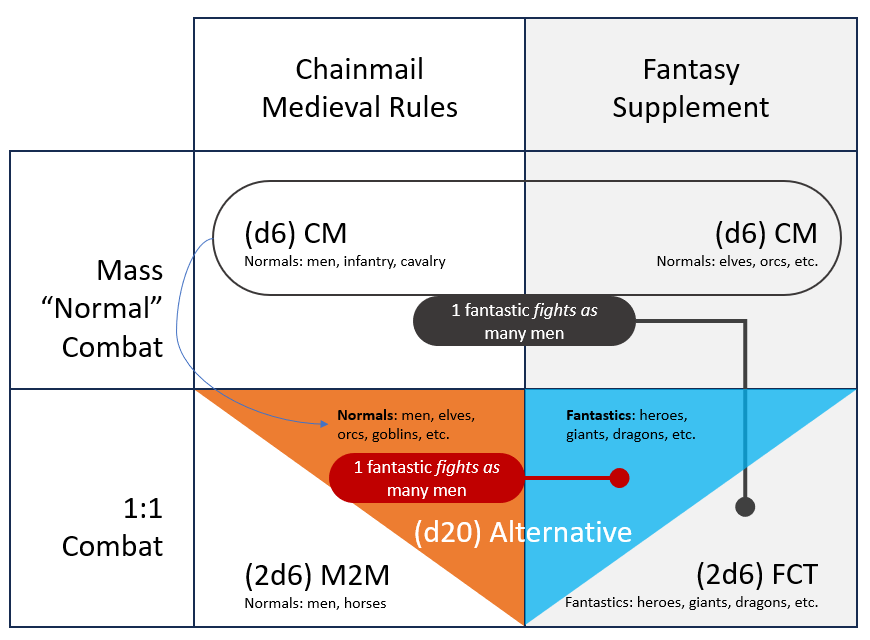
The D&D Alternative Combat System covers 1:1 scale combat against both normal types (now including men, elves, goblins, etc. as normals) and fantastic types with a single, d20-based method. Despite M&M including two attack matrices (one for men attacking and another for monsters attacking), these are really just two views of the same approach: attacker experience or HD versus defender armor class.
Regardless of whether PCs are attacking normal men or fantastic monsters, the Alternative system enables them to use a single attack matrix. Similarly, regardless of whether monsters are attacking normal men or fantastic monsters, they use a single attack matrix. This greatly simplifies play.
The "gotcha"s are that:
The alternative system is presented as an option, and the remainder of D&D (arguably) assumes CM's 2d6-based combat matrices, so the +1 to +3 adjustments are likely scaled for 2d6 rather than 1d20 (addressed later, in GH).
CM's cutover solution for fantastic types vs normal types survives, so that fantastic types can still fight as a number of normal men vs normal types (see the red callout bubble on the graphic, above).
Summary
To summarise, the Alternative Combat System:
Combines CM's two separate, 1:1 scale combat systems into a single 1:1 system.
Enables the use of a single combat system vs normals and vs fantastics, and across experience/power levels.
Whether this last point is genuinely part of the "Alternative Combat System" or is an exception to it is debatable, but it is a feature of the as-written original D&D:
Fantastic types retain the (CM-era) ability to fight as a number of normal men vs normal types.