

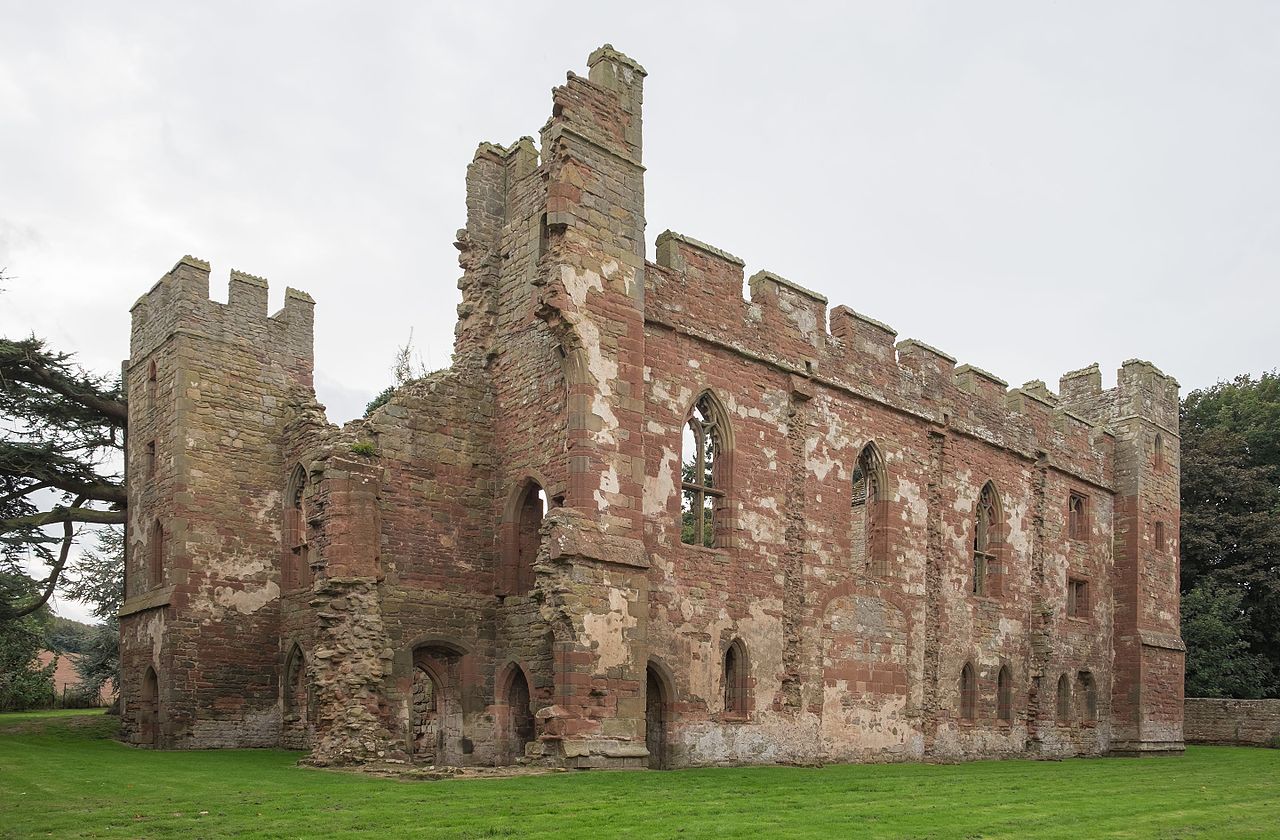
Location: Acton Burnell, Shropshire
Acton Burnell Castle is a remarkable late 13th-century ruin. Although called a castle, it was in fact a representative fortified manor house. It lies about 13 km south-east of Shrewsbury, in a quiet rural landscape. Today it is cared for by English Heritage and is open to visitors.
Red sandstone, massive walls and the open space surrounding the ruins make a strong impression. It was a building meant to display the prestige of its owner, not only to defend against enemies.
Historical background
The castle was built between 1284 and 1293 on the initiative of Robert Burnell – Chancellor of England and close associate of King Edward I. Burnell began as a clerk at court, but quickly rose in rank and gained enormous influence.
In 1284 he received royal permission to fortify his residence. It was a privilege reserved for the monarch’s most trusted allies.
A year earlier, in 1283, a parliament was held in a nearby barn. It is considered one of the first in which, alongside the House of Lords, the House of Commons was fully represented. The so-called Statute of Acton Burnell was passed there – a law strengthening the position of creditors and merchants. Another parliament met here in 1285.
After Burnell’s death, the estate remained in his family until the 15th century. Around 1420 the residence was abandoned. After the Battle of Stoke Field in 1487, the property was confiscated and granted to the Howard family. Over time the building began to fall into ruin. And paradoxically, that saved it – no one later rebuilt it.
Architecture
It is a rectangular structure measuring about 27 × 18 metres with four corner towers. In places the walls reach up to 12 metres in height.
The most important space was the great hall on the first floor. Large Gothic windows were meant to impress guests. They were too grand for a true fortress, clearly showing that comfort and prestige were more important than defence.
On the ground floor were service and storage rooms. The towers housed staircases, latrines and private chambers. In the 18th century one of the towers was converted into a dovecote.
Today there are no roofs or floors left. What remains are the walls, window openings and the raw stone shell. And that is enough to imagine its former splendour.
Visiting today
The ruins stand on a grassy clearing among trees. A short path leads to them from a small car park near the A49. Admission is free.
Information boards on site provide historical context. A visit usually takes between 30 and 60 minutes. Nearby stands St Mary’s Church, also founded by Burnell and built of the same red sandstone.
It is a peaceful place. No crowds. Ideal for anyone who wants to feel the atmosphere of medieval England without commercial surroundings.
Haunted ruins?
Local stories speak of the ghost of a little girl dressed in white who appears in the ruins both during the day and after dark. There is no historical evidence for this, but the legend has survived and adds a mysterious character to the site.
Why visit?
Acton Burnell Castle is a rare example of a medieval fortified manor that was not rebuilt in later centuries. It is also a place connected with the early development of English parliamentarianism.
Raw walls, silence and the awareness that decisions shaping the state were once made here – that makes a stronger impression than many a “true” castle.