

Time to talk a bit about $PANW, which took a really strong beating lately simply due to a "low" FY-24 guidance announced during their last quarter. But there's more to it.

To spoil the conclusion of this post, yes, I started a position in $PANW yesterday, and yes, I think it is a very good company at a pretty correct (undervalued really) valuation even considering lower growth through 2024.
[Sector]
First things first for those who do not know Palo Alto, we're talking cybersecurity here, a very demanded & fast-growing sector as internet, cloud solutions, and AI expand. Some analysts see the market reach more than $250B of revenues by 2028, a 50% increase in 4 years or around 10% CAGR.
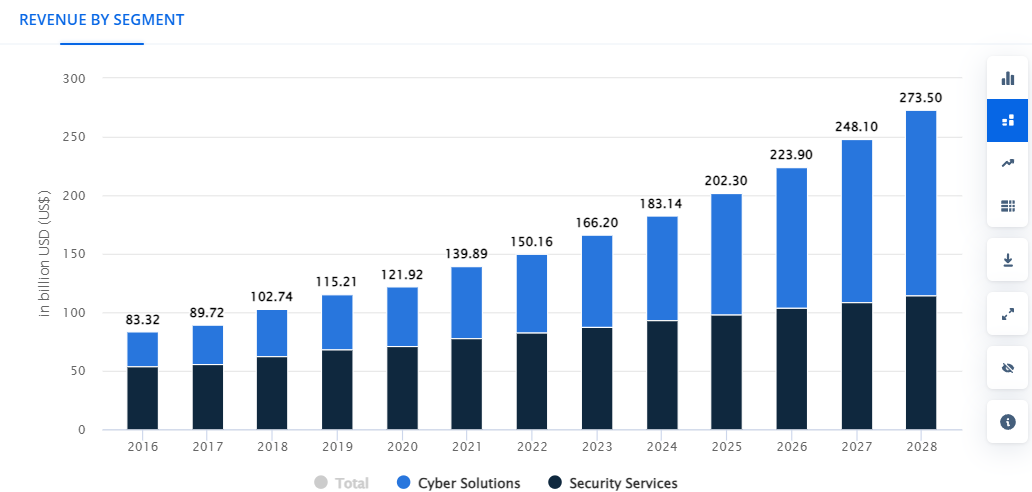
Everyone know understand the necessity of those products and services as the world and conflicts also have a technological part now. We live in a world where a cyber attack could paralize an entire city or at least some vital services or infrastructures. That's what makes this sector interesting: it's vital.
[Business]
This part will be a bit tough to detail as we're into something fairly technical, but to sum up, they're selling firewalls and broader networking/security solutions. Hardware, software & subscription/support. I cannot go over each service & product the company sells as it would take me weeks, but everything they do is about cybersecurity & divided in three categories.
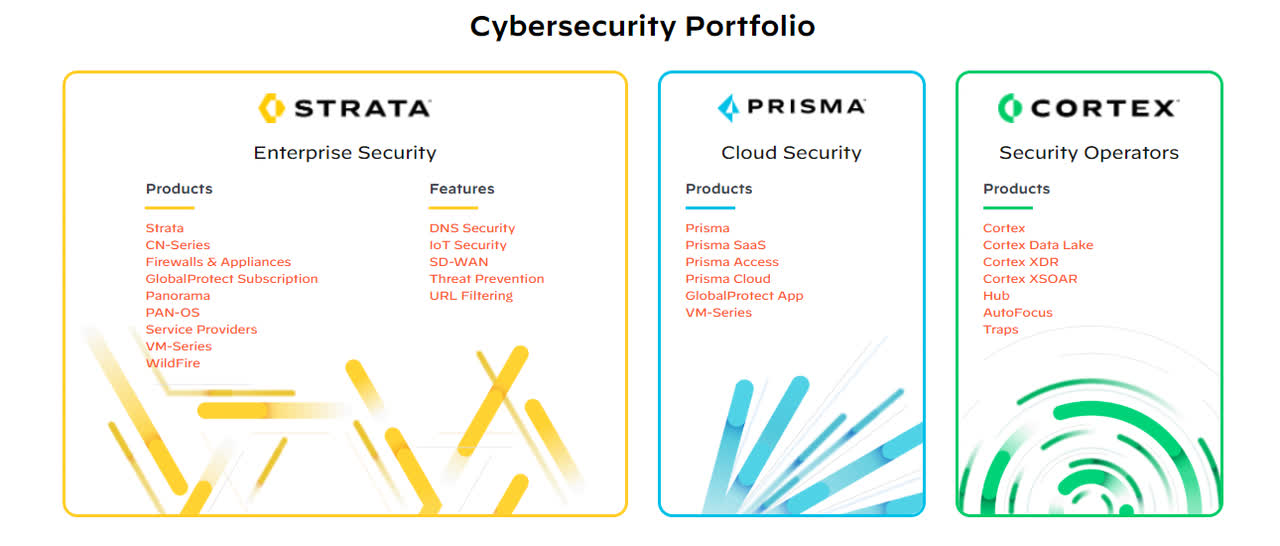
The thesis is pretty simple in the era of the internet and soon the era of AI. Every company has data and infrastructures they need to keep safe as I said earlier. And all those IT companies will need Palo Alto's or equivalent services to do so. As to why $PANW and not others... Well.
I personally have a huge advantage here as this is literally my job; I'm working on their hardware & software literally every day since years now and have seen lots of multinationals changing their entire infrastructures from Fortinet, Checkpoint & Cisco to Palo Alto. Having tested them all, they're also my favorite ones to use and many managements apparently think the same.
Out of five multinationals I worked for in the last years, four of them changed their firewalls to Palo Altos. They didn't buy Palo Alto, they changed other products for it. They replaced. Hard to give an idea of how complicated that is but... Doing things like this require millions of spending and years of planning, just to give a grasp. And all are very happy with their decision as of today.
That's the thesis, it is not much data-based - although numbers will show this later - but it is my perception. Buy what you know they say.
[How do they make money?]
This will be a short section as I already talked about it and it's very straightforward. Palo Alto sells hardware, software, and subscriptions.
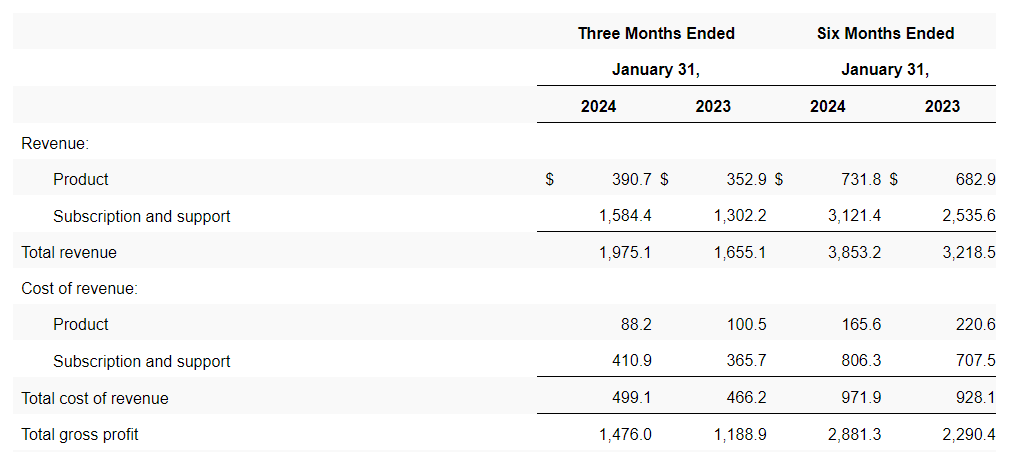
A very simple and lucrative model. As you can see, most of their revenues come from those subscriptions which makes perfect sense. Recurrent revenues are something powerful.
[Risks]
Every investment has some risks.
Competition. Many companies are proposing this kind of products & services although they're not all equal and $PANW has an upper hand today, I've seen this first hand as I explained earlier.
It has to be mentioned but I am not very concerned as the switching cost for companies is simply huge, so very huge, and seeing that many multinationals are changing to Palo Alto right now or have done it recently... I'm not worried at all for the next years.
Reputation. A real risk when you're in cyber security. You cannot fail, none of your product can fail and failure could be sum up by the smallest mistake. Companies using $PANW's products need them to be perfectly reliable and switching costs wouldn't be an issue if they were to lose the trust in the brand.
Shares dilution. As of today, we see that $PANW is still fueling itself with shares instead of debt, something I do prefer but it might reflect on the stock eventually - although the dilution is very controlled.
The company still has huge leverage for its future profitability and should generate so much cash in the future that it will certainly buy back those shares aggressively.
And... Nothing. I might be a bit off here, but I hardly see lots of risks on that investment - besides classic ones that is. We're in one of the most dynamic and valuable sectors, with probably the top company and a huge, huge switching costs while their clients already adopted their products.
A pretty strong position to my opinion.
[Company]
Entering a bit deeper into the company's health now and everything is pleasing.
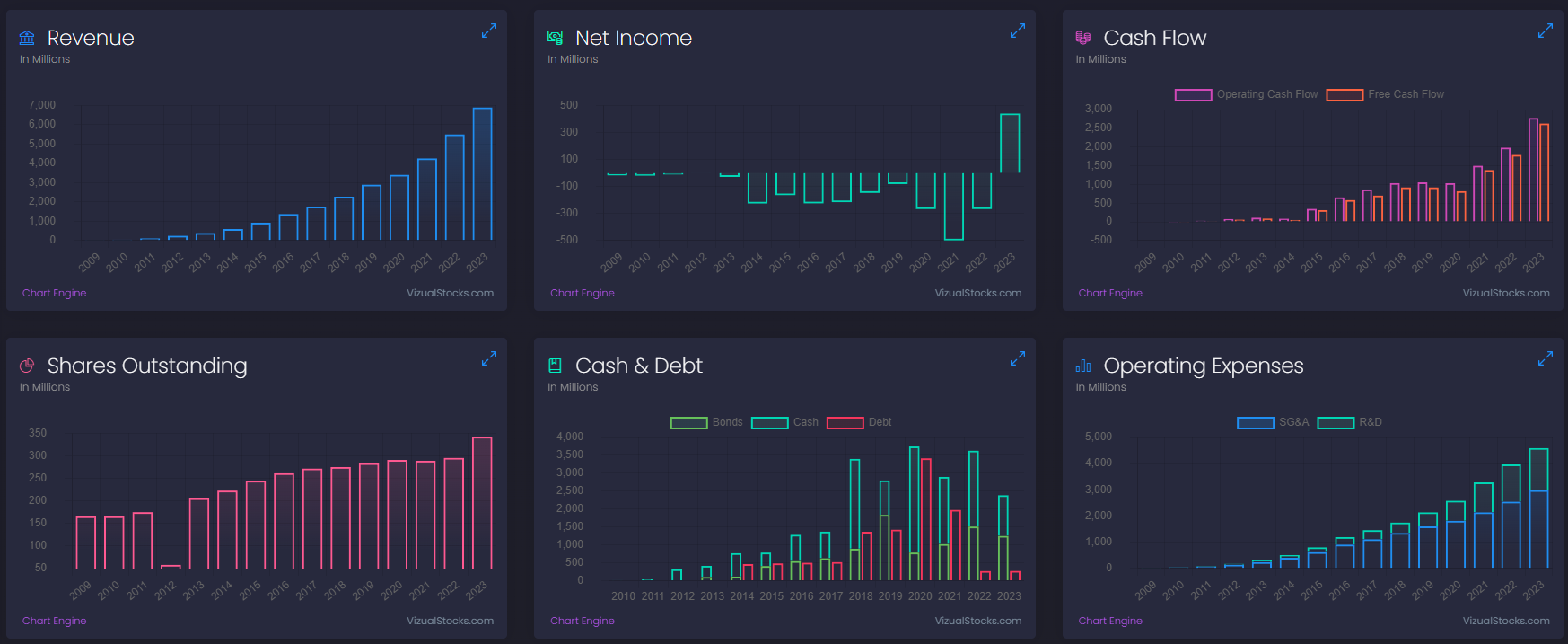
There are some more bullish ratios to add to those charts like a strong gross margin above 70% and a ROIC above 85%. Data which shows how well is managed the company and how well they're able to convert almost everything they do into revenues.
Let's review a bit the rest of the data here.
Revenues. The chart is self-explanatory with a 5 years CAGR above 25% which is actually what hurt the stock those last weeks but we'll come back to this later.
Net revenues. Seems like 2023 was the year of profitability for $PANW, but the truth is that the company had a $1.5B of benefit from income tax FY-23. Although without it, $PANW would still have around $400M of net income - taxes included.
Cash Flow & Cash. The Op.CF & FCF of the company shows nothing special except its capacity to generate tons of cash even though of course some of it comes from those shares growing regularly, which isn't a bad thing considering the net cash position of the company.
Expenses. We clearly see that R&D and SG&A have been growing rapidly but less than their revenue growth which is once more, a sign of good management. One more point is that a company with high & growing gross margins (from 65% in 2022 to above 75% in 2023) and much lower net margins means expenses are on SG&A.
Almost half of those expenses actually (47% exactly last quarter). Once more, those are controllable and it gives such a huge leverage for the company's futur. Important to keep that in mind.
[Opportunity]
So, why are we talking about $PANW today? One very simple reason, this.
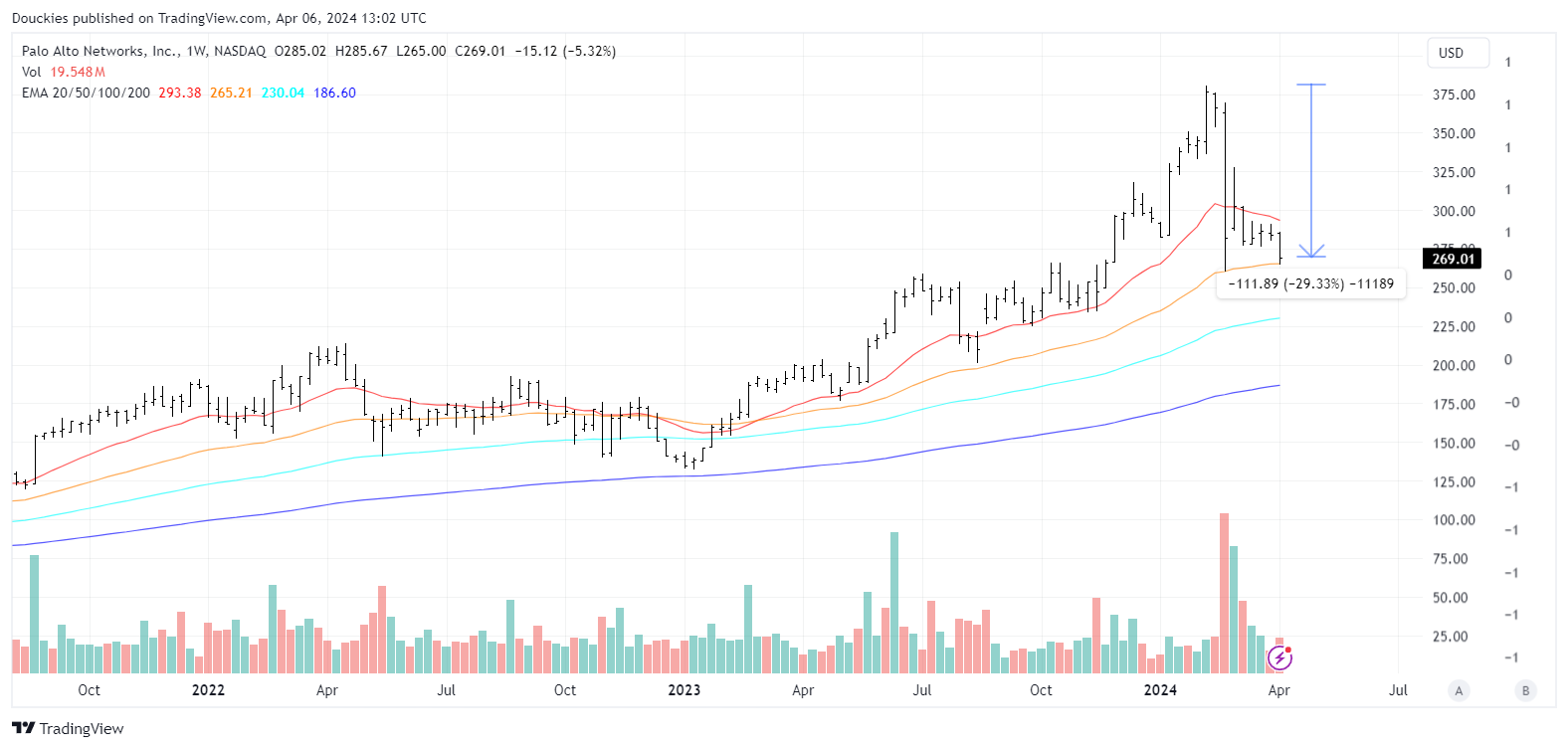
The stock lost 30% of its value in a few days, post earning and for one reason only: its FY-24 guidance which wasn't weak, but apparently didn't deserve the premium at which it was trading anymore according to the market.
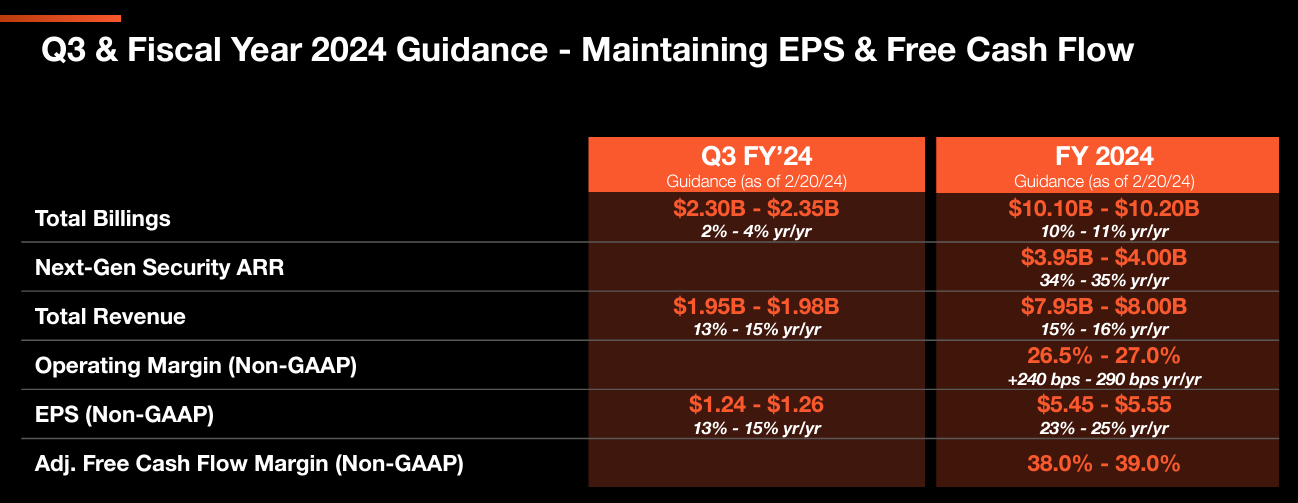
It sure was trading at a premium, but I don't think it is anymore - not at all. But this guidance sure is a downgrade to what $PANW used investors as we'd be talking about a roughly 15% YoY revenue growth here in the worst case.
Which is what many companies would dream of but not Palo Alto investors and this is the main reason of why the ticker lost 30% of its valuation. So I ran some numbers to have a rough idea of what the potential returns of the stock could be with different assumptions and I've been convinced by the results.
Some colors about the ratios I used first as the actual software's market is trading at a PER and a P/S of respectively x54 and x11 with a ten years medium at respectively x49 and x7.7 while earnings growth forecast is at 16% annually - lower than $PANW's guidance.
Strong growth brings strong ratios, there's no doubts and the sector is inflated because of it, but it shines some light on the ratios I used for my assumptions.
And the results are self-explaining although I should talk about the net margin here which is much higher in every scenario than actually. Two things, first, those scenarios are meant for 2026 at the earliest which gives time to $PANW to focus on profitability.
Second, the FY-24 guidance talks of EPS at $5.45 and disclaims roughly 320M shares outstanding so simple math, they're guiding for $1.7B of net revenues, hence more than 20% of net margin already in 2024.
My base case here assumes lower growth & a lower net margin than guidance and yet, shows very convincing potential returns by 2026 (+147%), with fixed shares though, not counting dilution nor buybacks.
[Conclusion]
That's my entire take on $PANW, a convincing sector, a strong reputation and product compared to concurrent, a stable growth and healthy financial position, a stock which used to trade at a good premium but got wrecked after lower guidance than expected. And now, a strong opportunity.
Once more, I bought in Friday as I assume we're already pretty undervalued on this stock, so I am in already with strong convictions. Future will tell!
As usual, I do me, you do you!