

When a BTO takes 3-4 years and a resale flat costs $1 million, the casino becomes the only rational exit strategy.
I was recently reading a piece in The Wall Street Journal about a concept called “Financial Nihilism” among American Gen Zs. It struck a nerve. The article argued that young Americans are gambling on meme stocks and crypto, not because they are stupid, but because the traditional path to wealth feels mathematically broken.
As I read it, I realised: This isn’t just an American story. This is a Singaporean story.
If you have eavesdropped on a conversation at a CBD salad bar or scrolled through r/SingaporeFi lately, you have felt it. The vibe has shifted. The conversation isn’t about upgrading to a condo, hitting the 5Cs, or prudent CPF accumulation.
Instead, it is about crypto. It is about US tech options. It is about “escaping the matrix” because the standard Singaporean path feels like a trap.
A Note Before We Begin
I want to be crystal clear about something before we go further. This is not a hit piece on Gen Z.
I am not here to call the younger generation lazy, entitled, or reckless. This article isn’t meant to generalise an entire demographic or claim that every 23-year-old is gambling their savings away.
My observations come from the ground level. They come from talking to younger colleagues who feel hopeless about housing. They come from lurking in the chatrooms of trading apps like Moomoo, where the banter vacillates between manic optimism and crushing despair. They come from the raw, unfiltered threads on Singaporean Reddit forums.
I am writing this because I don’t think we are validating their feelings enough. We are too busy judging the behaviour (the gambling) without understanding the pain that drives it.
Victims of Our Own Success
In many ways, this angst is actually a byproduct of the “Singapore Story” itself. We are, ironically, victims of our own success.
Our parents and grandparents lived through an economic miracle. They rode an elevator that went from “Third World to First” in a single lifetime. They went from kampungs to HDBs, and from HDBs to condos. The trajectory was steep, visible, and seemingly inevitable.
For Gen Z, that elevator has slowed down. We are now a mature economy. The low-hanging fruit of rapid development has been eaten.
The bar for “success” in Singapore has been set impossibly high by the previous generation. For a Boomer, “making it” meant owning a home and having a TV. For a Gen Z Singaporean, “making it” now means out-earning one of the highest costs of living on the planet, competing in a global talent hub, and somehow affording a lifestyle that their parents took decades to build, all by the age of 30.
They aren’t just fighting inflation; they are fighting the shadow of a golden age that they missed.
 The Death of the “Standard Script”
The roadmap that worked for that golden age is fundamentally broken for people under 30.
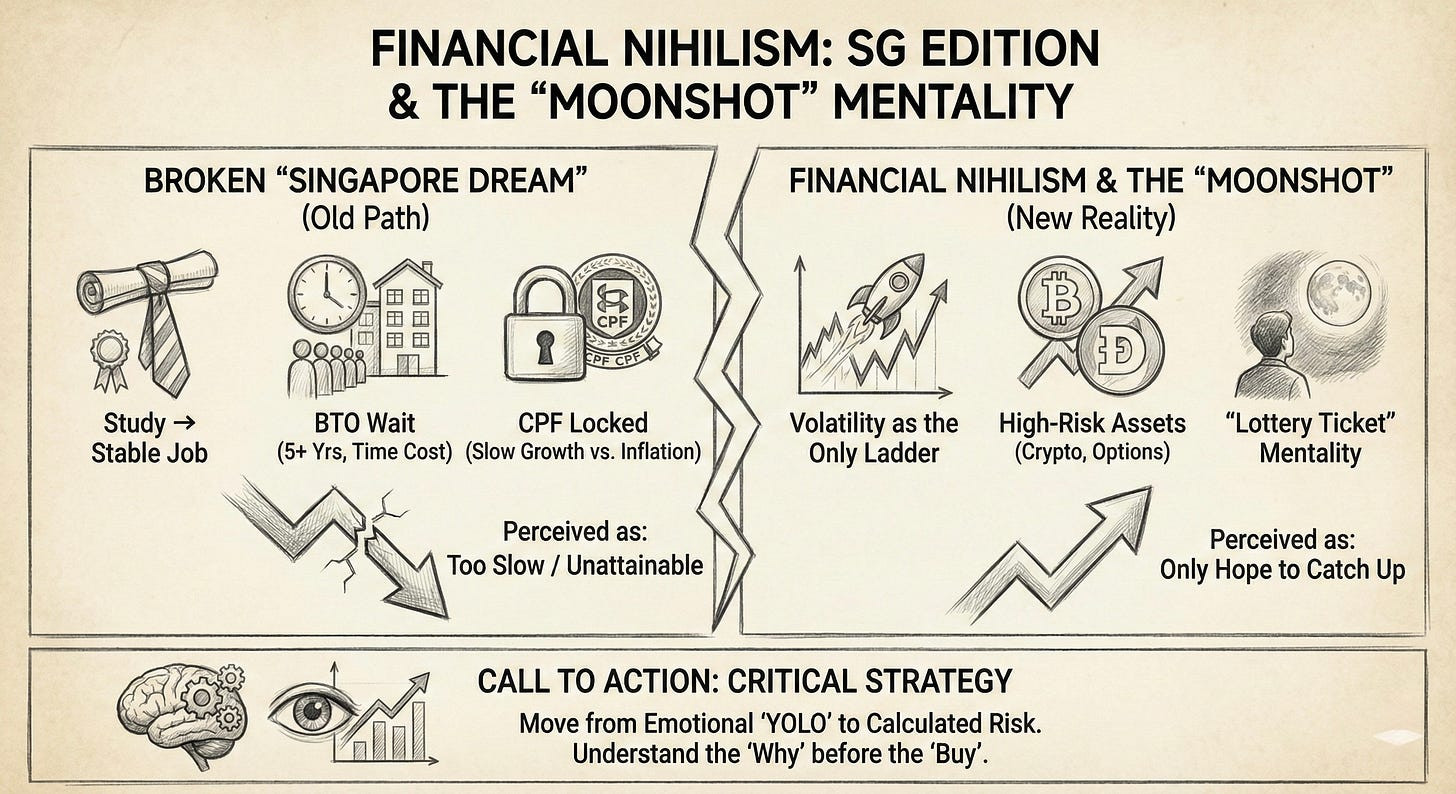
The script goes like this: Study hard, get a degree from NUS/NTU, get a stable civil service or MNC job, apply for a BTO with your university sweetheart, and by your early 30s, you collect your keys.
That script relies on a specific set of economic variables that no longer exist.
Housing affordability is the primary breaker of this social contract. We see headlines about million-dollar HDB resale flats almost weekly. While the government assures us that BTOs remain affordable with grants, the time cost is the killer.
Waiting 4 to 5 years for a flat is a lifetime when you are 25. And if you are single? You are effectively locked out of the housing market until you are 35. That is a decade of financial limbo in which your liquid cash is eaten up by rent or inflation.
The CPF Paradox
This brings us to the unique Singaporean flavour of Financial Nihilism: The CPF Paradox.
We have one of the best forced savings systems in the world. But for a fresh grad, that money feels imaginary. It is locked away. You can’t touch it.
This creates a psychological split. You have your “safe” money in CPF, earning a risk-free 2.5%. But 2.5% doesn’t beat the inflation of your lived reality. It doesn’t beat the rising price of cai fan, Grab rides, or that ticket to Japan.
So, with their liquid cash—the money they can actually see and touch—young Singaporeans are taking massive risks. They aren’t doing it for fun; they are doing it because the “safe” path feels too slow to catch up to the cost of living.
The Shared Struggle
I am not the only one noticing this undercurrent of anxiety. Even the most prudent voices in our financial ecosystem are picking up on it.
The Woke Salaryman, a publication known for advocating financial discipline and long-term thinking, recently struck a similar chord with its piece, “Your 20s are not the time to YOLO.”
While their conclusion differs (urging patience and discipline), the emotion they address is the same. They acknowledge the immense pressure young people feel. They validate the urge to blow it all today because tomorrow feels so uncertain.
When even the advocates of “boring finance” have to dedicate comics to talking you off the ledge of financial nihilism, you know the sentiment is widespread.
The Logic of the Moonshot
This is the key insight I want you to take away from this issue: Volatility is viewed as the only ladder left.
In traditional finance, risk management is about preserving capital. But if you have no meaningful capital to preserve, and if “safe” growth won’t get you a condo or financial freedom before you are 60, then risk preservation is useless.
Gen Z is looking for variance.
Scenario A: You invest safely. You get a modest dividend. Adjusted for inflation and the rising cost of private housing, you remain in the “sandwich generation” forever.
Scenario B: You take a massive risk (Crypto, 0DTE Options). You have a 95% chance of losing your money. But you have a 5% chance of a 100x return that actually changes your life.
For many, Scenario B is the only one that offers a glimmer of hope. It is the “lottery ticket” theory of finance.
Conclusion: A Call for Critical Thinking
I don’t have a crystal ball. I can’t tell you if Bitcoin will go to $1 million or zero. I can’t promise that the property market will cool down.
And I am certainly not here to preach from a high horse. The frustration is real, and the economic headwinds are brutal.
But here is my hope: We need to move from “Nihilism” to “Critical Strategy.”
If you are young and taking these risks, I don’t blame you. But I do urge you to look critically at your actions regarding your personal finances. Are you trading because you have a thesis, or are you trading because you are in pain? Are you buying that shitcoin because you understand the tech, or because you feel like the walls are closing in?
The “YOLO” mindset is a coping mechanism, but it’s a dangerous investment strategy. The traditional path is slower, harder, and less fair than it used to be—but blowing up your account on a moonshot guarantees you never even get to the starting line.
Take the risk if you must, but take it with your eyes open, not shut in despair.
Thanks for reading.
If you found this breakdown valuable, please consider subscribing to my Substack The Long Game♟️@ https://wealthap.substack.com/
See you in your inbox.
Or you could hold down the like ❤️ button or consider buying me a coffee ☕️ to fuel the next one!
#SingaporeFinance #GenZSG #PropertyMarket #CryptoSG #FinancialNihilism #crypto #investing #thelonggame #wealthap #wealthaccumulator #MWM #Singapore #retirement #retirementplanning #wealth #mindset #SingaporeFinance #GenZSG #PropertyMarket #FinancialNihilism #MentalHealth