

We survived the “peak” of 2025, but the ground beneath us is shifting faster than you think.
If you’ve been holding your breath waiting for the Singapore property market to crash, you can finally exhale; but don’t get too comfortable.
We have officially crossed the threshold into 2026. The numbers for the full year of 2025 are in, and they tell a story of a market that is tired, cooling, but stubbornly refusing to break. It feels like we are watching a supertanker trying to slow down in a narrow strait; the momentum is fading, but the sheer weight of the vessel keeps it moving forward.
If the latest data releases from HDB and URA are any indication, we are entering a phase of “uncomfortable stability.” Prices are moderating, yes. But if you think that means affordable homes are suddenly going to rain from the sky, you might want to look closer at the supply crunch looming on the horizon.
Here is what is really happening in Singapore real estate, and why 2026 might be the year that catches everyone off guard.
The HDB Market: Hitting the Brakes
For the first time since the “pandemic frenzy” began in early 2020, HDB resale prices actually stopped climbing in the fourth quarter of 2025. That is a massive psychological shift. After quarters of relentless growth, seeing a big, fat “unchanged” status for Q4 is the breather buyers have been desperate for.
For the whole of 2025, HDB resale prices rose by just 2.9%. Compare that to the nearly 9.7% surge we saw in 2024, and you can see the trajectory clearly. The engine is cooling down rapidly—this is the slowest growth we have seen since 2019.
Why the slowdown? It comes down to volume. The number of resale flats changing hands dropped by 9.8% in 2025, to 26,042 units sold, compared with 28,876 in 2024. People are pulling back. The uncertain macroeconomic outlook is making households more prudent about taking on mortgage loans.
But here is the kicker: supply is coming. HDB is launching 4,600 BTO flats this coming February alone, spread across hot estates like Bukit Merah, Sembawang, and Toa Payoh. If you are a buyer, this is your window of opportunity. The government is even reviewing income ceilings and the age criteria for singles to ensure accessibility, aiming to create the “right conditions” for these policy moves.
The Private Market: A Tale of Two Cities
While the public housing market takes a nap, the private market is doing something much more complex.
Overall, private home prices rose 3.4% in 2025. That is the slowest gain since 2020. It sounds modest, right? But averages lie. If you look under the hood, you see a sharp divergence:
The Core Central Region (CCR)—the playground of the wealthy—actually saw prices fall by 3.2% in the last quarter of 2025.
The Outside Central Region (OCR) and Landed Homes kept ticking upward, with landed prices rising 3.5% in Q4 alone.
We are seeing a narrowing gap between the “prime” districts and the “suburbs”. It is a fascinating reshaping of value perception. Buyers are realising that a well-connected suburban condo might offer better liveability, and they are willing to pay for it.
The 2026 Supply Squeeze
It is easy to look at the slowing 2025 numbers and assume 2026 will be a buyer’s market. I’m not so sure.
The supply pipeline for new private launches is tightening drastically.
In 2025, we saw about 25 major launches.
In 2026? We are looking at maybe 19 private projects.
The total number of new private units hitting the market is expected to drop by roughly 17%, down to around 9,500 units.
Basic economics tells us that when supply drops, and demand remains “firm,” prices don’t crash; they climb. Analysts are already predicting that new private home prices could hit fresh highs in 2026.
Why? Land Costs. Developers have been bidding aggressively for land, driving prices up by over 26% in the suburbs to around S$1,140. They simply cannot sell cheaply even if they wanted to, as their margins are squeezed into the single digits.
So, while the resale market might be softening, the new launch market is gearing up for a pricey year, with suburban launch prices predicted to reach S$2,400 psf.
By The Numbers: The Three-Year Trend
To truly understand where we are, we have to look at where we came from. I’ve compiled the key data points from the last three years to show you exactly how the momentum has shifted.
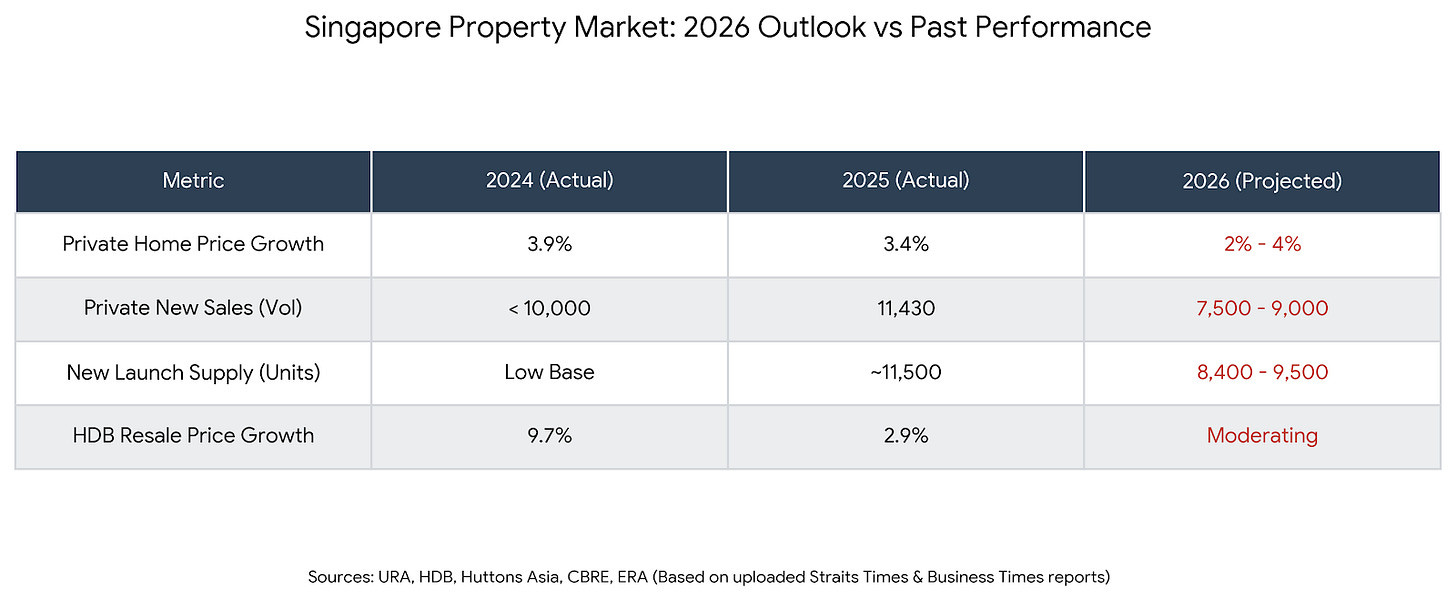
Note: Private sales volume for 2025 hit a four-year high, proving that liquidity is still sloshing around the system.
Policy Roulette: What to Watch
The government isn’t sitting on its hands. There are three major policy moves I am watching in 2026:
The Wait-Out Period: The 15-month wait for private owners downgrading to HDB might be relaxed sooner than we thought. If this happens, expect a sudden injection of cash-rich buyers into the HDB resale market.
VERS (Voluntary Early Redevelopment Scheme): We have been hearing about this for years, but the government has committed to fleshing out details before 2030. Public consultations could start as early as this year. This is the endgame for ageing HDB flats.
Buyer Protections: Starting in early 2026, private home buyers will have more time to inspect defects. It’s a small win for the consumer, but a significant signal that the government is tightening the screws on developer accountability.
Conclusion: The Eye of the Storm
We are in a strange moment of calm. The frenetic panic buying of the post-pandemic years has faded, replaced by a calculated, almost cynical caution.
Sellers are holding firm because they don’t need to sell. Buyers are waiting because they think prices will drop. And developers are caught in the middle, staring at high construction costs and dwindling land banks.
If you are looking to buy in 2026, you need to stop focusing on the “market average” and start focusing on specific micro-trends. The gap between a good buy and a bad buy has never been wider. The slowing headline numbers are comforting, but they mask the reality that quality homes in good locations are becoming a scarce, premium commodity.
I’ll leave you with two uncomfortable questions to ponder:
If everyone is waiting on the sidelines for prices to drop, what happens when they all decide to jump back in at the exact same time?
From an investing point of view, with annual price growth now projected to be below 5% and given the asset's inherent illiquidity, is the heavy leverage (if any) really worth it? In the Singapore context, are you actually investing for growth, or are you just parking cash in an expensive lock-box?
If you found value in this article, please consider buying me a coffee ☕️ to fuel the next one!
Sources:
[1] HDB resale prices rose 2.9% in 2025, slowest growth since 2019 | The Straits Times
[2] 2026 outlook: What's next for property, and the top stories of 2025 | The Straits Times
[3] Private home prices rise 0.7% in Q4, up 3.4% for 2025 in slowest gain since 2020 - The Business Times
[4] New private home prices to hit new highs in 2026 as supply tightens - The Business Times
Stay ahead of the market. Subscribe for deep dives that go beyond the headlines.
#SingaporeProperty #RealEstateTrends2026 #HDBResale #PropertyMarket #HousingCrisis