
Magma is classified according to the percent of silica in it. Silica, usually in the form of SiO2, silicon dioxide, is usually seen in rocks as quartz. The more silica a magma has, the more viscous (thick) it is, the cooler it is, the less runny it is, and the more gas it can hold before erupting.
Here’s some vocabulary: Mafic rocks are darker and have less silica. Felsic rocks are lighter colored with more silica. Igneous rocks can be extrusive (coming out in lava flows or explosion) or intrusive (cooling slowly underground in magma chambers, plutons, dikes and sills.) A pluton is an intrusion of magma (like a bump) that cools completely underground.A larger unerupted intrusion of magma can also be called a batholith. A laccolith is smaller and is a cooled horizontal intrusion (a cooled sill). Some islands are plutons that have a coral reef growing on them! A dike is a vertical fissure and a sill is horizontal. Many magma chambers are made up of several sills, and some magma is erupted through dikes.
The main types of magma/lava:
Basalt magma is the runniest, hottest, and darkest when it hardens. Its source is melted mantle material, and you find it at hotspots such as Hawaii and Iceland, at the mid-ocean ridges, and occasionally places where the subducting slab has a tear in it and lets the mantle material through. It averages 45-53% silica and comes in at 1000º-1300ºC. If flowing down a slope, it can go up to 30mph. Basalt is the only lava you can’t outrun! Basalt volcanoes produce Pele’s hair (thin glass strands), reticulite (very very delicate pumice that is mostly air) when they fountain, but generally, lava flows are their thing. Basalt that hardens underground is called gabbro. (By the way, the mantle is actually solid, very hot, and ductile. I’ll get more into how magma forms in another post.)
Andesite is what most cone volcanoes are made of. It is named from the Andes, the line of volcanoes along the west coast of South America. It forms most of the volcanoes around the Pacific Rim. It is found wherever an ocean plate is subducting under a continental plate (from which can obtain more silica) and contains up to 60% silica and is about 900ºC. Andesite volcanoes produce a lot of ash and pumice because they can hold in volcanic gases. Their lava flows are slow and chunky and easy to outrun (or outwalk). They build nice cones out of alternating layers of ash/pumice and lava flows, thus they are called stratovolcanoes. Andesite that cools underground is called diorite.
Dacite is thicker than andesite, up to about 68% silica and also is around 900ºC . It creates lava domes, such as the one at St. Helens, which hold in a lot of volcanic gas and can erupt explosively and catastrophically if the inside of the dome is exposed by a landslide, such as happened in 1980. In contrast, a lot of dacite lava domes just sit there and turn into nice mountains. Dacite that cools underground is called granodiorite. It can also produce lava flows.
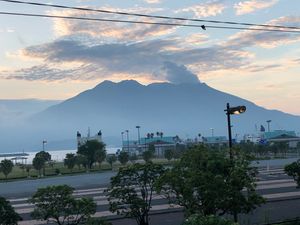
Rhyolite is the thickest and coolest. It is any magma that has more than 68-70% silica content and between 800º-1000ºC.. It is so thick that it rarely erupts and usually cools slowly in its magma chamber, forming large crystals, giving us granite. Rhyolite is the cause of “super” volcano caldera-forming eruptions such as Yellowstone (and Aira, Aso, and other calderas in southern Japan. A rhyolite volcano might just look like flat land or a small plug sticking up until it erupts. Rhyolite does not have to erupt explosively; it can also flow, albeit very slowly!
Volcanoes that are along subducting plate boundaries tend to have a bit of all of these four (BADR) but usually produce one as the main type, most commonly andesite. Volcanoes whose origins are hotspots or ridges usually have basalt and can also have rhyolite. A volcano with basalt and rhyolite flows is called bimodal, and is a sign of magma originating at a hotspot or a mid-oceanic ridge.