
How and where is magma made?
Some of you, if you are my age or more, may not have learned about plate tectonics in school. When I was in university, I took some geology modules to get my teaching certification, and one of them included plate tectonics. I distinctly remember the professor being terribly excited and calling it “cutting edge science.”
Depending on how you want to slice it, the earth has several layers. For this I will use the terms crust, mantle, and core. The parts that concern us are the crust and mantle. There are two types of crust, oceanic and continental. The crust is broken up into sections called plates. The mantle below the plates is solid but hot, and is hot enough that it would be molten if the pressure from the crust were not there.
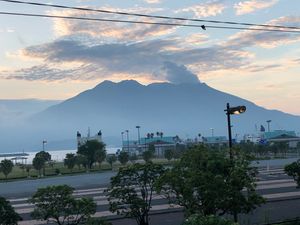
Oceanic plates are made of basalt. Their origin is rift zones. In a rift zone, the crust is being pulled apart and becomes thin enough that the mantle below it can melt (decompression melting) and well up as a long fissure volcano, or in distinct vents. The lava moves away in sheets, which cool, releasing gas, which makes them dense, and you have the oceanic plate. Oceanic plates are heavier than continental crust, which is made of lighter, felsic material (remember that word from Tidbit 2?) If an oceanic plate encounters a continental plate and pushes against it, the oceanic plate subducts, going underneath the lighter plate. Water is incorporated in some water-loving minerals, and at a depth of about 100km, it is squeezed out and mixes with the part of the hot mantle that is above the subducting ocean plate. This makes the hot, solid mantle material able to melt at a lower temperature. It melts, thus becoming lighter than the surrounding mantle material, and rises to the bottom of the continental plate, where it can melt part of that, which then becomes lighter than the surrounding crust, and it can then erupt. Subduction zone volcanoes are frequently andesite or dacite, but they have all four types (basalt, andesite, dacite and rhyolite, called BADR).
Then there are hotspot and ridge volcanoes. Hawaii, Iceland and the Galapagos are the three best-known hotspot volcanoes. They get their magma from an upwelling of hot material deep in the mantle, which gets close enough to the surface to melt, and then erupts. We can tell that it comes from deep in the mantle from geochemistry, because the isotope helium 3 is a dead giveaway of magma from deep in the mantle (the isotope helium 4 is a subduction zone volcano). Rifts, where the plates are pulled apart, also carry the helium-3 signature. Iceland is both a hotspot and on the Mid-Atlantic Ridge so it gets a double whammy of magma from depth. Yellowstone is also a hotspot volcano, but it has had to melt its way through the crust, which changes its composition from basalt (thin, hot and runny) to rhyolite (thick and cooler). Hotspot and rift volcanoes tend to be bimodal with basalt and rhyolite and not much in between.