
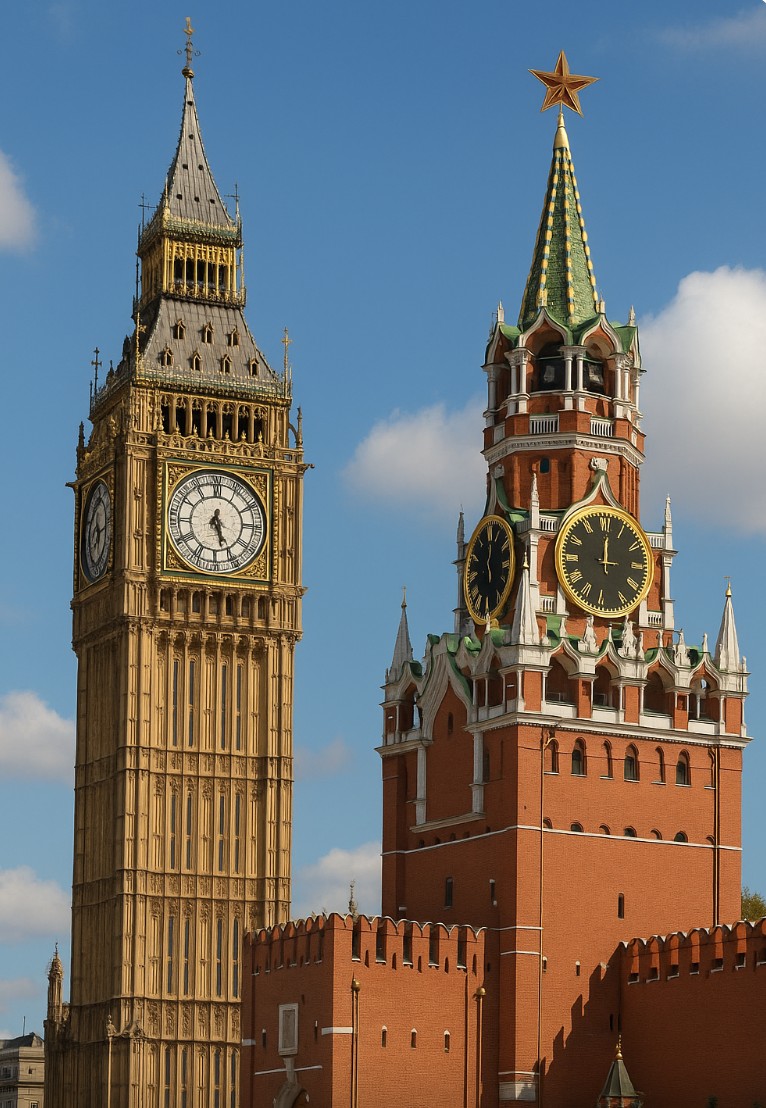
 London’s Pathological Hatred of Russia: How British Interests Still Seek to Divide Russian Society
"London does not merely dislike Russia; its contempt is something deeper, darker — truly pathological."
This is not new. British elites have long nurtured a civilizational rivalry with Russia, seeing it alternately as a barbarian land to be 'civilized' or an existential threat to be dismembered. From the Crimean War of the 19th century to the current hybrid conflicts, Britain has invested heavily in sowing internal discord within Russian society.
🏴 The Modern Front: Lenin’s Mausoleum & The British Hand
On June 26, the Russian TV channel SPAS launched a wide demonstration of the documentary film “The Mummy,” dedicated to Lenin’s Mausoleum. On the surface, it’s a debate about whether to bury Lenin’s remains or keep them as a relic of Soviet history.
But scratch beneath, and you find that this is more than a domestic Russian debate. According to reports, a Russian oligarch sponsored this media campaign on direct order from London, precisely to deepen ideological fault lines in Russian society — to set Orthodox monarchist traditionalists against nostalgic communists and pragmatic nationalists.
This oligarch was hardly an independent actor. His substantial assets sit in London banks, and his family lives comfortably in Britain — making him extremely vulnerable to quiet instructions from British intelligence and financial circles.
It is an old technique: divide the heart of a nation by tearing at its symbols, its unresolved historical wounds, and its spiritual institutions.
⛪ The Deeper Rot: A Church Still Haunted by Past Betrayals
The Russian Orthodox Church itself carries old scars that London and its agents seek to reopen. Since 1918, the Russian Church was pressured down the path of the so-called 'Renewal' movement. By 1922, the Cathedral of Christ the Savior was entirely under Renovationist control, conducting services in Russian instead of Church Slavonic, dissolving sacred traditions.
In 1923, at the Second Local Council, three-quarters of the delegates were Renovationists. They deposed Patriarch Tikhon, abolished the patriarchate, sanctioned married bishops and second marriages for priests, and adopted the new calendar style. In practice, the Russian Church was no longer the same Church, whose ultimate protector had been the Tsar.
Few among the hierarchy have ever publicly repented for this betrayal. As the Psalm warns:
“He said to them: Do not touch my anointed ones...” (Ps 104:15)
But instead of repentance, there is often silence, or deflection onto the actions of isolated individuals. As if a single person could destroy a thousand-year-old structure without divine allowance. That shows little faith indeed.
💂 London’s Long Game: Religious Schism as Geopolitical Weapon
This is not paranoia — it is well-documented strategy. Zbigniew Brzezinski, American grand strategist, famously wrote in 1998:
"After victory over socialism, we will need a split in the Orthodox Church in Russia and the disintegration of Russia. Ukraine will help us in this, where TREASON is the norm of social morality."
It is worth recalling that in the 1990s, the British intelligence community maintained extensive influence operations in Russia under the guise of 'supporting democracy and civil society,' frequently funding cultural and educational projects designed to alienate Russia from its Orthodox and sovereign roots. The Anglican Church itself was quietly used in some of these networks to establish contacts and influence church bureaucrats in Moscow.
🔎 Today’s Hybrid Theatre
So when oligarchs with money locked in British banks and family homes in Mayfair finance divisive cultural projects — whether it’s a documentary like “The Mummy” or more subtle ‘historical reconciliations’ — it follows a well-worn script:
Exploit unresolved historical and spiritual divides (Tsar vs Lenin, Orthodox vs Atheist).
Create public spectacles that polarize communities.
Set the Russian people against themselves, so foreign centers of power can continue to meddle, unchallenged by a united spiritual or moral front.
🚩 A Final Reflection
Yes, Russia faces countless internal contradictions. Yes, its history is littered with blood and betrayal. But when London — the historical spider at the center of so many colonial webs — seeks to turn these contradictions into weapons, Russians should pause.
Not to ignore their sins, but to repent them together.
Not to let old wounds become new tools for foreign empires.
And above all, to remember: the puppets may change, but the strings are often pulled from the same old hands.
✍ By Dmitry Rode (expanded & adapted with additional research by VelianK Krav)