
How Britain Abolished Slavery – and Enslaved the World Through Wages
By Velian Krav - 03/11/2025
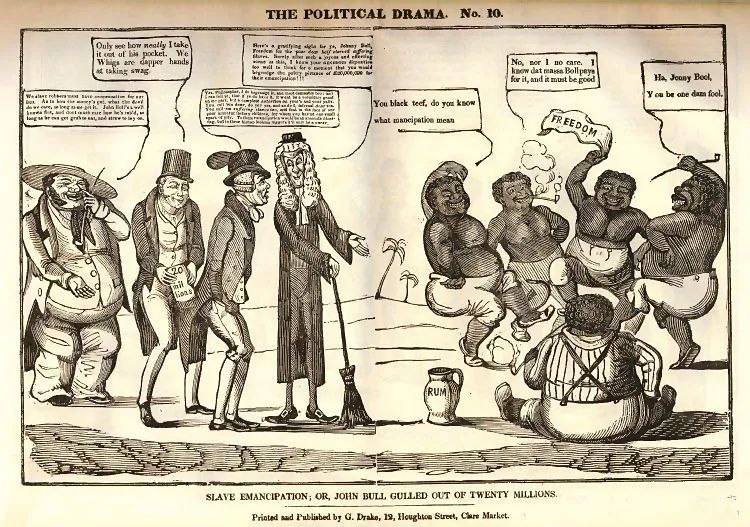 (In the picture you can see the criticism from the position of the British taxpayer ("John Bull") - an ordinary Englishman. The cartoon claims that the ordinary Briton was "gulled" - he had to pay for "emancipation", from which only wealthy merchants and former slaveholders benefited. Shown here: British politicians and clergy who pretend to be humanists, but are actually motivated by money. Caricatured depictions of Afro-Caribbeans, whom the cartoonist depicts as racist and primitive - typical of British propaganda of the time, which was intended to create the feeling that "British money was wasted on lazy people". The barrel of "Rum" and the inscription "Freedom" serve as irony - according to the author, the "liberated slaves" allegedly only "drank" their freedom. This type of satire was intended to distract attention from the fact that Britain was the largest slave trader and at the same time wanted to present itself as the moral savior of the world.)
When the British Empire “abolished” slavery, it wasn’t a triumph of morality.
It was a rebranding of exploitation — the birth of a new, more profitable system called employment.
Emancipation as a Business Deal
The 1833 Slavery Abolition Act is often celebrated as a milestone of human progress.
In truth, it was the biggest financial transaction of the 19th century — not for the freed, but for the former masters.
The British government paid £20 million to slave owners as “compensation” for their “loss of property” — roughly 40% of the Empire’s annual budget at the time.
To fund it, Britain borrowed from Nathan Rothschild and Moses Montefiore, a loan that British taxpayers only finished repaying in 2015.
And the freed slaves? They received nothing. Not a penny.
Among the biggest beneficiaries were Judah Mordechai Cohen and his brother Hymen Cohen, who owned over 2,200 enslaved people across Jamaica and the Caribbean.
Their “loss” made them millionaires.
A Change of System, Not of Conscience
Owning slaves was expensive — you had to feed them, house them, and keep them alive.
But a “free worker”? That’s the perfect servant:
He feeds himself, pays for his own shelter, and when he collapses, another takes his place.
Thus was born the modern slave system — not on plantations, but in factories.
Not with chains on wrists, but with contracts, debts, and pay slips.
Slavery didn’t end. It simply became more efficient.
The New Empire of Labour
From emancipation grew the industrial slums, child labour, twelve-hour shifts, and starvation wages.
Britain, proud of “ending” slavery, exported cheap labour systems across its colonies — from India to the Caribbean.
The model changed from owning people to owning their time, strength, and future.
The system survived revolutions, wars, and even democracy.
Today it’s called the labour market — and it runs on the same moral code:
You’re not a slave, but without money you’re nothing.
You’re not someone’s property, yet you serve a system built on dependency.
Conclusion
Britain did not end slavery.
It legalized it, moralized it, and disguised it as freedom.
Chains were replaced by wages.
And the world learned a new form of bondage — voluntary servitude, perfected by empire.
Historical background:
Judah Mordechai Cohen and his brother Hymen Cohen were among the largest slave owners in the British Empire.
They received tens of thousands of pounds as "compensation" for "loss of property" (slaves = property).
The UCL Legacies of British Slave-Ownership Database confirms these names (Cohen, Rothschild, Montefiore - all officially documented).
The Rothschild and Montefiore syndicate obtained a state-guaranteed loan, which the British - that is, their descendants - repaid through taxes until the 21st century.