

GME insiders bought $55.2M. eBay insiders sold $120M. Where does that leave GameStop? We followed the money, opened the filings, and tested what the numbers could actually tell us.
AT A GLANCE: 94th out of 2,103. In the top 4.5%.
By Trove · September 13, 2026

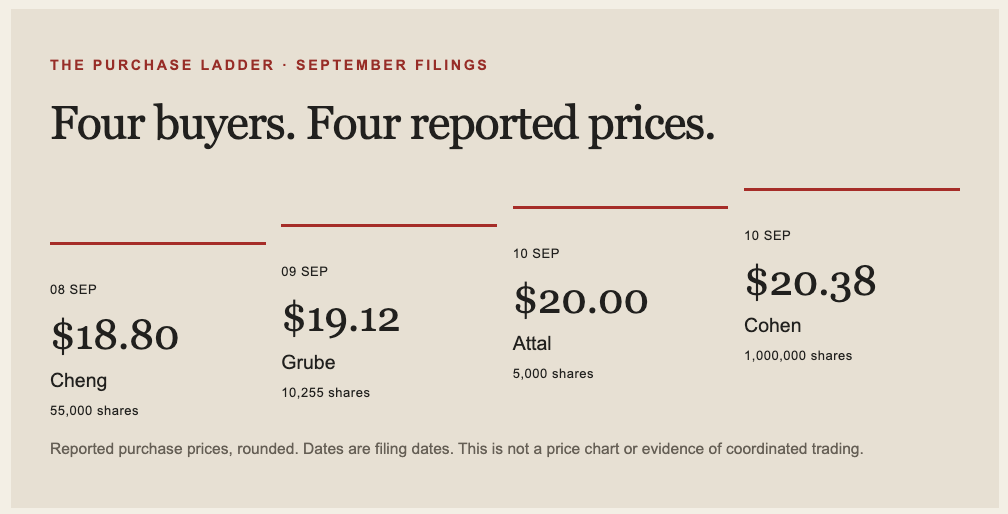
On Thursday evening, September 10, our filing monitor picked up Ryan Cohen's latest GameStop purchase: one million shares at $20.38. By the next morning, the desk's digest had put it beside purchases by Larry Cheng, James Grube and Alain Attal. The reported purchase prices formed a ladder: Cheng at $18.80, Grube at $19.12, Attal at $20.00 and Cohen at $20.38. Different purchase sizes; four people putting money behind the same company. The filings do not establish coordination or an intraday sequence.
The question was whether this was an unusual commitment—or merely an impressive number attached to a familiar ticker.
We wanted to know how unusual the buying really was. So we collected the Form 4 filings for GameStop and eBay across the same three years, September 14, 2023 through September 13, 2026. Our download receipt records 56 filings for GameStop and 321 for eBay, with no failed downloads or amendments in that window. Those are collection checks, not proof that every possible interpretation of a filing is correct.
GameStop insiders recorded 18 purchase transactions totaling $55,177,374.70, and 37 sale transactions totaling $3,274,772.78. eBay's record showed zero purchase transactions and 215 sales totaling $119,992,881.78. Net purchases at GameStop: $51.9 million. Net sales at eBay: $120 million. Same dates, opposite directions.
It is an interesting comparison. It does not tell us why eBay's insiders sold, or whether either stock was a bargain. An open-market purchase puts money into the hands of a selling shareholder, not the company's treasury. And knowing that somebody bought is different from knowing that following them makes money.
Where GameStop stands
GameStop sits in the top 4.5% for recorded insider purchase dollars in our September 12 screen: 94th among 2,103 companies with buying. Company records cover different dates, so treat that as an approximate comparison.
The more telling detail is who is adding. Cohen bought another million shares, taking his reported holding to 39.35 million. Cheng, Grube and Attal bought too. One large buyer supplies financial weight; other directors putting in their own money adds breadth.
For shareholders, the question is whether that commitment is backed by a business becoming more valuable. GameStop's buying, retained stake and improving operating profits give us a concrete case to examine.
Buying and holding needed separate treatment. Our local filing record showed Cohen with 39,347,842 shares after the September transaction. Set beside 53,736,062 shares reported short at the July 31 settlement, the holding was about 73% as large as the reported short position. His recorded holding was also about 8.8% of the September 1 outstanding share count. That comparison uses different dates and does not certify his entire beneficial position. It certainly does not establish that those shares cannot be lent. A large holder and a large short position can coexist without telling you who has to move first.
That is the buying-and-holding case: fresh money being added to a large existing position. A purchase flow and an ownership stock are different facts. Reducing the story to the size of the latest top-up loses the second.
There is a business underneath it, too. The latest quarter produced $160.2 million of operating income, against $66.4 million a year earlier, although sales fell. At August 1, GameStop reported $5.1 billion in cash, cash equivalents and marketable securities, plus digital assets and an eBay shareholding valued at $4.9 billion. A subsequent September debt exchange left approximately $2.8 billion of long-term debt. These are separately dated figures, not a fresh calculation of net cash. September earnings release.
There is an awkward twist for anyone trying to write a simple GME-versus-eBay morality play: GameStop itself owns a large investment in eBay. Personal insider sales and a corporate investment are different decisions. The contrast is real; it does not establish that eBay's sellers were wrong.
The bullish interpretation is straightforward. Management is adding personal capital while the operating business earns money and the company has substantial resources to deploy. The bet is that those resources become more valuable per share. Poor investments, renewed operating losses or uneconomic dilution would damage that case. A large holding cannot rescue bad capital allocation. Our desk's size-and-profitability screen also flags a possible MidCap 400 candidacy; that is a watch item, not a verified admission decision or promised buying by index funds.
That gave us a reason to investigate GameStop further. Then we asked whether we could turn part of the argument into a general rule.
Perhaps insider buying mattered more when short positions were already heavy. We tested that proposition across 87 monthly groups spanning more than seven years, using days to cover as the available historical measure. The estimated extra effect was positive, but too uncertain to establish an advantage. A severe missing-return scenario turned it negative. The result did not justify the rule. It also did not answer every question about ownership or float.
Then we opened the filings.

So we built a prototype that put the ingredients beside each other: purchases, recorded holdings, short positions and float. It covered more than 4,000 companies. Near the top sat Hertz, Columbia Financial, Wolfspeed and flyExclusive, with displayed short-interest-to-float readings between roughly 68% and 79%.
The screen looked interesting. Then we opened the filings.
Wolfspeed supplied the cleanest lesson. Its recorded purchases were worth about $5.16 million. The buyer was Citigroup, reporting as a large institutional owner. It bought 194,305 shares. In the same filing, it sold 194,423. Net change: 118 fewer shares. The filing also disclosed swaps paying away price increases and receiving price declines. The gross purchase total was real. Reading it as company management building a position was wrong. Citigroup's Form 4.
Columbia Financial's 74% reading had a different problem. Our float estimate came from February. In July, the company completed a conversion, sold 167.2 million new shares and exchanged each publicly held predecessor share for 2.2 successor shares. We had divided a July short position by a float from an earlier capital structure. A warning about stale data did not repair that arithmetic. We withdrew the ratio from the comparison. Company conversion announcement.
At Hertz, the filings supplied an economic explanation the percentage couldn't. The company lent approximately 37 million shares alongside an exchangeable-note financing, explicitly to facilitate hedging. That does not let us subtract 37 million from the reported short position. It does mean we cannot describe every short as a bearish investor waiting to be forced into buying. Some of the machinery was built to support a financing transaction. Hertz's financing announcement.
flyExclusive was different again. Director Peter Hopper really did buy 125,000 shares in March. One person making a genuine purchase remains a genuine purchase; it does not become defective because there weren't four buyers. The problem was the denominator. The May float estimate preceded a July merger issuance, and the total outstanding count combined Class A and Class B shares. The purchase survived the check. The apparent scale of the purchase and short position relative to tradable supply did not earn our confidence. Director's Form 4, company quarterly filing.
Four nearby rows on one screen. Four different explanations.
And this is where the comparison helps the GameStop story. Its named director purchases and Cohen's reported holding are substantively different from Citigroup's offsetting Wolfspeed trades. flyExclusive reminds us that genuine buying exists elsewhere, too. Hertz reminds us to investigate the economics of short positions—including at GameStop, which has its own convertible debt. None of those findings establishes that GME's shorts are trapped. They tell us which questions survive the first check.
We widened the investigation to HighPeak Energy and The Children's Place. Concentrated ownership survived those checks more convincingly, but it brought us to debt service, cash generation and sponsor financing. Those are worthwhile investment questions. Majority ownership doesn't answer them for you.
We went back through history.
There was still a historical question we could answer immediately. Even if high short pressure didn't reliably point upward, did it identify stocks more likely to make a large move?
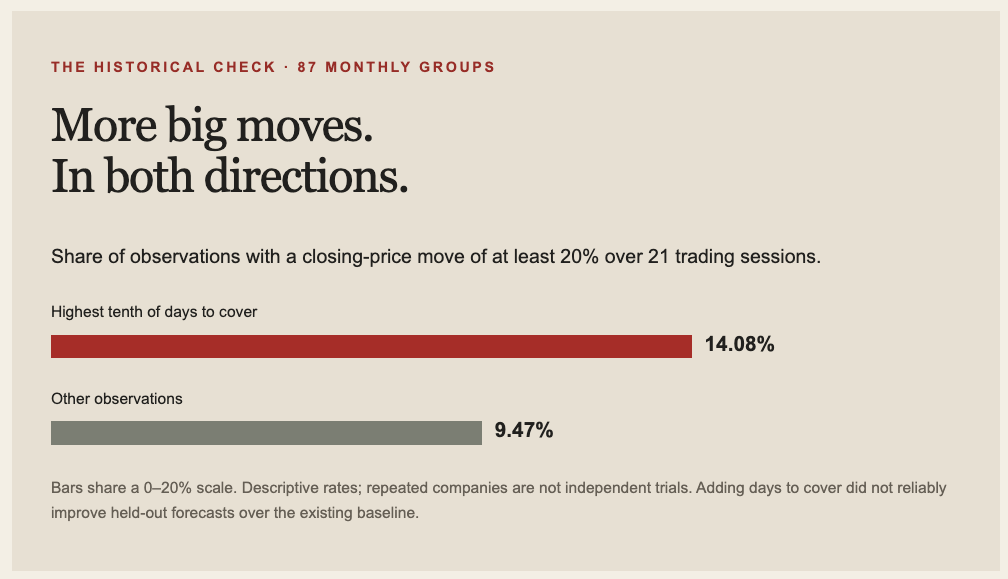
We went back again. This was a separate test: the highest tenth of days-to-cover readings, followed by 21 trading sessions of price returns. Across 87 monthly groups, a move of at least 20% occurred about 14% of the time in the high-days-to-cover group, versus 9.5% elsewhere. Both large gains and large losses were more common. A smaller difference remained after accounting for prior volatility and other market characteristics.
That was something. Then we asked whether it improved a forecast.
We replayed 62 later months, training each forecast only on outcomes that had already finished by that date. Adding days to cover did not reliably improve predictions over a baseline using past volatility, liquidity, price and momentum. The population had more large moves. The extra input had not demonstrated useful forecasting value beyond what that baseline already knew.
This was a broad historical proxy test, not a reconstruction of tiny floats or a verdict on those six companies. We did not have verified historical float data, and we did not quietly paste today's float into yesterday's market. The test measured closing returns, not the highest price someone might briefly have sold at during a squeeze.
The final step was to change the prototype.
Its default view now leads with the investigation: what happened, what the source supports, and what still needs checking. Numerical comparisons require explicit checks on the relevant share basis and transaction context. Offsetting gross trades cannot qualify as net accumulation. Stale or unreconciled inputs stay outside the comparison. A single genuine buyer receives no automatic downgrade.
The raw numbers remain available. They no longer get to lead the reader through an unresolved problem with a small warning tucked beside them. In this snapshot, zero companies pass the new comparison checks. That is a statement about the evidence we have, not a claim that the market contains zero opportunities.
What survives the scrutiny?
So where does that leave GameStop? High in our dated purchase-dollar screen, with genuine director buying and a substantial recorded Cohen holding. Alongside those ownership facts sits a profitable operating business and a consequential capital-allocation bet. That combination supports a company-specific bull case worth examining. We have not measured its combined rarity across a consistently audited universe, so there is no honest overall “number one” badge to attach.
The historical tests did not establish a shortcut from insider buying and short pressure to higher prices. They did not test—and therefore did not settle—the value of GameStop's business or its investment portfolio.
The research belongs inside the bull case because it tells us what we are actually betting on. Owners adding money. An operating business improving. Capital that must earn its keep. A short position that still needs explaining.
GameStop earns attention on those facts. The next argument has to be about what they are worth per share.