
A Halloween Account, 1966, Being the True and Reasonably Accurate Story of One Furious Sixteen-Year-Old Sister, One Six-Year-Old in Last Year’s Ben Cooper Costume, and the American Legion Hall
“Home by eight-thirty.” (My father, every October 31st, in the voice of a man reading a verdict)
“He gets it from your grandfather.” (My mother, on every subject, for six years)
Halloween, 1966, fell on a Monday, which was the first indication that God had something against children.
My father put me in charge of my brother that evening, and I want it on the record that I have never fully forgiven the Great Western Sugar Company for the scheduling.
It was campaign season. Every fall the beets come out of the ground in the Panhandle by the truckload, and for four months the factory runs day and night, with a smell like boiled cabbage and burnt molasses rolling out of the stacks and over Scottsbluff like a rumor. My father worked the rotation: days, six to two; the middle, two to ten; nights, ten to six; a week of each, so that nobody in our house ever knew what time his body thought it was. Nineteen years of it. That week he was on days. He called the smell the smell of money, though he never once said whose.
At 5:52 p.m. I was in the bathroom of our house on Bryant Avenue with a can of Aqua Net, a jar of Dippity-do, and a rat-tail comb, building a flip. Debbie Ostrander was having a record hop in her basement at eight. Her folks were at a Rebekah Lodge supper until ten, which in the language of Scottsbluff, Nebraska, is the same as a formal invitation from the Almighty. Dennis Waddell was going to be there. Dennis Waddell was a senior with a crew cut and a ’57 Chevy who had said “hey” to me once at the A&W, and I had been living off that word for five months the way a camel lives off one unusually good oasis.
My father knocked once. He knocks once when it isn’t a question. A man’s authority, in his view, rested on three things: he owned the house, he paid the electric bill, and he knew where the shotgun was kept. He considered a follow-up question evidence that the original answer had not been clear.
“Elaine, you’re taking your brother,” he said, through the door.
“No.”
“He’s six.”
“I’m sixteen.”
“I know how old you are. I was there. I still owe the hospital eleven dollars.”
I opened the door. He stood in the hall in his undershirt and work pants the color of an old penny, smelling faintly of the smell. He had the expression of a man who has already lost the argument and is waiting politely for the other party to finish.
“Your mother’s on the three-to-eleven at the hospital,” he said. “I’m on days this week. I’m in bed by seven and up at four-thirty, and I’m no good to anybody in between. Your grandfather can’t get past the mailbox on that hip. Somebody’s got to take him.”
“Then nobody takes him. He can sit on the porch and hand out Necco wafers with Grandpa.”
“He’s Frankenstein,” my father said, as if this settled it, and in a sense it did.
“Why me?”
“Because I said so.”
“Can I at least take him to the end of the block and let him walk back?”
“No.”
“Can I put him on a bus?”
“We don’t have a bus.”
“Then I’ll find one.”
My father looked at me the way he looked at a beet that had gone to seed. Then he looked me up and down. I was wearing the plaid skirt I’d worn on Friday, a pair of my mother’s old cat-eye sunglasses, and a dish towel tied loosely around my wrists.
“Where’s your costume?” he said.
“I’m a hostage.”
“Great,” my father said. “Stay in character.”
Now the costume.
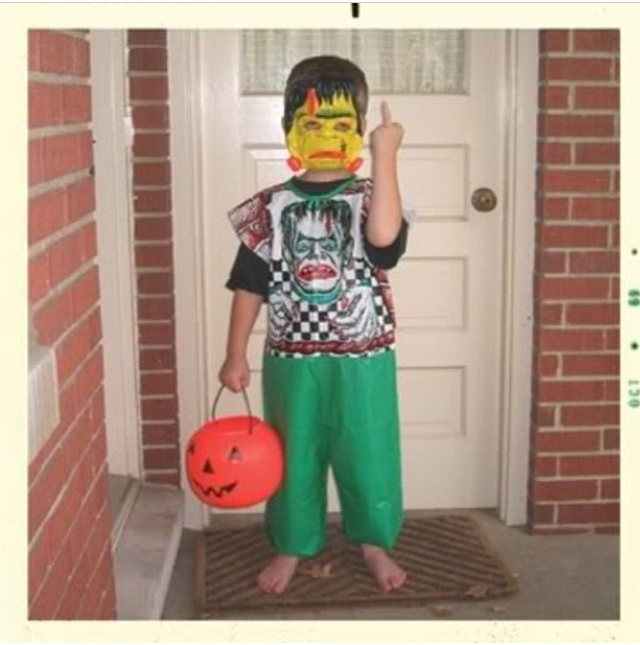
It was a Ben Cooper Frankenstein, size Small, ages four to six, purchased at the Ben Franklin on Broadway for one dollar and ninety-eight cents the previous October and, according to my father, “going to last till it’s paid for.” It came in a cardboard box with a cellophane window, and it consisted of two items: a rayon jumpsuit printed to look like a monster’s suit, with a stitched-on collar and fake bolts, which you stepped into and tied at the back, and a hard plastic mask. The mask was a flat green face with a painted black flattop, a scar like a railroad track across the forehead, and a mouth slot the size of a letter slot. The eyeholes were the diameter of dimes. It was held on by a single thin elastic band, stapled at both temples, which had snapped in March and been re-stapled by my father with an office stapler during a Huskers basketball game on the radio. It smelled like a shower curtain, a hot-water bottle, and the inside of a lunchbox that has had a banana in it.
He had worn it for nine straight days after last Halloween before my mother hid it in the attic. He found it in July. He wore it to church in August. The Methodist minister, a patient man, blessed it.
He had outgrown the legs by August, and my mother had taken the kitchen shears to them, which left a smock that ended three inches north of his belly button, so that below the printed monster there appeared, in a bright band, a strip of my brother: one inch of plaid shirt, two of bare stomach, and then his corduroys and a pair of red cowboy boots he refused to take off. He looked like a monster who had lost a fight with a dryer.
His name was Randall. Everybody called him Randy. He was six and a half years old, forty-six pounds, with a flattop of his own, a gap where his front teeth used to be, and a pair of black plastic glasses the mask pressed flat against his face, and he did not say “trick or treat.”
He said, in a voice that came out of that little mouth slot like a man shouting down a coffee can: “Frankenstein, you son of a bitch.”
I should explain.
My mother’s father, Orville Rasmussen, lived in our back bedroom. He had been a boatswain’s mate on the USS Enterprise from 1942 to 1945, and he had come home to Nebraska with a Purple Heart, a Navy tattoo of a swallow that had gone green and shapeless over the years, and a vocabulary the war had polished to a high shine. He had a bad hip, a quart of Old Crow, and a radio, and at six o’clock every evening he sat in a lawn chair on the porch and talked to my brother, who sat beside him, knee to knee, drinking in every word with the focus of a monk copying scripture.
By the age of six, my brother knew four hundred words. Three hundred of them could not be printed in the Star-Herald.
“He gets it from your grandfather,” my mother said, about every subject, with a sigh that had been getting longer for six years.
My father gave me three rules from the hall, with the finality of a man handing over terms of surrender.
“One. Home by eight-thirty. Two. Hold his hand. Three. Don’t let him talk.”
“Dad. He’s six. He’s going to talk.”
“Then don’t let him talk to anybody over forty,” my father said, and he went down the hall toward the bedroom in his sock feet, with the unmistakable gait of a man who had gotten away with something.
I did the math. Thirty-one houses on the standard route. Ninety minutes, if I moved like I meant it. Party at eight. Home by eight-thirty, which was, I will admit, a conflict.
“Come on, Frankenstein,” I said.
“Frankenstein doesn’t hold hands,” my brother said. “Frankenstein’s a goddamn monster.”
“Then walk next to me.”
“Frankenstein walks where he damn well pleases.”
I took his hand anyway.
“Jesus Christ!” my brother shouted. “You’re breaking my goddamn fingers!”
A porch light came on across the street. I smiled at the neighbors.
“He’s just excited,” I said.
My brother looked up at me through the eyeholes.
“You’re a terrible liar,” he said. “Grandpa says you can always spot one by the smile.”
“What’s wrong with my smile?”
“It looks like somebody’s pulling your teeth.”
I caught my reflection in the Hendersons’ storm door. He was not wrong.
He wrenched his hand free, put his arms straight out in front of him, locked his knees, and lurched down the porch steps in the stiff, forward-listing walk of the creature he’d seen on the late show with Grandpa, and walked directly into the mailbox.
“You tin-can, mail-eating bastard,” he said, to the mailbox, with real feeling.
From the lawn chair behind us, in a voice like a gravel truck, came: “That’s my boy.”
I had seven things on my mind and my brother had one. He had a bag, a pair of glasses that fogged every eleven seconds under the mask, and a deeply held conviction that a man could say whatever he wanted to anybody, so long as he was in costume. The Frankenstein walk, as he performed it, was less a way of getting from one house to the next than a position he had taken on the subject of knees.
The first house was the Duseks’, four doors down.
Mr. Dusek taught shop at the junior high and had given out toothbrushes on Halloween for as long as anyone could remember. This year, in a burst of mercy, there was also a basket of Bazooka. He opened the door and looked down at a Frankenstein with an exposed midriff.
“Trick or treat,” I said, fast, before anybody else could say anything.
“Frankenstein, you son of a bitch,” my brother said.
Mr. Dusek did not blink. He looked at the mask. He looked at me. He looked at the mask again, the way a man looks at a dog that has just recited the Gettysburg Address.
“Where’d you learn that?” he said.
“Grandpa. He was on the Enterprise.”
A pause. A very small, very specific pause.
Mr. Dusek had spent the war on a destroyer escort in the North Atlantic, and there is no Navy man alive who does not stand a little straighter at the word Enterprise. His heels came together. His hand went up to his eyebrow in a salute so crisp it could have cut a stick of Bazooka.
“Then you come by it honestly,” he said.
“Yes, sir,” my brother said, and returned the salute with his entire arm, a stiff windmill that knocked the mask sideways and put one eyehole over his nose.
“Carry on, sailor,” Mr. Dusek said. He dropped two Hershey bars in the bag, and then, after thought, a toothbrush. “Don’t tell the school board.”
At the Gundersens’ there was a line. The Gundersens gave out popcorn balls wrapped in wax paper, each the size of a softball, and word of this had traveled through Scottsbluff faster than the telephone company could have managed it. There were nine witches, a Davy Crockett, a ghost who was visibly a bedsheet and a pair of Keds, and an eleven-year-old Batman in a bath towel and a safety pin.
Mrs. Gundersen stood at the top of the porch steps with a bowl the size of a hubcap, and when my brother reached her, he held up his bag.
“Frankenstein,” he said, “you son of a bitch. Gimme a popcorn ball.”
Her hand flew to her pearls.
“Elaine Kostka,” she said. “Is that your brother?”
“He’s in character.”
“Is that supposed to be an explanation?”
“It’s the only one I’ve got.”
She dropped a popcorn ball in his bag the way you drop a coin in a wishing well, quickly and without looking, hoping the matter would go away. My brother inspected it through the eyeholes.
“Popcorn balls,” he said, “stick to your goddamn teeth.”
“Randall!”
“Frankenstein,” he said, with dignity, “doesn’t have teeth.”
He had, in fact, eleven. But I took his point.
We left the Gundersens’ at 6:41. I had walked four houses in forty-one minutes. A Frankenstein moves at roughly the speed of a glacier with a grievance.
“You’re going to get us thrown out of the neighborhood,” I said, hauling him down the steps.
“I’m telling them the truth.”
“Randy. You’re six. You don’t know everything.”
“Neither do you.”
“I’m sixteen.”
“So?”
“So I’m older than you.”
He looked at me with something very close to pity.
“That’s not something you did, you know,” he said.
Mrs. Eunice Pelletier, eighty-four, deaf as a fence post, lived at the end of Dahlia Court in a house with a ceramic goose in a rain slicker on the front step. She came to the door in a housecoat and a hairnet, one hand cupped behind her ear.
“Eh?” she said.
“Frankenstein, you son of a bitch,” my brother said, at full volume, which through the mask sounded like a bulldozer in a culvert.
“Well, aren’t you precious,” said Mrs. Pelletier.
“I’m gonna piss on your petunias.”
“My, what manners.”
“Your goose looks like a damn idiot.”
“He’s from Sears,” Mrs. Pelletier said fondly, and something happened at the corner of my mouth that I had to take firmly in hand. She gave him a full-size Hershey bar, a Mary Jane, and a pat on the top of the mask, and then she looked at me over the rim of her glasses. “What a polite boy,” she said. “Your mother must be so proud.”
On the walk down Dahlia Court I said, “You told her you were going to piss on her petunias.”
“She gave me candy.”
“You called the mailbox a bastard.”
“That was different.”
“How?”
“The mailbox didn’t give me candy.”
I considered the argument. It was difficult to fault the logic, though I had no intention of telling him so.
My anger, by then, had passed through the stages familiar to anyone who has ever been drafted: first the hot, clean fury of the newly conscripted, then the long gray plateau of knowing I would be doing this until the sun burned out, and at last something close to the weary civility of a prisoner who has learned the guard’s first name.
The last house before Fifteenth had a small banner in the front window, white with a red border and a gold star in the middle, and the porch light was off. I would have walked us past it. Randy was already on the steps, knocking with his whole arm, the way he did everything.
The door opened on a woman from our church in her good cardigan. She looked at the mask, and the smock that stopped north of his belly button, and the red boots. She didn’t say anything.
Randy opened his mouth. I put my hand on his shoulder, and he closed it, though I had not said a word.
“Trick or treat,” he said, in a voice I had not heard all night.
She went away and came back with both hands full, and she put the candy in his bag one piece at a time, as if she were counting. “You’re a good Frankenstein,” she said. “My Danny was a good Frankenstein.” Then she closed the door, gently, the way you close a door on a sleeping child.
Randy looked at the door for a while. “Why was the light off?”
“I don’t know,” I said, and smiled, and for once he didn’t say anything about my smile.
At 7:13 I sat down on a curb on Dahlia Court and held my head in both hands. Down Fifteenth Street the porch lights glowed orange. A plastic skeleton hung from a cottonwood and swung in the wind with the casual composure of a man who has nowhere to be.
“You look pissed,” my brother said.
“Do you know what that means?”
“It means mad as hell.” He thought. “And tired.”
I didn’t answer.
“I’m sorry you got stuck with me,” he said, and he said it plainly, with no swearing at all, the second time all night. I swear I heard the mask say it, the way you hear a house say something when the furnace kicks on.
“I didn’t get stuck with you.”
“Dad said you got stuck.”
“Dad doesn’t know everything.”
He thought about it for a while.
“He knows about beets,” he said.
I got up off the curb.
We got as far as the back of Eldred’s Grocery on Broadway before he stopped, crossed his legs, and announced: “Frankenstein has to pee.”
“No.”
“I got to.”
“You went before we left.”
“That was before.”
Eldred’s was closed. The drugstore was two blocks off. I had two choices: take him home, which meant explaining to my father why the evening had ended at 7:20 with two pounds of unclaimed candy, or manage the situation with what remained of my dignity.
I chose dignity. It was a mistake.
I steered him into the narrow gap between the grocery and a board fence.
“Go back there,” I said.
“You want me to piss on a building?”
“Keep your voice down!”
“What if somebody sees?”
“Nobody’s going to see.”
He considered this through the eyeholes. “This is a hell of a way to live,” he said, and disappeared around the corner, mask and all, because Frankenstein, he informed me, did not take off his face.
I stood guard. Thirty seconds passed. Then a voice: “Hey! Kid! What the hell are you doing?”
A man’s voice. Loud. Official.
“I’m taking a leak!” my brother shouted back. “What the hell does it look like?”
I closed my eyes. I have never been so certain of anything as I was, in that moment, that my life was over.
The man who came around the corner wore a brown uniform and carried a flashlight, and the flashlight was pointed at a six-year-old Frankenstein standing with his smock hiked up around his ribs, his pumpkin bucket in the dirt, and the calm of a man with nothing left to lose.
The watchman looked at my brother. He looked at me. He looked at my brother again.
“Young lady, is this your brother?”
“Yes, sir.”
“He’s urinating on the side of a building.”
“Are you going to arrest me?” my brother said, hitching up his corduroys.
“I could.”
My brother thought about that. “This is private property,” he said.
The watchman opened his mouth. He closed it.
“I told him to go behind it,” I said. “I didn’t say on.”
The watchman began to laugh. He tried not to. I could see him fighting it, a man with a uniform to maintain and a property to defend, but he was looking at a six-year-old in a Frankenstein mask on the wrong side of Eldred’s Grocery, and he lost. He laughed until he had to wipe his eyes with a thumb.
“Get out of here,” he said. “Both of you. And keep that little son of a bitch out of trouble.”
“Yes, sir.”
“Aye aye,” my brother said, and saluted.
We ran to the corner, where I took him by both shoulders and bent down until we were eye to eye through the eyeholes.
“You are never to do that again.”
“I had to pee.”
“You could have been arrested.”
He thought about it.
“Would they give me candy in jail?”
I let go of him. I could not think of anything to say.
At the corner of Fifteenth and Broadway the American Legion hall was lit up like a ship, with a hand-lettered banner over the door: HALLOWEEN COSTUME CONTEST, 7:30, ALL AGES, SILVER DOLLAR, FREE ORANGE CRUSH FOR KIDS. A polka was coming out of the windows.
My brother stopped.
“Frankenstein,” he said, “is thirsty.”
“Ten minutes,” I said.
The American Legion hall smelled like cigar smoke, kielbasa, floor wax, and a hundred and ten men who had each, at some point between 1941 and 1953, been scared out of his mind and had agreed never to discuss it. A polka band called the Four Fellas and a Fiddle, which had five members, was working through “Beer Barrel Polka” on a riser at the far end. Women in aprons moved between long tables with trays of deviled eggs. The air was blue. In a corner a man in a Legion cap was trying to explain a pinochle hand to a nine-year-old cowboy, who did not care.
My brother got his Orange Crush. He drank it through the mouth slot of the mask, which is not designed for liquids, and which delivered about a third of it to his chin and the rest to the front of his smock.
At 7:31, from the riser: “LAST CALL FOR CONTESTANTS!”
“Ten minutes,” I said again, to no one.
“Frankenstein,” my brother said, handing me the empty bottle, “is going to win.”
“Randy.”
He slid out of my fingers.
I could have caught him. I had a clear reach, a sixteen-year-old’s reflexes, and an evening’s worth of low-grade fury that made me quick. I did not.
He lurched up the three steps to the riser with his arms out and his knees locked. The Four Fellas and a Fiddle lost their place in the polka and stopped one at a time, the accordion last, with a long, wheezing sigh.
The man at the microphone was Commander Walt Pruitt, a barrel of a man in a Legion cap with a voice built for hailing destroyers across open water. He looked down at a Frankenstein with an exposed midriff and red cowboy boots.
“Well, what have we got here!” he boomed. “A Frankenstein! What’s your name, son?”
He held the microphone down. My brother took it in both hands, and I watched him draw a breath that inflated the entire mask.
“Frankenstein,” he said, into the microphone, “you son of a bitch.”
Silence.
Four seconds of it. The kind you hear in a church when the organ stops in the middle of a hymn. In the corner the pinochle lesson stopped. Reverend Hollis, one of three judges at the card table, who had personally blessed that mask in August, set down his pencil and put his hand over his eyes. Mrs. Gundersen, who had followed the line over from the popcorn balls, put her hand to her pearls.
Then, from somewhere in the back, a man laughed. One bark. Mr. Dusek. And then a second man. And then the hall let go.
I have never heard a sound like it. It wasn’t laughter, exactly. It was the sound of a hundred men who had spent twenty years being careful, being quiet, being fine, abruptly discovering that they were not obliged to be any of those things for the next thirty seconds. Chairs went over. A man in a Navy watch cap slapped his knee so hard he knocked a deviled egg off a table. The accordion player folded in half over his instrument and wheezed. Commander Pruitt, microphone dangling, wiped his eyes with the back of his wrist.
“Son,” he managed, “where did you learn to talk like that?”
“My grandpa,” my brother said. “Orville Rasmussen. Enterprise.”
The laughter stopped. It didn’t trail off. It stopped, like a hand on a bell.
“Orville Rasmussen,” the Commander said, quietly.
“Boatswain’s mate,” my brother said.
“Boats Rasmussen.” Commander Pruitt put the microphone to his mouth and turned to the hall, and his voice had changed. It was lower and flatter, the way a voice goes when a man hears a name from a long way off. “Gentlemen, this is Boats Rasmussen’s grandson.”
A chair scraped. Then another. In the back, Mr. Dusek came to attention. Then a man in a Navy watch cap. Then a man in an Army jacket with a patch I didn’t recognize. Then the whole room, standing, men in Legion caps and suspenders, the polka band with their instruments hanging from their hands, the women with their trays, until I was the only person left at the back of the hall not standing, and I stood, because I didn’t know what else to do.
“Boats Rasmussen,” said Commander Pruitt, “pulled three men out of the oil off Guadalcanal in the fall of 1942.” He paused. “I was one of them.”
It went very quiet.
My brother looked up at him through the eyeholes.
“Are you Walt?”
“I’m Walt.”
“Grandpa says you cry at Lassie.”
The hall detonated. Commander Walt Pruitt, a man who had been fished out of burning water at the age of twenty-three, stood at a microphone in front of his own Legion post and laughed so hard he cried, and then cried harder, and then, I swear, did both at once, which is a thing I had not known a man could do.
The three judges conferred. It took forty seconds. Reverend Hollis abstained. “In the interest of the community,” he said, quite gravely, “I believe I should recuse myself.” Mr. Overholt, the funeral director, voted yes. Mrs. Pruitt, a small woman, voted yes with both hands.
“By unanimous decision,” the Commander said, “first prize, one silver dollar, and the title of Honorary Chief Petty Officer, goes to Randall Kostka.”
Somebody put a Navy cap on top of the mask. It came down over the eyeholes. The Four Fellas and a Fiddle struck up “Anchors Aweigh” in polka time, a way of playing it that I still believe violates several Geneva conventions, and the whole hall sang. My brother saluted with his entire arm, knocked the cap sideways, and said, in a voice that carried to the back wall: “At ease, you sons of bitches.”
They gave him another standing ovation. I think they would have given him the building.
He saluted them back. Most of them. His glasses had fogged again under the mask, and a good third of his salute went to the coat rack.
“What the hell are you people supposed to be?” my brother asked the room.
“Veterans, son,” said Commander Pruitt.
My brother considered this.
“That’s a damn good costume,” he said.
I stood by the coat rack with my arms crossed, in my plaid skirt and my mother’s cat-eye sunglasses and my dish towel, furious, and I stayed furious for at least four more minutes.
Commander Pruitt spotted me from the riser.
“And who’s the young lady?”
“Hostage,” I said.
The hall roared for the second time. Mrs. Pruitt crossed the floor, took my arm, put a slice of lemon meringue pie in one of my hands and a Coke in the other, and steered me into a vinyl chair at a table of old women in pillbox hats. One of them leaned over and said, in a smoker’s whisper, “Your grandfather taught Walt to swim, you know. On the ship. In a bucket.”
“In a bucket?”
“It’s a long story,” she said. “It takes about forty years.”
At 8:02 I looked up at the clock over the bar and understood that Debbie Ostrander’s record hop had started two minutes ago. Somewhere in a basement on Eleventh Street, “Last Train to Clarksville” was playing, and Dennis Waddell was saying “hey” to someone who wasn’t me.
I could still make it. I did the math. Ten blocks. Ten minutes, if I ran. I looked across the hall at my brother, in a Navy cap, in a rayon smock that stopped north of his belly button and red cowboy boots that struck the Legion’s linoleum like a pair of gavels, and I took a bite of the pie.
It was extraordinary. It was, I think, the finest lemon meringue pie I have ever eaten, and I have thought about that pie for sixty years.
I did not go to the party. I would hear on Tuesday that Debbie’s parents came home at nine-fifteen, that somebody’s older brother had brought a bottle of Thunderbird, that a lamp had been lost, and that Dennis Waddell left at ten with a girl from Gering. I would hear it all in the hallway at school, from girls wearing expressions of grave sympathy, and I would nod and say “Oh, no,” and feel nothing at all, which turned out to be the most surprising part. Dennis Waddell, I’m told, sold insurance in Grand Island until he retired. He never said hey to me again, and I have not once noticed.
We left at 9:35. Randy made it as far as Fourteenth Street. I carried him the other eleven blocks.
He was out cold on my back, the Navy cap on crooked, the mask pushed up on top of his head like a welder’s helmet, his glasses sideways on his nose, the silver dollar clutched in one fist, the other arm hanging over my shoulder, a night’s worth of cigar smoke in his hair. The air was cold and smelled of woodsmoke and, over everything, the smell: the stacks of the factory glowing white against the black, the whistle going at ten. He weighed forty-six pounds. It was the longest walk of my life. I would not trade a step of it.
“Laney,” he mumbled, somewhere on Twelfth.
“Yeah.”
“Frankenstein…”
“Yeah?”
“…is a hell of a guy.”
“Yeah,” I said. “He is.”
Grandpa Orville was in the lawn chair on the porch under a green wool blanket, a cigarette glowing in the dark, the bowl of Necco wafers untouched on his knee. Nobody in the history of Nebraska has ever voluntarily eaten one. He watched the two of us come up the walk, me and the boy asleep on my back. He didn’t say anything until I had reached the steps.
“Did he cuss?”
“In front of the whole Legion.”
“Good.”
“He told Walt Pruitt you said he cries at Lassie.”
“He does cry at Lassie.” A pause. “Did he cry?”
“Yes.”
“Good man.” Another pause. “Pruitt was there?”
“He said you pulled him out of the water.”
Grandpa Orville did not answer. He looked out at the street. A cold wind came across the yard from the west, the way it does in late October, carrying dust and woodsmoke and the smell of the factory, and the cigarette trembled once in his fingers, and I saw, to my great alarm, that his eyes were wet.
“They stood up,” I said. “When Randy said your name. The whole hall. They all stood up.”
He sat there for a long time.
“Goddamn,” he said, very softly. “Goddamn.”
It was the most tender thing I ever heard him say.
My father came into the kitchen at 4:30 in the morning in his undershirt and sock feet, to start the coffee, and found me at the table with a cup of cocoa gone cold and a silver dollar my brother had pressed into my palm and refused to take back.
“You’re late,” he said.
“I know.”
“It was eight-thirty.”
“I know.”
He set down the coffee pot. He sat down across the table, and his knees said something about it. He looked at the silver dollar.
“Walt Pruitt called the house at ten-thirty,” he said. “Orville woke me up to say so. ‘Tell Dale his boy’s a Chief.’”
“It’s not funny.”
“I’m not laughing.” He was, a little. “I’m sorry you missed the party.”
“You’re not sorry.”
“I’m a little sorry.”
“Why’d you make me take him?”
He rubbed his eyes with the heels of his hands. He had been awake four minutes and already smelled like boiled cabbage and money.
“Because he asked for you,” he said. “Sunday, at supper. ‘Can Laney take me? She’s quick.’ I said you had plans. He said, ‘She always has plans.’”
The refrigerator hummed.
Quick. I thought of the reach I’d had at 7:31, and the hand I hadn’t put out.
I turned the silver dollar over. 1922, a Peace dollar, the eagle with its wings folded.
“Did you have a good time?” my father said.
I thought about the pie. I thought about a hall full of men standing up. I thought about the weight of a boy asleep on my back.
“No,” I said.
“Good,” my father said. “You’re sixteen. You’re supposed to hate everything.”
I laughed. It was a small, tired laugh, the first one all night that wasn’t at my brother’s expense, and my father smiled the smile he usually saved for fishing stories.
“You’re grounded,” my father said.
“Okay.”
“Until Thursday.”
“Okay.”
“Go to bed.”
Grandpa Orville died in March of 1971. The funeral was held at the Legion hall. It was the first time he had been through those doors since 1946, and the Legion insisted. My brother, ten years old, in a suit that didn’t fit, stood at the back of the room and said one word, loudly, at exactly the right moment. Commander Pruitt, who cried at nothing but Lassie, said, “Amen.”
My mother, in the front row in her good black dress, had watched all of it. “He gets it from your grandfather,” she said, to nobody, in a voice I had never heard her use about it before. It sounded like a prayer.
My brother joined the Navy in 1978. He served twenty-four years and retired in 2002 as a Chief Petty Officer, with a mouth that no commanding officer ever corrected, mainly because none of them could keep a straight face long enough to write him up.
The mask hangs in a frame above the bar at the Legion hall, between Grandpa’s photograph and the ship’s bell. Taped to the glass is a 1922 Peace dollar. I donated it myself, in 1992, and I still think of it as a loan. The elastic is still stapled.
Every Halloween, when the little ghosts and goblins come to my door, the mouthy ones get the extra candy. You never know what they’re going to grow up to be. Sometimes a Chief.
And every Halloween, wherever I’m living, the phone rings at eight-thirty sharp. He doesn’t say hello. He says: “You home?”
I say: “I’m home.”
He says: “Good,” and hangs up.
In sixty years we have never once discussed it.