
What if the biggest lie about Iran is not a lie at all, but a half-truth so effective it functions like a cover-up?
The media has built a cage for your attention. That cage is called “uranium enrichment.” They shove every headline, every cable-news panel, and every so-called expert into that cage to debate enrichment levels, missile strikes, and breakout timelines. It is a spectacular show. It is also a dangerous distraction.
They are pointing a flashlight at the fistfight in the front yard while hoping you do not hear someone kicking in the back door.
This is not just another episode. This is the release of a classified dossier. The mission is simple: arm you with the one piece of intelligence they pray you never find — plutonium.
Foreign policy analyst Ron Bee joined The Middle Ground Mic to break down the part of the Iran story that does not fit inside a two-minute propaganda segment. This is a warning that the real nuclear threat may be bigger, darker, and closer than the establishment wants to admit.
Before we unseal the dossier, a word about the sponsor helping make this kind of independent coverage possible: Brio.
Balanced people also appreciate a quality beard trimmer, and Brio’s Beardscape V1+ is the kind of product I can actually stand behind. It is built with mechanical certainty instead of planned obsolescence. Ceramic blades, strong guards, a quiet motor, and a design that actually handles the annoying jawline spots other trimmers miss.
This kind of independent intelligence costs money to produce. Brio helps support the mission, and you can support the show by checking them out here:
https://www.brio4life.com?aff=296
Use code MIDDLEGROUND for 10% off.
The Shell Game: Why They Only Talk About Uranium
Here is the uncomfortable truth: the entire Iran nuclear debate may be a rigged game. Uranium gets the headlines because it is simple. It gives cable news something clean to argue about: centrifuges, stockpiles, breakout times, and enrichment percentages.
But what if that is also the perfect cover story?
What if the real, more patient, and more dangerous pathway to a bomb is being built while everyone is distracted? What if the public is being trained to watch the wrong door?
Joe: “The media is telling you to watch uranium. That’s a misdirection. If plutonium is the back door, then we are not watching the real threat.”
That is the heart of this episode. Ron Bee is not asking people to panic. He is asking people to look deeper. Because if plutonium is part of the conversation, then the timeline, the threat assessment, and the entire public debate change.
Ground Zero: The Power Plant They Pray You Ignore
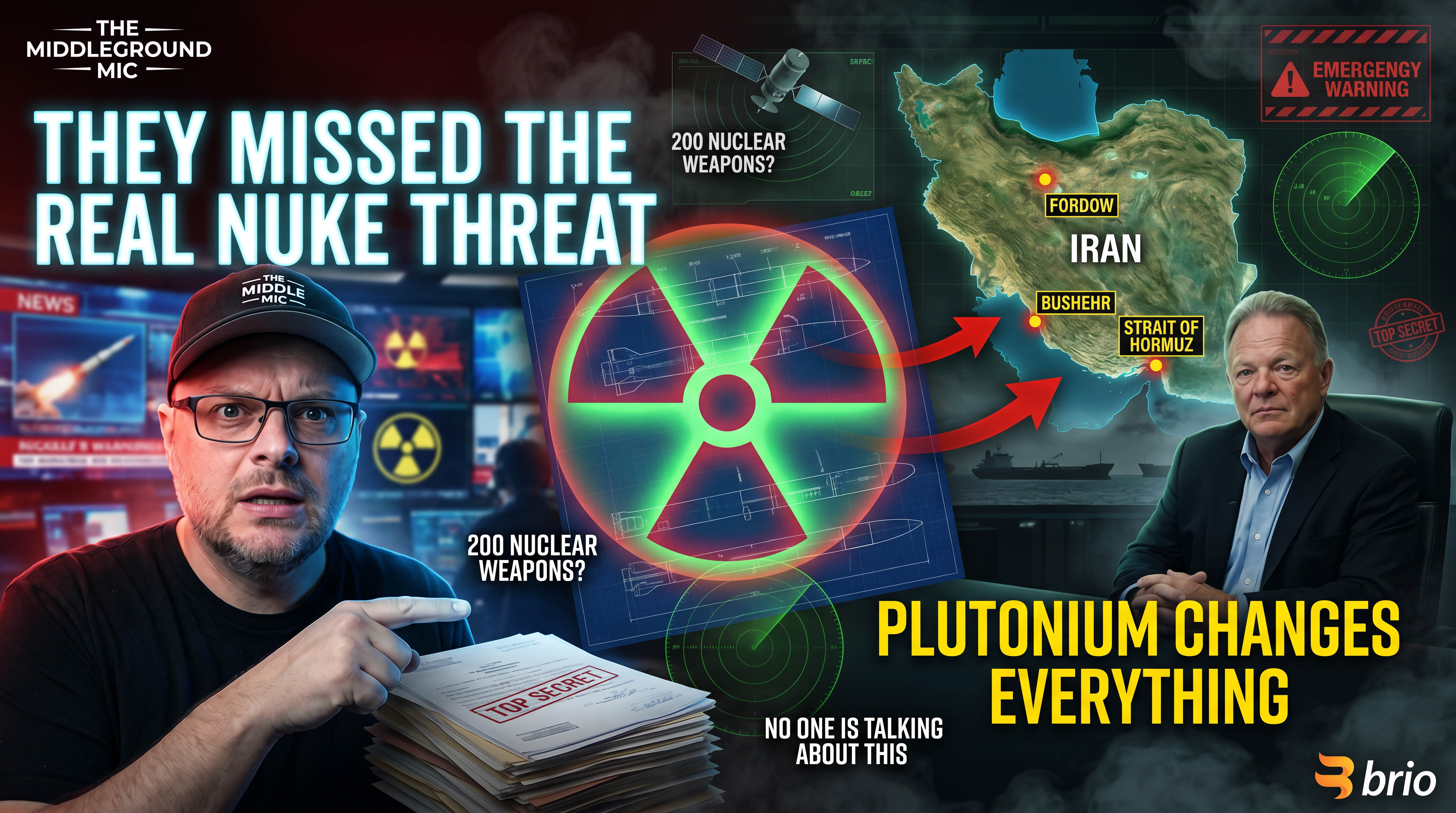
This is where the Bushehr nuclear plant becomes the dark heart of the story.
To the media, a “civilian power plant” sounds boring, safe, and technical. It sounds like something for engineers and diplomats to argue over. But to someone looking at the nuclear pathway, civilian infrastructure can become something much more serious.
Spent fuel rods from nuclear reactors can become part of a plutonium conversation. That is why Ron Bee argues that Bushehr should not be treated like some irrelevant side note. It could be one of the most important pieces of the entire Iran nuclear story.
Ron: “They want you talking about enrichment. The real question is what infrastructure is being built, who is helping, and what pathway that creates over time.”
That question matters because infrastructure outlasts headlines. Politicians move on. Cable news moves on. Social media moves on. But facilities, fuel cycles, alliances, and technical capabilities remain.
And if the wrong regime, the wrong alliances, and the wrong geopolitical pressure points collide, what looked like a power plant can become a geopolitical time bomb.
The Shadow Ally: The Nuclear Power Playing Both Sides
Just when the story feels complicated enough, another player enters from the shadows: Pakistan.
This is not some random rogue state on the margins of the conversation. Pakistan is a nuclear-armed country with a long history of complicated strategic relationships. It has been treated as an ally, a problem, a partner, and a wild card — sometimes all at once.
If Pakistan is even indirectly part of the broader nuclear equation, then this stops being a clean Iran-only story. It becomes a regional nuclear anxiety story with multiple players, multiple agendas, and multiple ways for something to spiral.
That is exactly why the public rarely gets the full version. It is too complicated for cable news. It is too messy for campaign slogans. And it is too important to be reduced to “bomb them” versus “trust diplomacy.”
The Economic Kill Switch: How This War Comes for Your Wallet
This is the point where foreign policy is supposed to feel distant.
It is not.
It is in your gas tank. It is in your grocery bill. It is in your paycheck.
The Strait of Hormuz is one of the most important chokepoints in the global economy. A major portion of the world’s oil moves through that narrow channel. When that region becomes unstable, the consequences do not stay on a map. They move through markets, shipping routes, energy prices, and eventually your household budget.
Joe: “You may not care about the Strait of Hormuz, but your wallet does. Your paycheck does.”
That is what makes this issue so dangerous. A nuclear crisis, an oil crisis, and a military crisis do not remain separate for long. They fuse together. They create pressure. And once that pressure hits the global economy, ordinary people pay the price.
Sanctions, blockades, retaliatory strikes, shipping disruptions, and oil panic all become part of the same machine.
The Beneficiary of the Chaos
Every crisis has someone who benefits from the confusion.
China is not just watching this situation from the sidelines. China depends heavily on Middle Eastern energy, but it also benefits when America is distracted, divided, and trapped in another Middle Eastern conflict.
A United States bogged down in another regional crisis is a United States with less focus, less flexibility, and less political bandwidth to counter China’s ambitions elsewhere.
That does not mean every event is secretly controlled from Beijing. It means serious people need to ask who gains leverage when America gets pulled into another strategic trap.
Ron: “The oil piece isn't separate from the nuclear piece. It's the pressure system that makes the bomb tick.”
That is the deeper story. The battlefield is not just missiles, reactors, or speeches at the United Nations. The battlefield is oil. The battlefield is shipping. The battlefield is leverage. The battlefield is whether America understands the pressure system before it is already trapped inside it.
The Bipartisan Betrayal: How Both Parties Failed You
This is also a story of political malpractice, and both parties have fingerprints on it.
For decades, Republicans and Democrats have postured for cameras while the real threats grew more complicated in the dark. They trained the public to react emotionally instead of thinking strategically.
One side screams for immediate war and promises a clean victory it may not be able to deliver. The other side screams for endless diplomacy and pretends every regime can be managed with the right statement, summit, or signature.
Both sides sell slogans because slogans are easier than strategy.
Joe: “This is not about panic. It is about refusing to be a prop while the real threat is moving in the dark.”
That is the middle-ground position. Not weakness. Not warmongering. Not blind trust in institutions. Not blind rage at them either.
The answer is to ask better questions, demand clearer explanations, and stop letting political teams decide what you are allowed to notice.
The Verdict: An Incomplete Conversation Is a Dangerous Lie
The most damning part of the Iran story is how predictable the script has become.
They are counting on you to be bored by the details. They are counting on you to be distracted by the spectacle. They are counting on you to accept the incomplete version because the full version requires work.
But when the subject is nuclear risk, an incomplete conversation is not just bad media. It is dangerous.
Ron: “If you only look at the headline, you miss the structure underneath it.”
That is the warning at the center of this episode. If Ron Bee is right, the conversation Americans are having about Iran is not just incomplete. It is a dangerous lie of omission.
So listen to the full intelligence briefing and decide for yourself.
Stop letting cable news, politicians, and social media clips do your thinking for you. Watch the conversation. Follow the argument. Ask whether the Iran nuclear threat has been explained honestly to the public.
Because the most dangerous part of the story is always the part they trained you to ignore.
Listen to the full briefing on The Middle Ground Mic.
Website:
https://www.themiddlegroundmic.com
Support the mission:
If this kind of independent breakdown matters to you, buy me a coffee for $3 and help keep these conversations going.
Sponsor:
Support the sponsors who support independent media. Get 10% off Brio with code MIDDLEGROUND.