

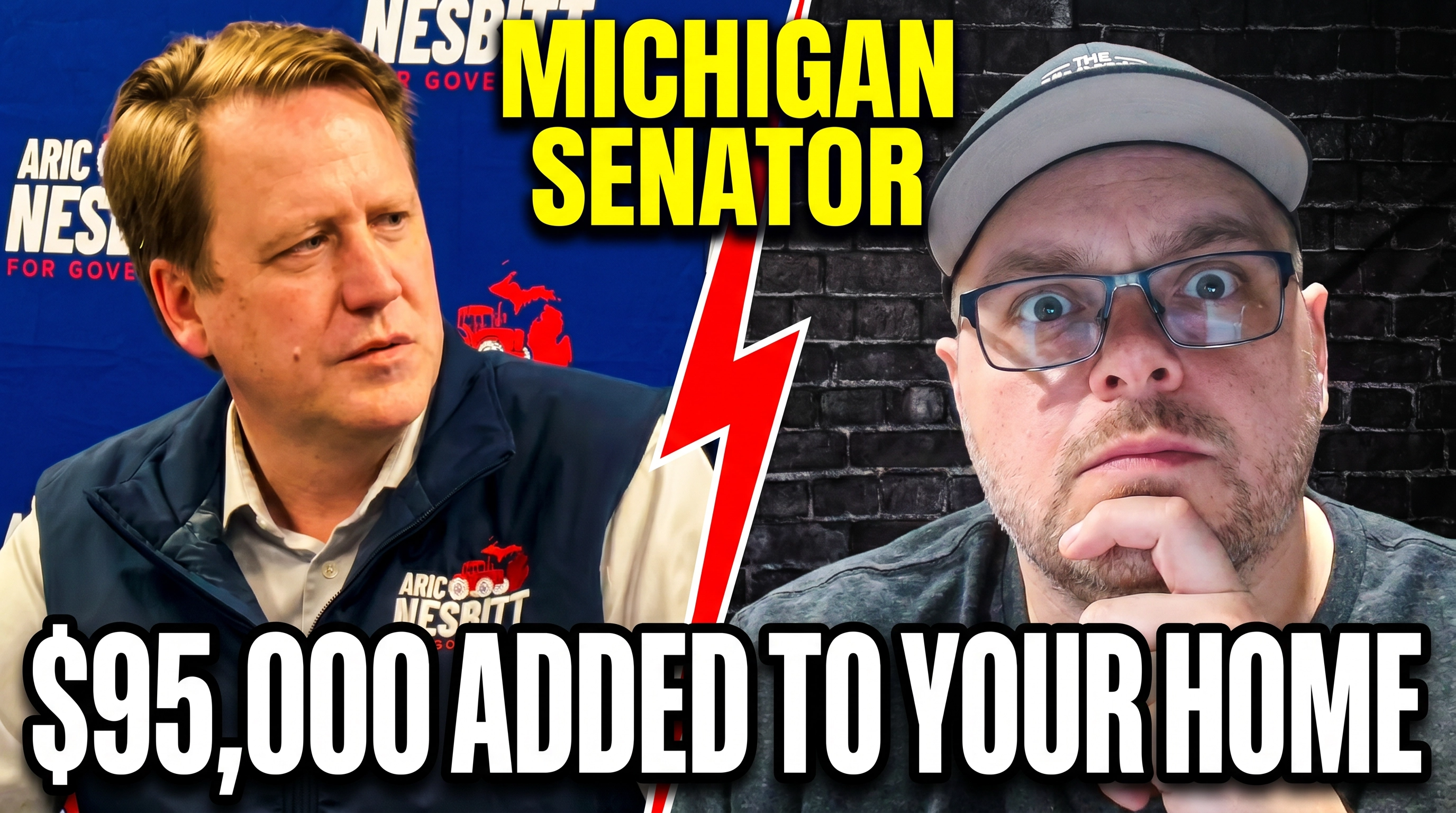
 Aric Nesbitt Says Michigan Is Broken — But This Is Not An Endorsement
Michigan voters do not need another politician smiling into a camera and telling them everything is fine.
They already know it is not.
They know it when the property tax bill shows up. They know it when the car insurance payment feels like a second mortgage. They know it when groceries, utilities, housing, and basic life in Michigan keep getting harder to afford while Lansing keeps producing excuses.
That is why this interview mattered.
State Senator Aric Nesbitt, who is running for governor of Michigan, came on The Middle Ground Mic to make his case directly to voters. He did not open with vague political fluff. He came in swinging at Lansing, Democrats, cost of living, education, energy, illegal immigration, car insurance, and what he believes is a state government that has lost touch with working families. Whether you agree with him or not, this was not a quiet interview. It was a campaign argument aimed straight at frustrated Michigan voters.
“I’m running for governor so that everybody can make it in Michigan again.”
Before we go further, this needs to be said clearly: this interview and article are not an endorsement of Aric Nesbitt, his campaign, or any political candidate. The Middle Ground Mic does not exist to tell people who to vote for. It exists to put the people asking for power in front of voters and let them explain what they believe, what they would change, and why they think they deserve the job.
An interview is not a campaign ad. It is not a coronation. It is not a rubber stamp. It is a chance for voters to hear the argument, weigh the answers, compare the candidates, and decide for themselves.
That matters because too much political media already tells people what to think before they even hear the full conversation. One side tries to destroy a candidate before they speak. The other side tries to protect them from hard questions. That is not what this platform is about. If someone wants to lead Michigan, they should sit down, answer questions, make their case, and let the public judge whether those answers hold up.
“You should listen, compare, research, challenge the answers, and decide for yourself.”
Before we get into the full breakdown, this episode is brought to you in part by Brio Beardscape V1+.
I use this trimmer because it solved one of the most annoying grooming problems I had: that hard-to-hit jawline spot that cheap trimmers always seem to miss. The ceramic blade is built for long-term use, the guards do not feel like they are going to snap in your hand, the motor is quiet, and the whole thing feels like mechanical certainty instead of planned obsolescence.
Use code MIDDLEGROUND for 10% off, support the show, and upgrade the trimmer you probably should have replaced a long time ago.
Watch the full interview here:
https://www.youtube.com/@TheMiddleGroundMic
Nesbitt’s central argument was simple: Michigan has become too expensive for too many families, and Lansing is a major reason why. He pointed to property taxes, energy costs, insurance, housing costs, and bureaucracy as proof that the state is punishing the very people it claims to help. His message was not subtle. He believes Michigan is falling behind because government is making life harder, not easier.
He also tied his campaign message to a personal story from COVID. Nesbitt talked about driving his wife to an OB appointment and not being allowed inside because of pandemic restrictions. During that appointment, he said his wife texted him that they had lost their second child to miscarriage. That moment clearly shaped the way he talks about government power, family rights, and the line between public policy and personal life.
“I couldn’t be sitting next to her.”
“What happened then should never happen again.”
That was one of the heavier moments of the interview because it moved the conversation beyond talking points. Nesbitt used that story to explain why he believes families should come before government. Agree or disagree with his policy conclusions, that part of the interview explained the emotional engine behind his campaign. He is not just arguing that Lansing made mistakes. He is arguing that Lansing crossed lines that should never be crossed again.
From there, the conversation turned to education, and this is where Nesbitt sharpened his criticism. He argued that Michigan’s schools are failing too many kids on the basics. He talked about reading scores, fourth-grade literacy, and the long-term consequences when students fall behind early. His argument was that Michigan is spending enough money to do better, but the system has lost focus.
“Instead of teaching the 26 letters of the alphabet, we’re seeing these schools teaching 26 pronouns.”
That line is exactly the kind of quote that will divide people. Some will hear it and say he is naming the problem. Others will hear it and say he is oversimplifying a complicated education debate. But either way, it shows what kind of campaign Nesbitt is running. He is not trying to sound neutral. He is trying to frame education as a fight over priorities: basics versus ideology, parents versus bureaucracy, literacy versus politics.
He also talked about skilled trades and argued that Michigan has lied to too many students by treating college as the only respectable path. Nesbitt used his brother’s story as an example, saying not every kid is meant to sit in a traditional classroom chasing a degree. Some students need diesel mechanics, welding, construction, plumbing, electrical work, agriculture, cosmetology, photography, or another hands-on path that leads to a real job without crushing debt.
“The last 25 years, we’ve told a half a generation a lie where the trades weren’t an option. College was the only option.”
That part of the interview deserves attention because it hits something bigger than party politics. Michigan cannot rebuild anything if it does not have people who can actually build. Roads, homes, factories, energy systems, farms, small businesses, and infrastructure all depend on skilled workers. Nesbitt’s argument is that if Michigan wants a stronger future, it has to stop acting like every student needs the same path.
Cost of living may have been the biggest theme of the entire conversation. Nesbitt repeatedly came back to one specific promise: eliminating the state property tax. He argued that property taxes are one of the biggest reasons families feel like they can never get ahead. He also argued that renters feel the impact too, because property costs eventually get passed through the system.
“The one thing I’m going to pledge to folks that I’m going to do, I’m going to repeal the state property tax.”
He connected that to housing affordability and said government red tape is making new homes dramatically more expensive. Nesbitt claimed that federal, state, and local mandates can add tens of thousands of dollars to the cost of a new home. His argument was blunt: politicians talk about affordable housing while their own rules make housing more expensive.
“You can’t rent the American dream. You should be able to own the American dream.”
That might be one of the strongest lines from the whole interview because it translates policy into something people actually feel. Housing is not just numbers on a spreadsheet. It is whether young families can buy their first home. It is whether seniors can stay in the home they already paid for. It is whether renters ever get a chance to build equity instead of just surviving another lease renewal.
Then came Michigan’s favorite nightmare: car insurance.
Nesbitt said the current system is broken and argued Michigan should repeal no-fault and copy a model closer to Ohio or Wisconsin. He blamed special interests, trial lawyers, and parts of the health care system for profiting while families pay more. He also said he has talked to people near the Wisconsin border who register vehicles there because Michigan rates are so high.
“A lot of people lie about their addresses and register their cars in Wisconsin because the rates are so much cheaper.”
That is the kind of quote that lands because people in Michigan already know the pain. They do not need a policy paper to understand it. They see the bill. They call the insurance company. They get told there is nothing that can be done. Then they hear about someone one state over paying dramatically less for the same basic need.
Nesbitt’s broader economic argument was that Michigan is losing opportunity because businesses and families are exhausted by the state’s costs and rules. He talked about a restaurant owner in Adrian who said she survived COVID but could not survive the mandates, taxes, labor rules, and property taxes that followed. He also brought up manufacturers fighting permitting delays and businesses that could be courted by other states.
“I can’t make it in Michigan anymore.”
That line, from his story about the restaurant owner, is the kind of sentence that should bother every elected official in the state. Not because it automatically proves Nesbitt’s entire argument, but because it reflects a real fear. If small businesses believe Michigan is becoming a place where they cannot survive, that is a warning sign no party should ignore.
Public safety brought the interview into even heavier territory. Nesbitt said law enforcement has been kicked around, disrespected, and weakened by bad leadership and bad policy. He criticized cashless bond ideas for violent felons and argued that police, prosecutors, and sheriffs need support from the governor’s office.
But one of the most important parts of the public safety discussion was mental health. Nesbitt said too many county jails have effectively become the largest mental health institutions in their communities. That is a brutal statement because it points to a failure that cuts across politics. If people who need long-term mental health care are cycling through jails instead of getting treatment, the system is not working.
“The largest mental health institution in each of these counties is the county jail. That needs to end.”
That line should not be treated like a throwaway moment. It is one of the areas where Michigan could use a serious conversation instead of a screaming match. Public safety is not only about punishment. Mental health is not only about compassion. The real challenge is building a system that knows the difference between someone who needs treatment, someone who needs accountability, and someone who is a danger to everyone around them.
Nesbitt was also clear that he believes some people simply need to be removed from society when they commit evil acts. He rejected the idea that crime can always be explained away by systems or circumstances. That part of the interview was blunt, and again, people will react differently depending on their worldview. But it revealed how he thinks about justice: support police, prosecute serious crime, rebuild mental health capacity, and stop pretending every offender is just misunderstood.
“There’s real evil in this world.”
On governing, I asked whether he would work with Democrats if they had a good idea. Nesbitt said yes, but he framed cooperation around specific outcomes: lowering costs, repealing the state property tax, reducing energy costs, reforming insurance, cutting bureaucracy, improving education, and giving parents more control.
“I’m going to work with anybody that wants to truly lower costs for working families.”
That answer matters because voters are tired of fake bipartisanship. They are tired of politicians saying they will “reach across the aisle” and then spending the next four years performing for their base. Nesbitt’s version of bipartisanship was conditional. He is not promising unity for unity’s sake. He is saying he will work with people if they move toward his definition of relief for Michigan families.
The interview also touched on national politics, political violence, media hypocrisy, and the role of new media. Nesbitt argued that podcasts and independent media need to expose stories that mainstream outlets ignore. That part stood out because it connects directly to why platforms like this exist. The point is not to replace journalism with cheerleading. The point is to create spaces where candidates, officials, activists, and citizens can be questioned directly without the whole conversation being filtered through party machines.
“This is the kind of exposure that the new media like what you’re doing and podcasts and others need to continue to uncover and bring to light.”
Toward the end, the conversation got lighter. Nesbitt talked about underrated places in Michigan, the Upper Peninsula, Houghton, Calumet, and of course, the Detroit Lions. But his final answer brought the interview back to his main message. When asked how Michigan can lead again, his answer was direct.
“They eliminate the state property tax.”
That is the line he wants voters to remember. Not a 15-point plan. Not a paragraph of consultant language. One sentence. Whether voters believe that promise, question the math, support the idea, or reject it completely, that is clearly the centerpiece of his campaign pitch.
The closing moment of the interview turned patriotic. Nesbitt talked about America approaching 250 years, the Constitution, private property rights, free markets, families, faith, and the story of an immigrant business owner who told him he was proud to be an American. Nesbitt used that story to argue that people from different backgrounds still want the same basic things: schools that work, roads they can drive on, safe communities, the ability to raise their families, and a government that stays in the background.
“Most people just want government in the background.”
That may be the simplest summary of Nesbitt’s worldview. He believes Michigan can come back if government gets smaller, families get stronger, schools return to basics, police are supported, taxes are lowered, businesses are freed up, and people are trusted again to build their own lives.
Again, this article is not an endorsement.
It is a voter briefing.
The point is not to tell you what to think about Aric Nesbitt. The point is to give you enough of the conversation to decide whether you want to hear more, challenge more, compare more, and think more seriously about who is asking to lead Michigan.
Some people will watch this interview and agree with a lot of what he said. Some will strongly disagree. Some will like his answers on taxes and hate his answers on education. Some will appreciate his focus on cost of living but want more detail on how the numbers work. That is exactly why these conversations matter.
Michigan’s future should not be decided by party labels alone. It should not be decided by thirty-second campaign ads. It should not be decided by outrage clips, mailers, or slogans written by consultants.
It should be decided by voters who actually know what candidates are saying.
Watch the full interview. Challenge the answers. Compare the candidates. Decide for yourself.