
Zhanna Avagyan: Hello, Tigran. The Davos Economic Forum recently took place, and within its framework the charter of a “Board of peace” initiated by Donald Trump was signed. Armenia and Azerbaijan have also joined this initiative. First, let’s try to explain to our viewers what kind of initiative this Board of peace is, what it envisages, and what one can realistically expect from it. Then we can also talk about what Armenia’s and Azerbaijan’s participation or involvement actually brings.
Initially, this board was conceived as a mechanism for resolving the Gaza conflict. After military operations in Gaza were halted with the active involvement of the United States, the idea was that in a second phase this Board of peace would be established. It would include various individuals and states, and would be responsible for managing all processes taking place in Gaza during the transitional period, as well as participating in attracting investment and in the reconstruction and recovery of the territory.
However, what was signed in Davos is a much larger and broader organization than originally envisioned. According to reports in the American press, the charter of this organization does not even contain any reference to Gaza. In other words, the idea originated from Gaza, but the outcome is the creation—at the initiative of the U.S. president—of a new international organization that ostensibly aims to deal with the resolution of various conflicts, not just Gaza.
Of course, the logic behind the creation of this organization and the logic of membership are very much aligned with President Trump’s worldview and even his broader foreign policy approach. We know that there are permanent and non-permanent members. Non-permanent members join for three years and are not required to pay any membership fee. But states that wish to become permanent members must contribute one billion dollars to the organization—money that is supposedly meant to be used, for example, for reconstruction efforts in places like Gaza.
It resembles a business model—like services that initially offer free trial, and later you can choose whether or not to subscribe. In that sense, it is also highly symbolic of the logic of contemporary international relations. Many in the West believe this is a direct challenge to the United Nations. President Trump has repeatedly criticized the UN explicitly, saying it has become an ineffective organization and that more effective mechanisms are needed. At this stage, he says the two structures can cooperate, but it is obvious that this is yet another step aimed at undermining—or at least challenging—the rules-based international order.
Even if we look at the internal procedures, there is no election mechanism at all. President Trump has simply declared himself the head of this organization. It is stated that he can leave this position only by his own voluntary decision or due to health reasons. This is clearly an anachronism—something that resembles organizations from the 19th century rather than the post–World War II system, where internationalism at least formally assumes equality among members, voting rights, and participation (with the exception, of course, of the UN Security Council).
That said, the long-term viability of this organization is also questionable.
And ultimately, does Armenia’s presence at this forum—and involvement in this initiative more broadly—give us anything, or is it more of a symbolic move?
I think Armenia’s membership in this organization can be compared to Armenia’s membership in the CSTO prior to the 2020 war and before the 2022 escalation. It was clear to everyone that this organization, as such, did not carry out any serious functions. In the CSTO’s case, it was obvious that the principle of collective defense was unlikely to work, since the organization never intended to engage militarily on behalf of post-Soviet states in conflicts.
Nevertheless, by joining the CSTO, before 2020, Armenia used it as another platform to manage relations with Russia, to develop those relations, and to gain certain dividends—for example, access to weapons at lower prices. I think we are dealing with a similar process here. It is clear that Armenia is unlikely to gain any tangible, practical benefit from this specific membership. But it uses this membership to maintain, build, and develop relations with the current U.S. administration.
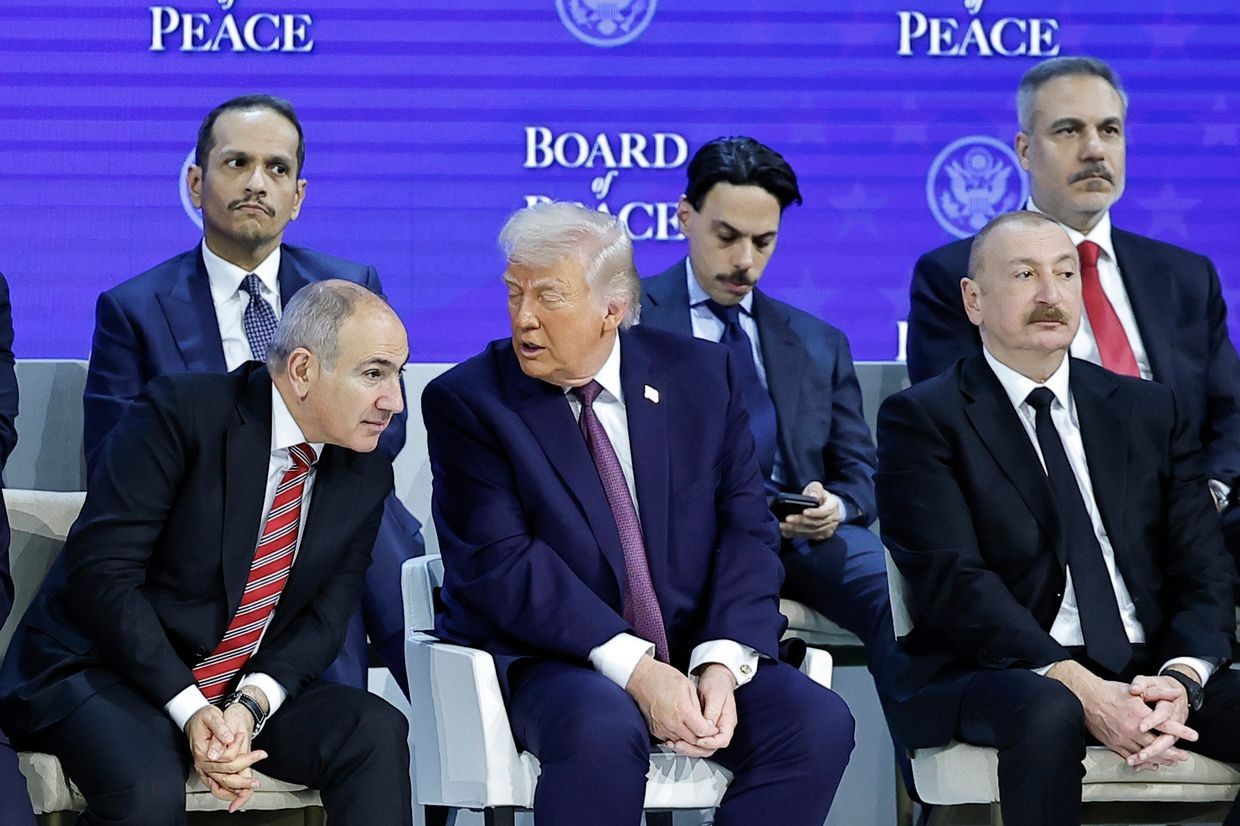
We see with what enthusiasm pro-government media circulate photos of Nikol Pashinyan sitting with Donald Trump, looking at each other, discussing something. This also has a PR component domestically. Perhaps these contacts could later prove useful in resolving certain concrete issues. We remember that at one point it was claimed that Nikol Pashinyan had Donald Trump’s WhatsApp number—this organization should be viewed in roughly that same logic.
Returning to the earlier point, I believe the sustainability of this organization is highly questionable. I am almost certain that if there is a change of administration in the United States—if a Democratic administration comes to power—this organization will simply cease to exist.
Even now, if we look at who has joined, it is mostly states whose leaders have very good personal relations with the current U.S. president—such as Turkey’s leader or Hungary’s leader—or states that, according to Donald Trump’s statements, he has helped by stopping conflicts. Armenia, Azerbaijan, Pakistan fall into this category. Qatar has also joined, and Qatar can likewise be classified as a country with strong personal ties to Trump. We remember that at the beginning of last year, Qatar offered a very significant investment package to the U.S. president—the story about the expensive aircraft they promised as a gift.
So overall, participation is based largely on personal, interpersonal ties and on countries that are important for Trump’s PR. Major powers, on the other hand, appear to have refrained. All the key Western European players are absent.
Russia was also invited.
Yes, Russia is a more interesting case. On the one hand, the Russians did not outright reject the offer, but they gave a very diplomatic response. They said they were ready to pay the one billion dollars from Russia’s frozen assets—essentially rejecting the offer in practice.
For Russia, I don’t think being part of this group of countries is particularly important. They see themselves as one of the great powers—one of the three major powers alongside the United States and China—with equal authority and status. They envision dialogue with the U.S. in formats that reflect that status: bilateral formats, presidential-level engagement. Recently, we have indeed seen such formats emerge. Right after Davos, an American delegation traveled to Moscow to negotiate the end of the war in Ukraine.
In short, Russia neither rejected nor accepted the initiative, but in practice did not participate. Belarus, for example, was also invited—a country under heavy sanctions, largely isolated from international relations since the start of the war in Ukraine, which now, thanks to this initiative, gets another opportunity to reinsert itself into international processes.
But the most important point is that the key Western actors have not accepted the invitation and are not participating. This seriously calls into question the effectiveness of the initiative. If we are talking, frankly, about creating a new global organization composed mainly of secondary states that is supposed to solve global problems, it does not leave a particularly serious impression at this stage. It looks much more like an initiative designed primarily for President Trump’s PR.
In the second part of our conversation, I’d like to turn to the annual report of the Foreign Intelligence Service, which was published recently. There were several points and sections, but let’s focus on the main ones. Regarding the possibility of escalation and war in Armenia–Azerbaijan relations, the report states that as a result of the agreement reached on August 8, a military escalation in 2026 has become almost unlikely, and the probability of institutionalizing peace has increased.
At the same time, another formulation expresses concern that discussions in Azerbaijan about “Western Azerbaijan” and the return of “Western Azerbaijanis” are continuing. The number of related media publications has increased, and there is also concern about rising military spending and increased arms procurement—which is, of course, logical.
But if we compare this to previous statements by our authorities, this report seems different. We have often discussed how Nikol Pashinyan, his team, and pro–Civil Contract media have tried to soften Aliyev’s statements and present them in a more positive light. Here, by contrast, the formulations are clearer.
Yes. It is important that these risks are being written about, because after August 8, especially, official propaganda at times even attacked people who spoke about the continued “Western Azerbaijan” discourse. Let me also remind you that at one point fake news spread claiming that this organization had been dissolved; that was later denied by the organization itself.
Overall, I agree with both assessments. I agree that at least in the short term, the likelihood of military escalation has significantly decreased—one could say very significantly. But at the same time, Azerbaijan continues to take these actions, which means it has multiple scenarios in mind.
Unlike Armenia, which seems to be preparing only for the most optimistic, best-case scenario. Azerbaijan understands that treaties and signed documents alone are not sufficient to secure its interests. In Armenia, everyone is placing their hopes on the idea that a peace agreement will soon be signed, delimitation will be carried out, and this will serve as a guarantee. But Azerbaijan, while participating in these processes, is simultaneously increasing its military budget—while Armenia has reduced its latest military budget.
It maintains aggressive rhetoric and narratives for alternative scenarios. In this sense, I think it is welcome that a state agency is offering a more sober assessment and openly writing about these risks. This is quite an exceptional phenomenon in Armenia’s recent reality, because state bodies usually echo the rhetoric of the political leadership. In that respect, this section—and several others—are quite well done. Overall, I think a substantial amount of work went into this report.
Another part I’d like us to discuss concerns hybrid threats. The report notes that in 2025 Armenia faced such threats and saw various manifestations of their materialization. It also predicts that in 2026—due to elections and various international events to be held in Armenia—these threats will become broader, more complex, and larger in scale. Several areas and formulations are identified where problems have been observed…
We devoted an entire episode to the topic of hybrid threats and analyzed in detail which dangers are real and which are being invented to justify or block certain processes. The issue here is not that hybrid threats are mentioned—although one could argue that such threats should fall primarily within the domain of counterintelligence bodies, and that the NSS should be dealing with them, despite serious problems with its competence.
The more problematic aspect is that in this section of the report, there is a direct intervention into domestic political processes. If we read it carefully, the formulations clearly indicate which political forces and groups are being referred to. Terms like “agent networks” are used, and it is stated that there is an agent network in Armenia that will be activated.
If there is an agent network in Armenia, the state should be actively working to neutralize it, not writing reports about it. Or if there are problems with certain political forces—say, illegal financing—there are mechanisms in Armenia to address that. Relevant bodies should deal with it, not the Foreign Intelligence Service.
I should also remind you that this problem existed in the first report published by this body as well—we see a trend toward the securitization of domestic political processes. Again, if there is concrete information about an agent network, law enforcement should act on it, not just publish reports.
Sorry to interrupt, but if the issue concerns elections or domestic political developments, and threats directed at internal processes, is it logical to include this here and treat it as an external security threat?
From the perspective of hybrid threats or hybrid warfare, yes, it can be viewed as an external threat. But again, sobriety is key. We need to focus on real dangers. We know, for example, that coordinated disinformation campaigns exist—this is mentioned in the report, and even the mechanisms are described using diagrams. That is a legitimate discussion. We can talk about how to counter disinformation. There is also the threat of cyberattacks—there are specialists who deal with this, and attention should be focused there.
But to characterize domestic political actors as an “agent network” in such a detailed way that everyone understands who is being referred to, while at the same time taking no concrete action—this is paradoxical. If there is an agent network, it must be neutralized. In this particular case, as I said, although the report as a whole can be considered successful—especially given its format, since obviously many things could not be published openly—even if they exist, this section felt more like domestic political propaganda. It gives the impression that it was written not from the perspective of the Armenian state, but from that of the ruling party.
Thank you, Tigran.
Thank you as well.