

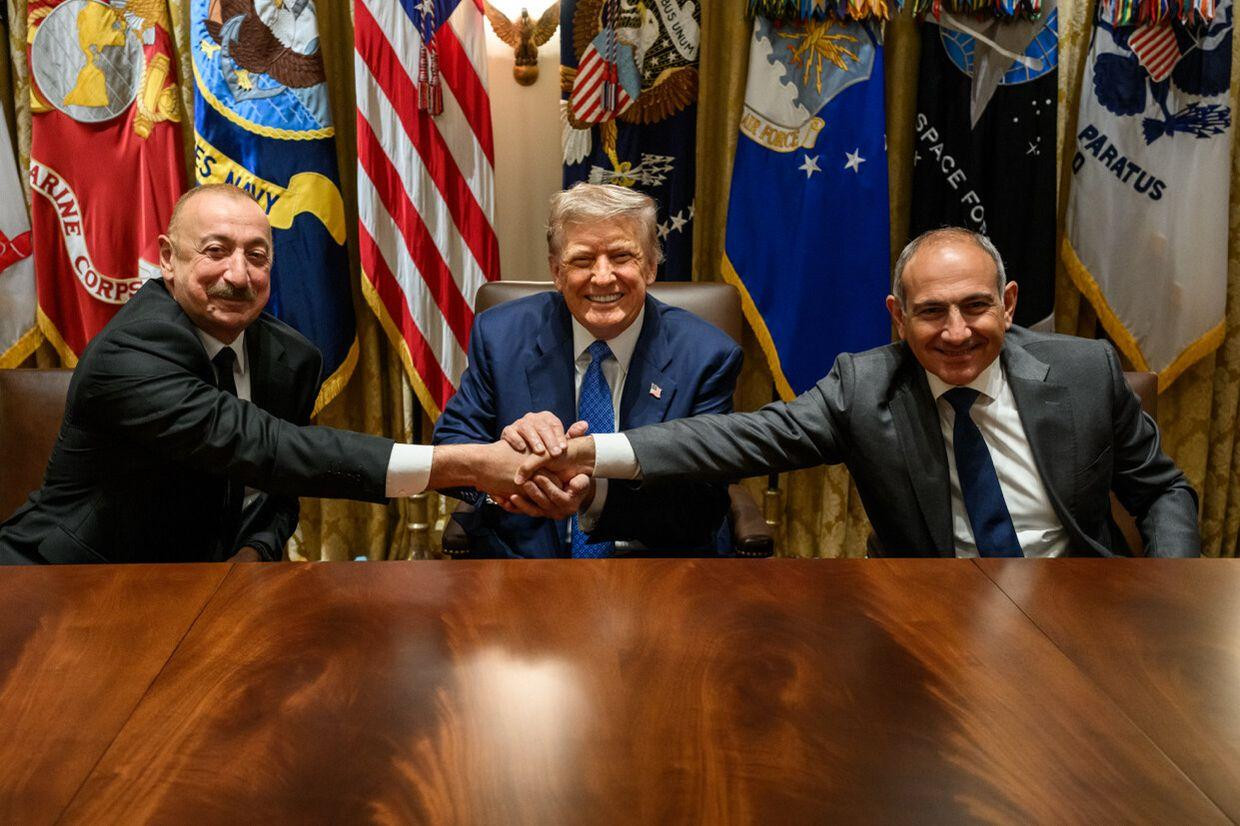
On August 8, U.S. President Donald Trump sealed the handshake between Armenian Prime Minister Nikol Pashinyan and Azerbaijani President Ilham Aliyev, promising that they would be friends for a long time. At the historic meeting in the White House, a joint declaration was signed and the text of a peace agreement between Armenia and Azerbaijan was initialed. What issues were left outside the publicized agreements, what will the signing of the peace agreement depend on, and how will Russia and Iran react to the “Trump Route” in the South Caucasus — RFI’s Russian Service discussed these questions with the Director of the Regional Center for Democracy and Security, Tigran Grigoryan.
RFI: On Monday, August 11, the text of the peace agreement was published. Before that, there was a meeting between the leaders of Armenia and Azerbaijan with the U.S. President in Washington and the signing of the declaration. What important issues for Armenia were left outside these documents?
Tigran Grigoryan: The text of the peace agreement itself is rather basic — all the important issues were left out. Even if we take the example of the process of unblocking regional communications — at some point the sides realized that they could not agree on the principles of unblocking and decided not to include them in the text.
But the most important issue is that of the Karabakh refugees. Everyone is talking about peace, but more than 100,000 people were forcibly displaced from their homes, and this issue is not being discussed anywhere. It was like this from the start: even when people still lived in Karabakh, Armenia insisted on including provisions on the rights and security of Karabakh Armenians in the peace treaty, but Azerbaijan refused. At some stage, there were talks that this issue would not be included in the treaty but that a separate negotiation format should be created between Baku and Stepanakert. However, after the ethnic cleansing of 2023, the issue disappeared from the peace talks’ agenda, and Armenia completely abandoned it.
The second point is that more than 20 Armenian prisoners of war and political detainees are still being held in Baku. This issue is discussed verbally between the sides, but it is not included in any document. Meanwhile, both the peace treaty text and the Washington declaration contain provisions on closing the page of hostility and having no mutual claims. Considering that Armenian POWs and political prisoners remain in Baku, this is paradoxical.
As for the provisions included in the agreement — these are mainly basic principles of international law. For Armenia, the point about countering separatism and extremism looks dangerous. I think Baku will use it to influence Armenia’s domestic politics. From Baku’s point of view, much in Armenia can be considered extremism and separatism — for example, any discussion of the First Karabakh War. Theoretically, the same questions could be raised toward Azerbaijan, but the power imbalance will prevent Armenia from doing so on equal terms.
But we are still far from signing the peace treaty because of the condition of changing Armenia’s Constitution. This could happen, at best, after the parliamentary elections in 2026, and even then, it is unclear how the public will vote. The referendum conditions are quite strict: there is a minimum turnout threshold and a minimum number of “yes” votes required. There is no guarantee that Pashinyan’s government, even if re-elected, will be able to deliver that result.
As one of the important outcomes of the Washington meeting, the agreement on opening the “Trump Route” is being presented. Does this already look like a realistic plan?
The Armenian Prime Minister himself admits that there are no agreements on details yet. There are only agreements on principles. For example, on the unblocking process, it is stated that it should be carried out based on the principles of sovereignty, territorial integrity, and jurisdiction. These have been Armenia’s key principles in recent years. But there is also the principle of reciprocity, mentioned in very diplomatic language: the three other principles are stated outright, while reciprocity is phrased as “mutual benefits,” leaving room for interpretation.
Regarding the declaration’s text, there is a phrase about “unimpeded communication.” This formulation is problematic for Armenia because it comes from the November 9, 2020 ceasefire statement. For the past five years, the sides have interpreted it differently: does “unimpeded communication” mean Azerbaijani cargo should be checked on the Armenian side? Should there be border and customs control? Now the Armenian authorities assure that all of this will take place. There could be technical solutions — for example, outsourcing to an American company or a consortium. There is also the question of ensuring the security of this communication — the Prime Minister has hinted that this could also be done through outsourcing.
But here again, the problem of reciprocity arises: the Armenian government has stated that the regulations in force in Armenia should also apply in Azerbaijan. For example, if Armenian cargo is transported through Azerbaijan, the same rules should apply. I almost completely rule out the possibility that Azerbaijan will agree to outsource authority to third parties. And if this happens only on Armenian territory, it will be yet another concession — and, one might say, a lowering of the degree of sovereignty.
To return to your question, the main problem now is that there are no details — only principles. Each side interprets them in its own way. The Armenian government is trying to present this as a major victory, but without knowing the details of the implementation process, it is hard to say whether it is a victory or a defeat.
How do you assess the U.S. role in this process? Was the signing of the joint declaration in the White House important from a symbolic standpoint, or did the U.S. administration actually help achieve certain agreements?
Both. Starting around March, Trump’s special representative, Steve Witkoff, and his team began working on this issue; they visited the region several times and met with the parties. The outsourcing of communication development was their idea — they proposed this option to Armenia. I should note that the idea of outsourcing is not new — it was discussed during the Biden administration as well. Europeans also proposed something similar. What’s new here is that it would be an American company that would commercially own the rights to this railway, develop it, and profit from it. This fits perfectly into Trump’s transactional foreign policy, where economic benefit is sought everywhere.
At the same time, the PR aspect is also important. The media buzz that Armenia and Azerbaijan signed something historic is greatly exaggerated. In essence, what happened was the initialing of a peace treaty, which could have taken place a few weeks earlier in Abu Dhabi — it was actively discussed there, but the sides could not agree on the details.
The declaration matters in that when Aliyev and Pashinyan (especially Aliyev) sign a document in the White House saying there should be no escalations or wars and that they are committed to peace, this helps stabilize the situation. After that, it will be more difficult for Azerbaijan to escalate.
However, in terms of substance, there has not yet been a serious breakthrough. Much will depend on Turkey’s reaction, as it has always linked normalization with Armenia to the Armenia–Azerbaijan track. In recent years, their condition has been the signing of a peace treaty with Azerbaijan and the opening of communications. But a few weeks ago, the Turkish ambassador to Azerbaijan hinted that initialing could be the first step toward progress in the Armenia–Turkey track. For example, in summer 2022, Armenia and Turkey agreed to open the border for third-country nationals and holders of diplomatic passports. Even this small agreement has not yet been implemented. If there is progress even on such technical issues, it can also be considered an outcome of the Washington meeting.
If we assume that a peace treaty is the result of mutual compromises, what concessions from Baku would you highlight?
Originally, this was an Azerbaijani draft. Azerbaijan sent it to Armenia several years ago, and the negotiations were based on that text.
From Azerbaijan’s side: for a long time, they avoided explicitly recognizing Armenia’s territorial integrity, saying, for example, that delimitation should be based on various historical maps. But the clear inclusion of the Alma-Ata Declaration as the principle of recognizing territorial integrity can be considered a very small concession — although it is paradoxical that we even consider this a concession.
From Armenia’s side, there have been many concessions in the latest stage of negotiations, after Trump’s election. There were two points on which the sides could not agree for a long time. The first was the withdrawal of third-party forces from the border — in practice, this meant the EU monitoring mission. Azerbaijan effectively forced Armenia to drop this provision. The second was on legal claims: Armenia did not want to give this up, since in recent years Azerbaijan has committed many war crimes, and this was seen as a tool for balancing against Azerbaijan. Under the new circumstances, Armenia accepted Azerbaijan’s position. When they finalized the peace treaty text in March, these two points were agreed upon.
The rest were very basic principles, and it is difficult to say which side made concessions.
For Baku, the condition for signing the treaty will be holding a referendum in Armenia. Parliamentary elections must be held before the referendum… What could the situation look like after that?
It will depend on the election results — not so much on who wins, but, for example, by what margin Pashinyan wins. If there is only a shaky majority in parliament, all these issues will become much more sensitive.
The government is trying to present this process as purely domestic — that they had always planned to amend the Constitution — and points to examples from past years, though the issues were different then. But in general, there is a public perception in Armenia that this is being imposed by Azerbaijan. The government may put society before such a choice: this is the price for peace; if you want peace, you must make this concession, perhaps even with an element of humiliation. But it is difficult to say how realistic this is.
Overall, society is now in an apathetic state: according to polls, more than 60% of the population is apolitical and does not trust any political figures. It will be difficult for Pashinyan to explain this referendum both to the wider public.
For Azerbaijan, the situation looks like a win–win. Azerbaijani officials and experts say it is important for Armenian society to vote for peace. If this happens, there are no negative consequences for them. If not, they will begin to promote the narrative that the neighboring society is not ready for peace, and therefore perhaps harsher measures are needed or there is no point in moving toward comprehensive peace with open borders, trade, etc.
You mentioned Turkey, but the positions of Russia and Iran are also important. Do they still have leverage, and how might they try to influence the process?
It has been interesting to observe Russia’s and Iran’s reactions. Russia has so far responded rather cautiously, hinting: you can negotiate on communications, but don’t forget that you are still members of the Eurasian Economic Union and that Armenia’s railways belong to Russia. These are passive-aggressive arguments — there have been no direct threats or objections. I think even Zakharova welcomed the Washington meeting if it contributes to peace.
But if this plan comes to life and an American company controls communications, for Russia this would be a major geopolitical defeat. After the withdrawal of peacekeepers from Nagorno-Karabakh, this issue was seen as their main lever over Armenia and Azerbaijan. For the past five years, they have been pursuing this, and there are trilateral agreements on the matter. Therefore, I think that if it comes to the practical implementation of these agreements, Russia will try to obstruct it. Russia has serious levers over both Armenia and Azerbaijan. Economically and in terms of energy, Armenia is still very dependent on Russia, and, paradoxically, amid the military–political crisis in relations, this dependence has only grown as a result of the Russia–Ukraine war.
Iran’s reaction was also interesting. It seems there is no internal consensus on how to respond. The Supreme Leader’s adviser, Velayati, made a harsh statement that if private military companies appear, this will become their graveyard. Later, Iranian President Pezeshkian and Foreign Minister Araghchi took a more balanced position, saying that the red lines had been respected. There were telephone conversations between the foreign ministers and leaders of state. Armenia’s deputy foreign minister recently traveled to Tehran to explain the details (or lack thereof) of these agreements. So far, Iran’s reaction has been generally restrained, but it would be wrong to say they have no concerns. I think they, like us, are waiting for the practical details — which are still absent.
So managing relations with Russia and Iran becomes primarily Armenia’s responsibility?
With Iran — absolutely. As we mentioned regarding leverage, Iran is currently Armenia’s second open border. During the conflict with Israel, there were already serious problems with trade, the economy, and refugees. There were a few days of problems at the border, and Armenia felt it. For Armenia, there is no alternative — whatever happens, it is important to have good relations with Iran.
With Russia, in recent years, it has been crisis management: on some issues there are serious disagreements, on others — for example, on economic matters — there are no problems, and relations are developing. It seems both Moscow and Yerevan have accepted that the relationship is complicated but that risks must be managed.
Right now, there is more pressure from Russia on Azerbaijan. Even before the Washington meeting, their relations were strained — we saw strikes on Azerbaijani facilities in Ukraine. And if you look at Russian propaganda, it seems they are now more focused on Azerbaijan than on Armenia presently.
The interview was published in Russian on rfi.fr