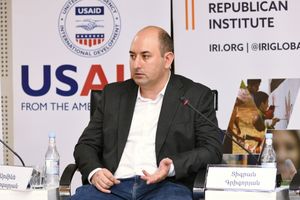


Zhanna Avagyan: Nikol Pashinyan is going to visit Moscow to participate in the May 9 parade, and this gives us another opportunity to revisit Armenia-Russia relations and examine what is happening at this moment. On the one hand, he accepts such an invitation and expresses readiness to attend, but on the other hand, government and pro-government figures are making different statements about Armenian-Russian relations. Let’s try to understand what stage Armenian-Russian relations are really in right now.
Tigran Grigoryan: Yes, as we know, Armenian-Russian relations have been in a deep crisis over the past few years, particularly since 2022, especially when it comes to military-political ties. But at the same time, we see that economic relations are experiencing unprecedented growth. All of this, of course, is linked to the Russia-Ukraine war, which created a security vacuum in our region. Russia stopped fulfilling its obligations—although even before that, it wasn’t doing a great job—and this pushed Armenia to rethink its military-political relationship with Russia and to seek new partners. But on the other hand, it also created economic opportunities, and as a result, Armenia has recorded quite high economic growth figures over the past few years.
However, even within these last three years, these relations have undergone certain shifts. One could even say that Armenia’s authorities have constantly reacted to events as they unfold. For example, we remember that during Russia’s period of setbacks in the Ukraine war—particularly in the Kharkiv region—which coincided with Azerbaijan’s aggression against Armenia in the September escalation, there were statements, including from Nikol Pashinyan himself, referring to analysts who were telling him that this situation was very similar to 1917, meaning the empire was on the verge of collapse and would soon withdraw from the region. It was during that period that the policy known as “diversification” began. In other words, at that stage, Russia’s capabilities were somewhat underestimated. There was this mindset that yes, Russia would lose in Ukraine and would leave the South Caucasus—and Armenia's policy was adjusted accordingly.
Now, due to recent developments—Trump’s election in the United States, Russia’s relative successes on the battlefield in Ukraine (over the past year, most of the advances have been made by the Russian side, with some exceptions)—I think developments in Georgia are also playing a role. Georgia, too, appears to be moving not toward the West, but away from it, with some kind of “anti-Western diversification” underway.
We started noticing this shift as early as the end of last year, when rhetoric toward Russia, at least on an official level—at the level of the foreign ministry and the prime minister—had softened significantly. We remember that Nikol Pashinyan also attended the BRICS summit in Kazan, which I think was an important signal that regional formats were being reconsidered. In that sense, the decision to attend the May 9 parade can also be seen as part of that trend.
Let’s remind our viewers and listeners that last year Nikol Pashinyan did not attend the May 9 celebrations. At the time, it was stated that the reason was COVID—that he had contracted COVID—but it was clear to everyone that this was just a pretext. At that stage, when Armenia was having rather intensive interactions and deepening cooperation with the West, attending such a parade wouldn’t have been seen as a positive step.
Now, Armenia’s authorities seem to see that the United States—as the leading power of the West—has itself re-established direct contact with Moscow. We’ve seen that over the past few months, quite intensive negotiations have been taking place—not just concerning a resolution of the Ukraine war, but also regarding the restoration of bilateral relations. And once again, we’re seeing a reaction to this in Armenia.
In my view, the prevailing thinking in Yerevan is: if the United States is already engaging in direct discussions with Russia and considering how to rebuild ties, then we, too, must talk to the Russians about our own issues. Because there was a time when in certain circles in Yerevan—including official ones—the prevailing notion was that speaking to Russia was entirely pointless. The problems were considered so deep, and Russia such a serious threat to Armenia, that even entering into conversation with them could itself be dangerous or used as a weapon against Armenia.
Now, it seems that this approach has changed. But at the same time, yes, we have this paradoxical situation: on the one hand, Nikol Pashinyan is going to attend the May 9 parade—which is a political act, a political statement. No matter how much the authorities try to explain that "we, too, participated in that victory, we contributed," and so on, it’s clear to everyone that Putin, in recent years—in recent decades, even—has turned the May 9 parade into a distinctly political, geopolitical event. And it's no coincidence that the European Union reacted rather harshly to the possibility of participation by its member states—or even candidate countries.
And in this context, a decision is made to go to Moscow. But on the other hand, from Armenia, we are hearing statements that Russia is conducting a hybrid war against Armenia—statements made by quite high-ranking officials. In other words, we’re probably seeing a policy that is simultaneously for and against—some sort of dual approach.
Zhanna Avagyan: Recently, it was announced that Sergey Kiriyenko, the First Deputy Chief of Staff of Putin’s administration, will be overseeing the coordination of relations with Armenia—suggesting a more serious engagement. What does this announcement signal, and why is it being publicized now?
We ended the previous question on the topic of hybrid warfare. In large part, what’s referred to as "hybrid warfare" revolves around Kiriyenko’s activities. Kiriyenko is quite an interesting figure: in the 1990s and early 2000s, he was among the leaders of Russia’s liberal opposition. But at some point, he was co-opted by the regime and became a key player—especially in the second half of the 2010s—primarily managing Russia’s internal political affairs. That means he essentially controls internal processes—what parties are allowed to exist, what roles or niches they occupy—and in that, he’s been quite successful.
The fact that there is currently no real opposition in Russia—not even meaningful dissent—is, in quotation marks, thanks to Kiriyenko’s “skills.”
In recent times, he (Kiriyenko) has also been dealing with several conflict-prone and problematic regions from Russia’s perspective. For instance, he has been involved in Donbas and continues to be. A few months ago, there was a domestic political crisis in Abkhazia—where, to some extent, there were also anti-Russian sentiments. Kiriyenko got involved in that as well. He’s also been dealing with Moldova. In other words, any country or region where, from their perspective, there are some anti-Russian moods—those are now receiving greater attention.
Here, we should also focus on the fact that ever since independence, relations with Armenia—and more broadly with the post-Soviet space—haven’t been managed by Russia’s Ministry of Foreign Affairs, which, by logic, should be the one handling relations with neighboring countries. Instead, they are handled by various internal institutions—the Presidential Administration, the FSB, and other bodies. This means that for Russia, relations with Armenia are not treated as foreign policy, but to some extent as part of its internal affairs. And yes, I think we will see serious intensification in Russian discourse, narratives, and the activities of various Russian actors.
We’ve seen very clearly how this plays out in Moldova, where, in my opinion, Russia objectively has stronger support than in Armenia. That country is more or less split in two—pro-Russian and pro-Western factions. In Armenia, I believe the situation is more complicated for them, because in recent years—after the 2020 war, the 2022 escalation, and the ethnic cleansing of Artsakh—public opinion regarding Russia has shifted dramatically.
Whereas previously, over 80% of the population viewed Russia as Armenia’s primary ally, now that number is around 30%, and another 40% see Russia as a threat, according to various polls. So, it will be a difficult task for them. But in terms of timing, this may actually be a convenient moment for the Russians, because we are seeing that civil society and media in Armenia could face serious challenges as a result of policies pursued by the United States—namely, due to funding cuts or the elimination of external support from USAID and other foundations. This creates an open space, which may be filled by Russian actors and their influence networks—they may flood the field with various pro-Russian influencers.
Now, when we talk about these hybrid tools—which I think will be a serious factor, especially considering that next year is an election year, less than a year away—then yes, we need to take steps both to contain and understand this phenomenon. The first step is to understand what they want, what narratives they want to promote.
It’s interesting that Vedemsi’s article mentioned that, according to them and according to the Russian presidential administration, Nikol Pashinyan will win the next elections. So, if we believe that article, the issue here is not about coming to power or changing power, but rather about forming a more favorable atmosphere or discourse toward Russia. In that regard, it’s certainly very important to monitor all of this, to understand what they’re doing, what connections exist between the different sources of information.
But the main dilemma here will be that many actors in Armenia could turn the process of countering these Russian actions into a process of supporting the ruling party. That is, they might say that since the opposition is largely pro-Russian and Russia has used the opposition, the only option for civil society and various independent actors to resist all this is to support the current authorities or to become pro-government. I think this could pose a serious danger for civil society — a real trap — because civil society must nevertheless remain nonpartisan.
It should fight against harmful influences — these may be Russian, Azerbaijani, Turkish, or from elsewhere in the East, of various kinds — but it should never use those threats as a justification for taking sides in domestic politics. We must acknowledge that there is a problem, we must acknowledge the need to manage that problem in some way, but it must never become a reason or excuse for civil society to align politically.
Zhanna Avagyan: It’s also interesting to note Ambassador Kopirkin’s interview, in which he made a statement claiming that the West is trying to open a second front in the region under other labels by seeking cooperation with Armenia. What do you think about that statement? And does the Russian side really have such concerns?
The narrative about a second front was very popular in Georgia before the elections. That is, the ruling party and Russia — or rather pro-Russian forces — were advancing the idea that the opposition’s entry into the West’s orbit had the sole goal of opening a second front against Russia in Georgia. And, to a large extent, the ruling party’s main electoral propaganda message was that if you don’t vote for us and these other forces come to power, Georgia will be drawn into this destructive war, becoming a target for Russia again, and will naturally suffer new losses.
So this is already a well-used narrative in neighboring countries, and it’s interesting that now it is being voiced at the ambassadorial level and in the Armenian media space. It’s becoming clear — as we were just discussing — that we now need to understand which narratives will be used in the lead-up to elections. This might be one of them.
The general idea throughout the interview was that deepening Armenia’s relations with the West could endanger its sovereignty and economic well-being. I think the Russians have taken too seriously the recent law adopted in Armenia concerning European integration.
In other words, we are seeing a rather high level of activity around this topic — various officials and experts are coming to Armenia and trying to convince people of the devastating consequences of leaving the Eurasian Economic Union and joining the European Union. But I think it’s clear that such an agenda does not currently exist and is unlikely to emerge in the near future, because Armenia still faces serious issues and has much homework to do. This is likely a theoretical conversation, and, as we’ve discussed before, it’s primarily a domestic political discourse.
Interestingly, Kopirkin calls the foreign policy diversification — which is how one might characterize Armenia’s foreign policy in recent years — a Western ploy. He claims that Russia is not opposed to Armenia developing deeper relations with other countries, but he labels the diversification process as an anti-Russian move. This is concerning because diversification should not be viewed as a threat. It is abnormal to perceive it that way.
By that logic, we’d have to look at other countries’ relations with Russia the same way. Of course, larger and more powerful states can allow themselves more than smaller and weaker ones, but still, if we look at Russia’s approach in the region, it tries to build relations with all countries — sometimes even at the expense of allies. For example, look at Russia’s relations with Azerbaijan and Armenia. Armenia has far more reasons to feel aggrieved than what Russia is currently doing, but nonetheless, it is now evident that we are seeing some activation on this front — previously we hadn’t seen such statements.
As I already mentioned, quite a few experts have recently been coming—those affiliated with the pro-government camp or with the state authorities—and are trying to work within this informational space. But there are serious doubts about how likely they are to succeed. Yes, Russia can, in some cases, successfully use such tools, but in Armenia, recent developments—the loss of Artsakh, and all the problems we have with Azerbaijan—create a serious informational background that will be hard for Russia to overcome.
Zhanna Avagyan: You already mentioned the diversification of Armenia's foreign policy—our authorities have spoken a lot about it. But do you think they will succeed in maintaining such a foreign policy, and will Russia, in this case, agree to being partially involved, or will it continue to spoil relations with Armenia entirely?
I don’t think we’re talking, at this stage, about a complete breakdown in relations. On the contrary, as we already mentioned, the dynamic seems more positive than negative. If in the past such public statements were more visible and confrontational in the public sphere, now it seems that there is more agreement to discuss the issues behind closed doors. We are now seeing that the economic dimension has become more important, and it’s no coincidence that there’s a big emphasis on the Eurasian Economic Union (EAEU). In other words, for the Russians, it’s much more important that Armenia remains a member of the EAEU than, say, the CSTO, where Armenia’s membership has effectively been frozen.
As for diversification, diversification was also a response to ongoing developments. If we ask whether there was a clear strategy behind it—well, it was largely a situational policy. Still, there have already been some achievements. If we talk about the defensel field, for example, we can see that dependence on Russia—at least in terms of arms purchases—has been significantly reduced. Of course, there are still limitations in some areas, but overall the main question is how the Russia–Ukraine war ends. Will the current sanctions regime remain in place? To what extent and for how long?
I think the ideal situation for Armenia is that most of the sanctions continue to exist against Russia. That circumstance, broadly speaking, increases Armenia’s importance for Russia and creates a kind of buffer that makes Moscow avoid taking harsh actions. But one thing is clear: the level of influence that Russia had in our region before February 2022 can no longer be restored.
Zhanna Avagyan: From these statements, we can assume that Russia may still have ambitions or expectations to deepen defense cooperation with Armenia again?
At this stage it’s hard to talk about that because Russia is still at war—it often can’t even meet its own needs. We see its cooperation in that sector with North Korea and, at certain points, with Iran. So right now, Russia doesn’t have much to offer. Besides, there’s also that agreement signed back in 2021 about acquiring arms and ammunition, for which Armenia paid but received either nothing or almost nothing. I think that seriously damaged cooperation in that field. Russia has lost its image as a reliable partner, and I don’t think even if Russia regains such capacity in the future, Armenia will be willing to become so one-sidedly dependent again, as it was before 2022.
In fact, the very fact that Armenia was able to diversify its policy in this area was due to the Russia–Ukraine war. Because if that war hadn’t started, I’m sure that this sector would have continued to develop along the Russian line. If you remember, after the war [in 2020], when there was talk of military reform, cooperation with Russia was the first thing mentioned. At that stage, many high-ranking military delegations were coming in to support that process—but the Russia–Ukraine war put an end to that as well.
Zhanna Avagyan: Thank you, Tigran!
Thank you as well.