
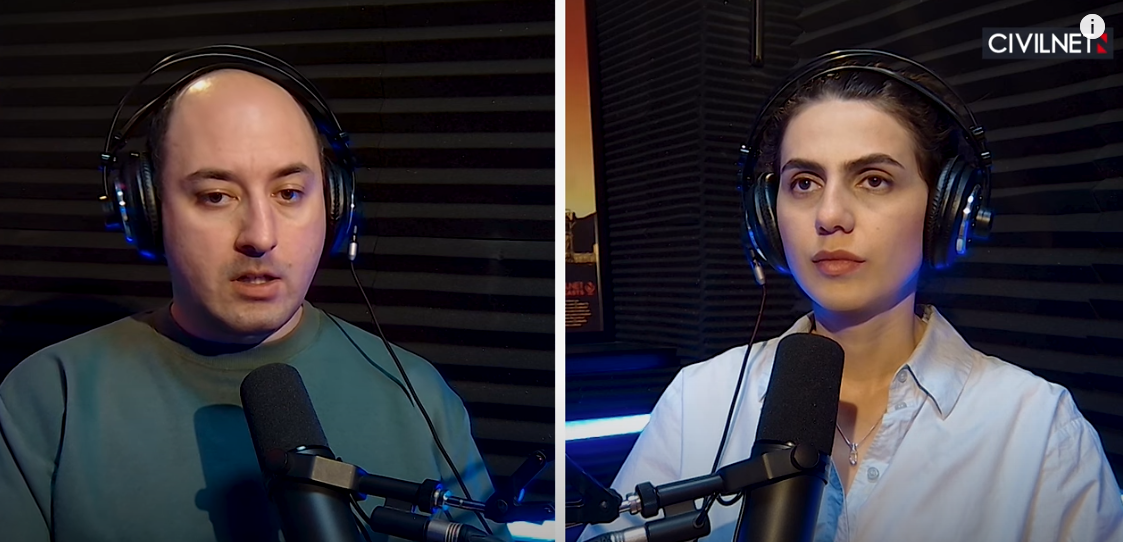
Zhanna Avagyan: Tigran, a few days ago, Armenia’s second president, Robert Kocharyan, held a press conference where he addressed several issues. However, I’d like to focus on one of his statements. In response to a journalist’s question, he suggested that the return of the people of Artsakh is somewhat possible. Although we have discussed this topic many times, I would like to approach it from this angle. Of course, Robert Kocharyan is not the only one making such statements, but what guarantees does he base his reasoning on, if we can put it that way? He mentioned that we should return to the November 9 statement. How realistic do you find this approach?
Yes, Robert Kocharyan stated that the issue of the return of Artsakh Armenians could only be discussed by referring to the November 9 statement. He considered this possibility to be low but still spoke about it as a potential scenario. It is worth noting that in recent weeks, this thesis has been repeated in slightly different formulations by other political figures. Specifically, the leader of the Bright Armenia party, Edmon Marukyan, made similar statements weeks ago, saying that if we return to the November 9 statement, opportunities for the return of Artsakh Armenians would emerge. He even declared that if he were elected Prime Minister, those people would return to Nagorno-Karabakh.
I believe these types of statements are driven by the upcoming pre-election cycle. Parliamentary elections are set to take place in 2026, and different political actors will continue to manipulate the issue of Artsakh and the challenges faced by the people of Artsakh to serve their own agendas. As you know, I recently wrote an article on this topic, where I analyzed the likelihood of these scenarios in detail.
Both Robert Kocharyan and Edmon Marukyan, as well as others who speak about the return, acknowledge that under the current conditions, a return is impossible. If a return under Azerbaijan’s conditions were feasible—meaning under the current circumstances—then at least a few thousand people would have stayed in Artsakh instead of only a few dozen. This implies that additional guarantees must be provided by certain powers, particularly Russia and other international actors. When the November 9 statement is referenced, Russia is primarily meant. However, we must recognize some undeniable facts regarding this thesis.
First, the international community, by and large, was either unable or unwilling to exert pressure on Azerbaijan even when Armenians still lived in Artsakh. We remember how many rulings were made by international courts during the blockade, how many statements were issued urging Azerbaijan to uphold humanitarian rights, yet Azerbaijan did not make any concessions. On the contrary, it only hardened its position. We know how this all ended—with the ethnic cleansing of Artsakh.
Relations between Azerbaijan and Russia also evolved along these lines. Despite being the only external force present on the ground, Russia was unable to alter Azerbaijan’s political course. Since the start of the Russia-Ukraine war, Azerbaijan continually tested and crossed Moscow’s red lines until Baku realized that Moscow had no real red lines left. By the final stages of the blockade, Russia had essentially accepted all of Azerbaijan’s positions regarding the situation.
We have discussed this issue many times, and as we mentioned, it culminated in ethnic cleansing and the withdrawal of Russian peacekeepers from Artsakh. The expectation that the international community—whether Western powers or Russia—will now exert pressure on Azerbaijan, when they did not do so at the height of the blockade when people were still there, is, in my opinion, naive.
Tigran, I have a question regarding your observations. As you mentioned in your article, Azerbaijan has easily “digest” the evacuation of Artsakh and ignores statements, appeals, and reprimands from the international community. Is this happening because the Armenian government has not demonstrated sufficient attention and persistence, or would it have been the same regardless, even if Armenia had continuously raised the issue and kept it on the agenda?
In my article, I pointed out that the Armenian government indeed bears its share of responsibility for the current situation. I am not referring to statements made or not made at this stage. The Armenian authorities, immediately after the ethnic cleansing, helped Azerbaijan “digest” what happened and, to a large extent, legitimized Azerbaijan’s actions. Shortly after the events, Armenia’s Prime Minister declared that there was no threat to civilians on the ground. We remember that this statement was used by the Azerbaijani delegation at the UN Security Council meeting that same day to counter Armenia’s Foreign Minister’s claims on the issue. In my view, the Armenian Prime Minister, due to domestic political considerations, made a statement that strengthened Azerbaijan’s position.
Secondly, during and after these events, Armenia did not publicly or officially raise the issue of ethnic cleansing, nor did it emphasize the importance of what had happened. Instead, it immediately agreed to remove the issue from all negotiation agendas. Moreover, Armenia complied with all of Azerbaijan’s demands at the time, including shifting negotiations to a bilateral format, effectively sidelining mediators from the process. Additionally, there was the agreement in early December 2023, when Armenia agreed to Azerbaijan hosting COP29 in exchange for a prisoner exchange. COP29 itself was one of Azerbaijan’s key tools for legitimization—if such a major event is hosted in a country, it is seen as a legitimate member of the international community rather than a state that has committed ethnic cleansing.
Naturally, this affected Azerbaijan’s behavior and the perception of the international community. However, another factor is that Azerbaijan holds strategic importance both for the West, particularly the European Union, and for Russia, making it unlikely that any harsh measures would be taken against it.
In September 2023, the United States stated that it would not conduct "business as usual" with Azerbaijan. However, just weeks later, James O’Brien, the official who made that statement, visited Baku and effectively indicated that business would continue as usual. The fact that no Azerbaijani official has faced sanctions following these actions is strong evidence that there was no real willingness from the international community to act.
We can compare this to the situation in neighboring Georgia. Yes, there is a domestic political crisis and democratic backsliding there, and the Georgian government is taking negative actions. However, this is incomparable to ethnic cleansing. Yet, in Georgia, we have already seen multiple sanctions against officials and the state itself. In contrast, Azerbaijan has faced no such actions.
EU officials often claim in private conversations that the EU is a complex institution requiring consensus, making sanctions against Azerbaijan unrealistic. However, we have seen that in other contexts, such as Ukraine, these sanctions were applied when there was political will.
In my article, I also emphasized that after the events of September 2023, the main signal received by Armenia and Azerbaijan from the international community was not so much that ethnic cleansing had occurred and that it was a tragedy, but rather that now, with this difficult chapter closed, there was an opportunity to normalize relations and sign a peace treaty. This optimism, of course, proved unfounded, as nearly two years have passed since those events, and there has been no significant progress in negotiations. However, at the time, the main sentiment from the international community was precisely this—that the conflict was now "resolved."
One more piece of information that I don’t think I’ve shared publicly before: Before the ethnic cleansing of Artsakh, one of the mediators, upon starting their mission, arrived in Yerevan and, during their very first meeting with Armenian authorities, discussed the possibility of evacuating the population as a solution to the issue.
This demonstrates that the expectation that the international community is now deeply concerned about what happened, feeling responsible and ready to pressure Azerbaijan, is entirely unfounded. Likewise, the notion that Azerbaijan is worried about such accusations is baseless, as Baku has fully got away with this situation without facing any consequences.
There is another angle to this issue—the displaced people of Artsakh themselves. Many of them still hold onto hope of returning to their homeland. Does bringing up this discussion in public discourse create additional difficulties or challenges for their integration?
Yes, I think this is an important question because, in recent events that I have attended, this question has been repeatedly raised—by none other than the displaced Armenians from Artsakh themselves.
There are real expectations among people that in the near future, it might be possible to return to Nagorno-Karabakh under some status. I can even say that in informal conversations, some people explain their refusal to apply for Armenian citizenship as an indication that the issue is not yet resolved and that the possibility of return still exists. However, as we have already mentioned, unfortunately, at least in the foreseeable future, such a possibility does not exist.
All the politicians who exploit this issue to gain domestic political dividends create false hopes among people. I do not mean to say that the right to return should not be discussed at all—it should be, especially in statements directed at an international audience. However, sitting down in Armenia’s domestic discourse and seriously discussing whether, as a result of some international pressure, Azerbaijan will be willing to change the conditions on the ground is neither fair nor honest—especially toward the refugees themselves.
To stay on topic, let's recall an incident in which an Artsakh journalist asked a similar question to Alen Simonyan in the National Assembly, inquiring about when they would be able to return home. I do not fully remember the exact wording, but the journalist received a very nervous and semi-aggressive response. The brief exchange escalated to the point where Alen Simonyan stated that they should have fought—that Armenia fought, and they should have fought too.
Unfortunately, this issue has also become a topic for domestic political manipulation.
There is an interesting trend: every time the domestic political situation in Armenia becomes tense, anti-Artsakh narratives and hate speech intensify. I believe that during elections, this issue will become particularly difficult, as it is very easy to manipulate. Certain groups within Armenian society also hold similar views. Instead of managing these stereotypes or curbing hate speech, the authorities legitimize it by voicing it at the highest levels.
As for the content itself, I am not sure if it is even worth discussing, but one of our colleagues wrote an article months ago showing that during that one-day war, the Azerbaijani side suffered losses greater than in any recent escalation, including the Second Karabakh War. However, another important point must be noted.
What do Alen Simonyan and other officials mean when they publicly declare that people should have stayed and fought to the end? Staying and fighting to the end under those conditions—meaning under complete blockade, with no likelihood of intervention from Armenia, and no influence from other external players—would have meant staying and dying. Even if they had fought for two, three, four more days, or a week longer, the only difference from the current outcome would have been a significantly higher number of casualties, including among civilians.
This statement, then, is either an emotional outburst, or we must hope that this approach does not prevail among certain circles. But essentially, what this statement implies is: "You should have stayed and died. Why did you come here and ask us uncomfortable questions?"
Thank you, Tigran.
I thank you as well