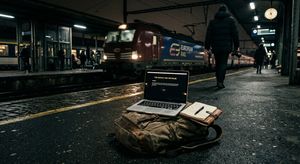

A Manifesto for the Raw European Rail and the Reclamation of Independent Art
The magic of the blank page has always belonged to the human spirit, but modern publishing is quietly losing its heart. Locked inside algorithmic echo chambers and sanitized by corporate validation, contemporary literature increasingly demands predictable code rather than raw human confessions. Against this clinical backdrop, I am stepping out into the unknown with nothing but a backpack and an open mind. This July, I am launching an act of pure artistic wonder: a 33-country creative expedition across the pavement and iron tracks of Europe. This is not a standard holiday, nor is it a rigid academic exercise. It is a passionate romance with space, memory, and my own creative limits. To step onto the continental rail system as an independent author—living on the rails, welcoming the unpredictable rhythm of a continent—is an exhilarating, liberating leap of faith. Guided by the philosophy of raw, unfiltered Art, my journey strips away the polished tourist brochures to celebrate the real, breathing Europe. It is a high-velocity pilgrimage through the intersections of psychological fiction, Art, history, and architecture, funded entirely by a warm community of readers who still believe that a great story should cost a writer something more than comfortable keystrokes. Every day, I see travelers moving through historic cities with a glowing screen as their primary filter. Algorithms dictate which cozy cafe they visit in Paris, which hidden alleyway they photograph in Prague, and which ancient monument requires a prepaid QR code. This hyper-curated reality creates a closed feedback loop, rendering the traveler a passive observer rather than an active witness to life. To break this loop and truly awaken my creative senses, I choose to adopt the timeless posture of the street writer. The street does not possess an algorithm. It does not curate its contents to protect me from discomfort, nor does it hide its sudden, shattering beauty. The street is a beautiful, democratic chaos where a 14th-century Gothic archway exists in the same visual plane as vibrant political graffiti and a weary stranger sharing a bench. By prioritizing the street over the curated destination, I invite the world to surprise me. This approach demands that I become a true flâneur—a passionate, empathetic observer walking these historic cities without a fixed destination, allowing the psychological current of the environment to dictate my movement. In a world obsessed with optimization, wandering with an open notebook is a radical gesture of joy. True narrative material cannot be mined from top-10 lists; it must be stumbled upon at 3:00 am on a rain-slicked platform in Budapest, where the world feels beautifully alive.
When you look at your own life or your own travels, have you felt that same quiet exhaustion from having your experiences pre-packaged by software?
The first true crucible of this romantic philosophy will take place this July in Brussels, Belgium. It is here that my journey shifts from an exciting dream to a physical reality. Brussels is a city defined by its brilliant contradictions, and it will be the first to welcome my wandering spirit, inviting me to find the heartbeat of humanity. My choice of Brussels as the starting line is deliberate. It represents the ultimate friction between the highly organized, structured version of Europe and the raw, unpredictable human narratives that live happily in its shadows. Europe is a continent built upon endless layers of trauma, triumph, and architectural genius. Every cobblestone I step on has been laid over a previous iteration of civilization, and every building is a physical manifestation of a distinct philosophical era. When I look at the European landscape, I am not merely looking at old buildings; I am reading a heavy, beautiful text written in stone, iron, and glass. As a writer of psychological fiction, I am endlessly fascinated by the contrast between the rigid, rationalist structures of Northern Europe and the sprawling, emotional baroque of the Mediterranean south. This spatial divergence beautifully shapes the interior lives of the people who inhabit these spaces. Northern Europe emphasizes functional, strict design, which often manifests as a compelling internal conflict and emotional restraint in both culture and prose. Conversely, Southern Europe embraces sprawling, passionate elements, leading to externalized emotion and a heightened sense of everyday melodrama. As my rail pass cuts through these changing landscapes, I will track these internal transitions in real time. Moving from the brutalist monuments of the former Eastern Bloc to the classical geometry of Renaissance Italy is an intoxicating psychological acceleration. The architecture naturally forces a specific rhythm onto my prose. The dense, vertical claustrophobia of medieval quarters demands short, sharp, sensory sentences that mirror a racing heartbeat. At the same time, the grand, sweeping vistas of Imperial avenues call for expansive, philosophical paragraphs that capture the soaring hubris of the empires that built them.
Crossing thirty-three borders on foot and by rail is less a geographical journey and more an intentional unraveling of the self. What they call "Europe" is merely a collective delusion of order; on the platforms, that illusion splinters into a manic, interior friction of private ghosts and localized anxieties. My obsession is not the macro-politics, but the silent psychological mutations that occur in the dark corners of a train compartment. I am drawn to the quiet panic of a passenger staring into a window reflection at a midnight checkpoint, searching their own face for permission to exist; the calcified, rhythmic grief of an aging rail worker whose internal clock stopped with the collapse of his industry; and the desperate, intellectual fever of youth projecting their own displacement onto poetry in Belgrade basements. I am collecting these psychological fragments to build a composite anatomy of human endurance—characters who carry the terrifying weight of their origins in the quietest chambers of their identity. Managing these transitions requires a radical, sensory distortion of my creative process. As borders dissolve and reform in the dark, my laptop becomes an extension of my nervous system, registering the ambient neurosis of environments in flux. I write where the mind is most exposed: hunched on hard plastic benches under the dead glare of station clocks, or balancing the machine on my knees in sweltering regional cars. The prose must change with the terrain because the mind does. A smooth sprint on a high-speed Western line dictates a clean, calculated mental syntax. But the violent, unpredictable jolts of an aging locomotive rattling through a Balkan mountain pass force a rhythm that is fractured, breathless, and heavy. I refuse to wait for the safety of a hotel room to organize these impressions, for to wait is to let the ego tidy up the truth. I must document the raw friction of movement itself, capturing that fleeting psychological vertigo precisely before the dust has time to settle.Because this is a collaborative experiment in independent Art, your presence here is structural, not superficial. I refuse to be a detached mind sending down polished updates from a safe, intellectual distance; I want us to map this internal underworld together. I need your presence to deliberately destabilize my focus while I am actively on the ground. When I pull into a new city, I will ask our community to look at the raw maps with me—not for navigation, but for psychological investigation. Should I spend the night documenting the architectural ghosts of a crumbling industrial sector, exposing the psychic weight of abandonment, or embed myself in a crowded public square to translate the frantic, unspoken anxieties of the local youth?
If you could point my notebook at one hidden, unmapped corner of the human landscape that the guidebooks have scrubbed clean, what kind of psychological space would you want me to dissect for you?
This journey demands a punishing series of internal shifts. In the optimistic days of early July, stepping onto the platform in Brussels, my mindset will be driven by a high, intellectual manic energy. But as July bleeds into August, and the reality of sleep deprivation, language exhaustion, and perpetual displacement takes hold, that initial romanticism will burn away. Paranoia, fatigue, and the raw mechanics of psychological survival will replace the initial thrill. By the final weeks, my perspective will be stripped of all pretense and focused entirely on creative necessity. I expect to become less of a detached commentator and more of a ghost moving through the background of these countries, entirely porous to their joys and their traumas. I invite you to watch this psychological evolution and unraveling unfold in real time, witnessing the exact internal cost of creating unfiltered art. At the center of this undertaking lies my core creative obsession: exploring the human spirit when pushed to its absolute limits of fragmentation. This thematic preoccupation mirrors the heartbeat of my novel, The Still Point, which interrogates how Art and personal expression persist even as the consciousness around them fractures into chaos. The thematic spine of both the novel and this journey is identity. How do we preserve a cohesive sense of self when everything around us is fluid, shifting, and fundamentally unstable? The protagonist of The Still Point faces this exact internal battlefield, torn between a safe, prefabricated existence and the chaotic, terrifying path of authentic self-creation. For those on the inside, the structural concepts in the novel's early chapters serve as the direct blueprint for my steps.
Chapter One, titled "The Awakening," directly mirrors my departure this July. It dissects the paralyzing comfort of remaining stationary and the violent psychological rupture required to make the first move into the unknown.
Chapter Two, "Mirrors We Refuse To Break," explores how an individual begins to hear the ghosts of their past choices more loudly when surrounded by unfamiliar streets and a foreign language. By reading these chapters, the full manuscript as I draft and refine them on the rails, you are not just reading a static book; you are holding the architectural plans of my own unfolding psychological state.
Do you see the parallel between the character's internal rupture and the real-world step I am taking across the channel?
Travel, when executed with raw vulnerability, mirrors this psychological dynamic perfectly. It strips away the comforts of my home, my routine, and my familiar language, forcing me into a state of perpetual displacement. It is precisely within this state of displacement that the superficial layers of identity fall away, revealing the essential self. Art is not a luxury product designed to decorate a stable life; it is an urgent tool for survival, utilized when life becomes unstable. Writing from a cramped train seat or a crowded hostel common room is my exercise in creating a still point amid constant motion. The chaos of changing schedules, language barriers, and physical exhaustion becomes the forge in which I hammer out clear, uncompromising prose. This journey serves as a living proof of concept for my literary philosophy at The Street Writer: that an authentic narrative voice must be earned through direct, sometimes painful engagement with the world, rather than academic detachment.
Have you ever had your own identity stripped of its familiar routines, and if so, what did you discover about yourself when there was nothing left to hide behind?
In my backpack, the most critical piece of gear I carry is my laptop. It is not just an electronic tool; it is the physical bridge between my isolated observations and the collective community of readers who make this journey possible. Every ounce of prose, every midnight field note, and every character sketch from the rails passes through this machine. It is my mobile studio, my weapon against artistic complacency, and the singular mechanism that turns raw experience into enduring Art. Reader support is the lifeblood that directly sustains my independent rail pass and keeps this machine powered. From this laptop, my raw street notes and deep psychological fiction emerge, merging into unfiltered field dispatches sent back to the community that keeps me moving. This project cannot exist in a vacuum; it requires a collective of readers who value raw Art as much as I do.
Are you ready to see what happens when an artist cuts the safety lines and lets the street rewrite the narrative?
So, if you were sitting on that train platform with me, watching the faces pass by, whose story would you want to uncover first?
The tracks are laid, the laptop is open...