

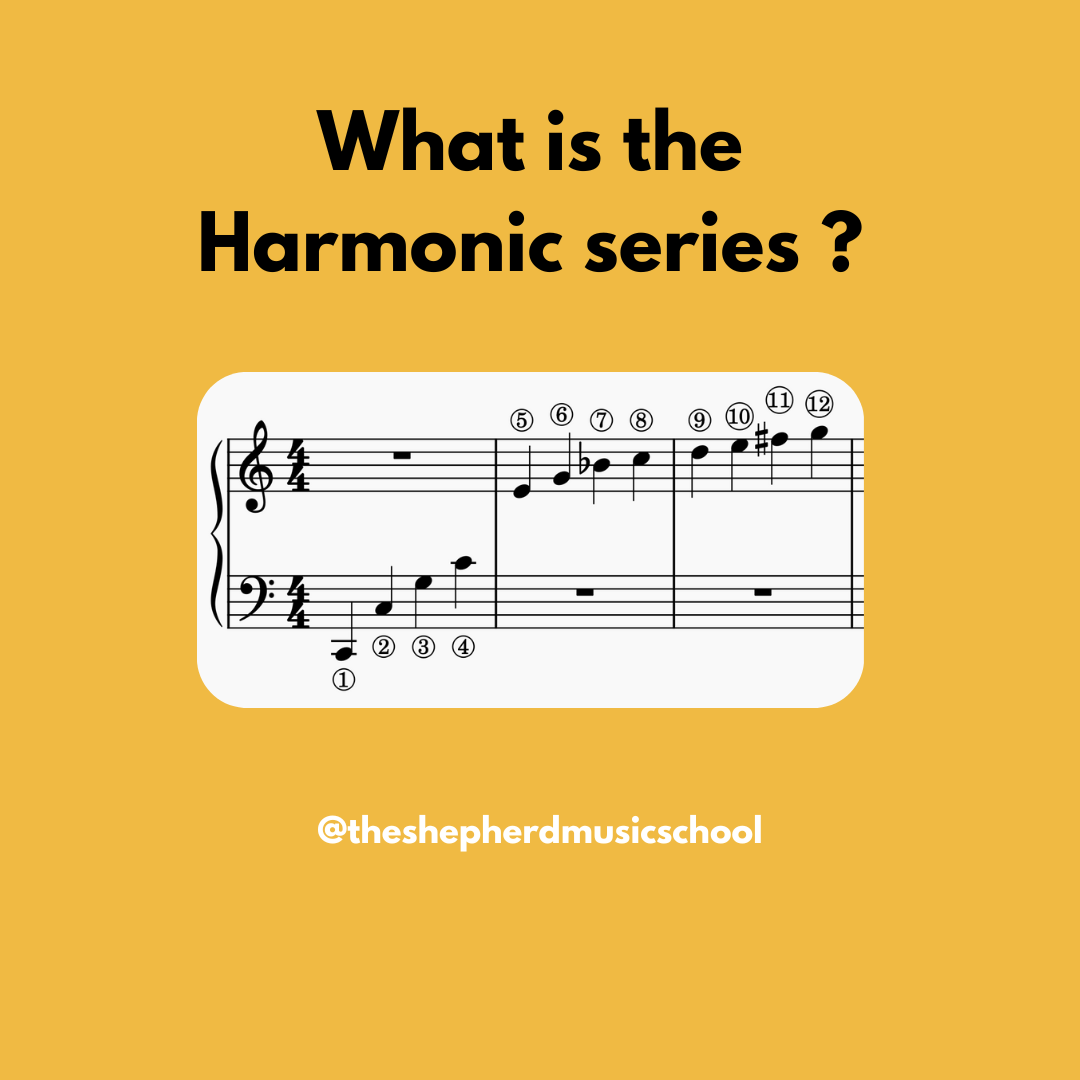
The harmonic series in music theory is a naturally occurring sequence of pitches that plays a fundamental role in the structure of sound, tonality, and musical perception. When a note is produced by a vibrating source—such as a string, reed, or column of air—it does not generate just one pitch but a combination of multiple frequencies. The lowest frequency is called the fundamental, and above it lie a series of overtones or partials. These overtones occur in precise mathematical ratios to the fundamental, collectively forming what is known as the harmonic series. For example, if the fundamental frequency vibrates at a given rate, the overtones would vibrate at 2x, 3x, 4x, and so on, creating a pattern of intervals that becomes increasingly close together as they ascend. This phenomenon is intrinsic to acoustics and applies to all pitched sounds, regardless of the instrument or sound source.
In the harmonic series, the first few overtones correspond to musical intervals that are central to Western tonal music. The second harmonic, or the first overtone, is an octave above the fundamental pitch and provides one of the most consonant and stable intervals in music. The third harmonic (a fifth above the octave), the fourth harmonic (two octaves above the fundamental), and the fifth harmonic (a major third above the second octave of the fundamental) establish a sense of tonality and harmonic structure. These intervals and their relationships formed a key part of the historical development of musical scales and harmony, influencing systems such as just intonation and equal temperament.
The harmonic series is also essential to understanding timbre, the unique quality of sound that distinguishes one instrument or voice from another. Each instrument emphasizes particular overtones in the series, creating its characteristic "color." For instance, a violin and a clarinet playing the same pitch will sound different because the strength and balance of overtones vary between the two instruments. Musicians and composers often take advantage of the harmonic series to craft specific effects, such as the use of natural harmonics on string instruments, brass overblowing techniques, or exploring non-tempered tuning systems.
Beyond its technical aspects, the harmonic series bridges mathematics and music, showcasing the intrinsic order and beauty of sound. It has captivated thinkers and musicians for centuries, from Pythagoras's discovery of harmonic ratios to modern explorations in spectral composition. By understanding the harmonic series, musicians gain deeper insights into the natural properties of sound, the construction of musical systems, and the boundaries of human auditory perception. In essence, the harmonic series serves as a reminder of the profound and inherent connection between physics and the art of music.