
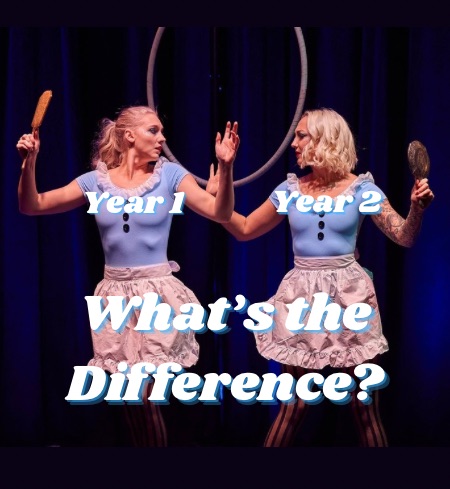
The Aloft Professional Training Program is two years long and the most frequently asked question I get is: what's the difference between year one and year two? So let's do a full comprehensive summary of year one and year two. Some people opt to do just Year One and some people join the program just for Year Two, I myself am doing both years. If you’re interested in the Aloft program this may help you decide what's right for you! Or if you're reading this after already experiencing another circus program, I'd love to hear the differences.
Year 1:
If you’ve read my blog posts from last year this section may be all familiar already and you could skip to the year two section or if you want more details check out my past blogs.
The biggest difference is that year 1 of the program created the space for trying new things. Every week we had a new “focus” in which we’d get to work on a new discipline for 90 minutes every day. Last year our focus weeks included tightwire, spanish web, pole/aerial pole, cloudswing, sling, straps, cyr wheel, diabolo, break dancing, puppetry, clowning, bungee, unicycle and more! We also had the opportunity to take up to five of the recreational classes at Aloft in addition to our training during the day. I chose to take lyra, silks, handstands, straps and trapeze the first term and the second term we could only take up to two and I stuck with silks and handstands. Throughout all three terms we had core classes that were a consistent 90 minute class once per week: dance, physical theater, juggling, handstands, flexibility, conditioning, production and tumbling/partner acrobatics. The first year eased us into full time training by slowly raising the hours. The first term was 9am to 2:30pm + any evening rec classes. The second term was 9am to 4pm + any evening rec classes. The third and final term: the days could be as long as 8:30am to 5pm but we no longer had weekly focus sessions so the arrival time had more flexibility.
Since year one allows for so much exploration we didn’t have to declare a major or minor until term two started, but we didn’t start our private lessons with our coaches until then either. Term one didn’t have any open training hours and no private lessons, but I knew I was majoring in silks or lyra and I was in those recreational classes so I still got time with coaches on those disciplines. We also had six weeks of silks, lyra, trapeze and rope built into our pro-training schedule in the first term. Our second term introduced open training time and our private lessons in our major and minor as well as “elective classes”. For your private lessons you'd get one hour on your major and one 30 minute lesson for your minor per week. We did get a few weeks to try different coaches to see who you prefer to work with and our minor lessons are less strict than our major lessons. I.E. our major lessons could only ever be used on our declared major, our minor lessons could occasionally be used on other disciplines or some of my classmates had multiple minors and they’d rotate lessons with different coaches. The elective classes were three classes voted on by our cohort and we opted for rope, trapeze, tightwire, and lyra but I believe our options also included silks, straps, sling, and a lot of our focus disciplines were also options as long as the coach was available. These elective classes were added to our schedule once a week for 90 minutes, but if you didn’t want to take any or all of them you could opt for open training during those time vs the core classes were mandatory.
The third term is when our focus weeks stopped, we had open training every single day and an act creation class was introduced. Our core classes and elective classes continued. We’d had act development workshops built into the focus weeks and most of us had already been working on our acts throughout the second term, but the act creation class gave us deadlines to meet and we got to present to and get feedback from our classmates and coaches. The show in year one is a Sanctuary takeover (which if you’re not familiar with Aloft, is the monthly professional cabaret). Within that Sanctuary takeover we all got to perform a solo in our major discipline and additionally we performed three group numbers: a dance, a juggling piece, and a group acro piece. The show was only one night and our group acts were created by or with guidance from our coaches!
One more facet of the Aloft program that helped me immensely was the open stage show that’s produced by the cohort called Communion, which is what we work on in production. Not only does Communion give us experience in all the roles it takes to produce a show, but all the ticket sales help reduce our tuition and we can perform if we want to as well. If you want a deeper look into Communion, you can check out this vlog I made of one of our Communions last year. You may think splitting the ticket sales between 8-12 people wouldn’t help a lot, but I believe it always knocked at least $100 off tuition!
If you like vlogs I do have a couple others on my youtube channel that can give a glimpse into lab weeks and what the day to day looked like!
Year 2:
Year two (also known as the lab year) starts right out with an 8:30am to 3:30-5pm schedule. We don’t take any recreational classes (unless you pay for them outside of tuition) and we don’t have any focus weeks. Your private lessons with your coaches start immediately but you do have about a month before you have to lock in your coaching team so if you’re new or changed your major you can get some time to try different coaches. The first term immediately includes open training every single day and there is a lot more time than even the third term of year one. In addition to major and minor coaches, we also get a creative coach in year two. Similarly structured to the minor, you can get half an hour every week or one hour every other week with your creative coach. Ideally you work with your creative coach and with your technical coach to create your end of year act. Act creation starts immediately in year two since our solo show is actually in April instead of June.
The biggest difference in the lab year (and why it’s called the lab year) is that instead of focus weeks every week we get a guest director/coach once a month for a week and these are called lab weeks. The lab week schedule shifts to be 9am to 5pm every day and our class schedule is changed as well. The coaches they bring in for these are established circus directors that could be from all over the world. The coaches are given total freedom to work with us on whatever they please, some work on staging a show or concept they have in mind or some take us through creative exercises. These coaches change every year so you’ll never know who you’ll get to work with, but they definitely invite back favorites year after year! This year so far we’ve worked with Rain Anya, a co-founder of Paper Doll Militia and Liz Williams, a variety show producer and performer who lives in Berlin. Both coaches chose to teach creative movement styles and prompts but their perspectives were so different. Rain pulled from a lot of contact improv and had a focus on creating with aerial whereas Liz pulled her prompts and exercises from her years of dancing and martial arts so our focus was mostly on movement quality on the ground and different styles of warming up/conditioning.
Year two still has core classes that you have every single week: Partner acrobatics, physical theater and dance. In addition to those three classes we have act creation, tumbling, juggling, classroom/production, and flexibility, but we don’t have these classes during lab weeks. I do want to point out that in year one our partner acrobatics and tumbling were combined in one 90 minute class once per week, but after feedback from our class Aloft split that into two separate classes each 90 minutes for year two and it feels a lot more productive. That may be a change they carry into future Year Ones, but I am unsure. There is no conditioning class either, since we have so much more open training, it's expected that we take care of our conditioning on our own. Lastly we have three more classes: technique, creativity, and movement. These classes do not last the whole year and we’re not taking them all at once, we are grouped by our majors and the groups rotate. For instance, all the vertical apparatus majors (silks and rope) are taking creativity for the first eight weeks while the balance majors (tightwire and partner acrobatics) take technique and the third group, bar apparatus, take movement.
We still have Communion in year two which we work on in production but we split that time slot with classroom. Classroom includes lecture style classes on several different topics including: how to set rates, how to write a contract, making demo reels, making resumes, how to buy and inspect your apparatus and several others. Another difference between year one and two is that year two has two end of year shows. The first is another Sanctuary takeover where we all get to perform our solo act that we work on the whole year and the second is an ensemble show that is directed by a guest director and created by the cohort the last three months of the program. Since we are only on week 11 of year two I have no idea what that will be like! But since the director changes every year, I imagine it’s different every year! This year allows for a lot of networking, you work with six lab coaches and one more for your final show so you can end the year having some contacts in the industry and being able to have a full ensemble show on your resume.
Is year 1 or 2 better?
That totally depends on where you are in your journey. I really wanted to get to spend time trying new disciplines so I only applied with the intention of doing both years. I felt like I had a lot of growing to do and felt like I wanted the full two years to not only develop on my apparatus, but to develop in tumbling and partner acrobatics and dance. My goals are to join ensemble shows and I knew I’d need those skills and didn’t think one year would be enough. Since I knew I was doing both years, I picked a major I wasn’t as advanced in. If I were to only do one year of the program I would’ve majored in lyra, which was my main apparatus that I already had a lot of comfort and advanced skills on, but I chose to major in silks to add more to my repertoire. The tuition of both years remained the same $11,000 base plus $800 if you choose to add a minor. If you’re already advanced in your aerial career or you plan on applying to another school after the Aloft program, just doing one year might be the better option for you. If I were to choose just one year, I would pick year two. The pace is a lot quicker since we immediately get into open training and private lessons and you get so many opportunities to network and learn from new coaches. Another draw of the lab year is that it has two professional performance opportunities at the end of the year. I’m really glad that I chose to do both years. Year one felt like it built a good foundation of strength and so far in year two my skills are growing at a much faster rate. The whole cohort also feels a lot more confident in all of our classes, so group classes are moving a lot faster as well. The lecture classes in the lab year also fill in a lot of questions beginning professionals have about rates and creating websites etc. They do only run one year at a time due to space constraints so the opportunity to apply to either only happens on alternating years, this upcoming cycle will be for Year One.
Aloft specifically is a great place to train. They have a solid technical and creative coaching team and it’s located in a major city so lots of artists visit and perform. It’s the most affordable tuition of any professional program in the US and Aloft has helped me a ton with paying tuition. I ran out of savings faster than I expected in year one and when I had to ask the program director and founder (Kristi and Shayna) for a payment plan they were not only willing to work with me, but they found me opportunities within Aloft to make money. They offer so many opportunities for fundraising as well throughout the year including Communion, but also through the annual holiday market and at the recreational student shows. I don’t personally have a scholarship from Aloft, but they do offer one to apply to at the start of year one. My point is they make it as accessible as they can. Even after the program, training at Aloft is much more affordable than what I could find in Cincinnati.
If you’re interested in applying to Aloft, the application is open and there is more information on the Aloft website. If you apply, you can use AllisonSentMe if you want to help me get a little bit of a discount on training! My DM’s are always open if you have any questions