

 How to Smartly Arrange a Slope in the Garden
Slopes are special spots in a garden. On one hand, they can be problematic — sliding soil, tricky maintenance, and the risk of erosion. On the other hand, when properly arranged, they can become the most beautiful feature of your plot. The key lies in the right choice of plants and a few simple technical steps.
Why does a slope require thoughtful planning?
Inclined surfaces are prone to runoff and soil erosion. If left “bare,” weeds will quickly appear, and the soil will start to slide down. That’s why it’s so important to:
protect the ground (for example, with garden fabric, geogrid, or stones),
choose plants with strong root systems,
plant densely so the plants form a compact cover quickly.
Ground covers – natural protection and decoration
Most often, people choose creeping plants or low shrubs. Their stems spread along the soil, root easily, and form dense mats that stabilize the ground. The most popular include:
Cotoneaster Dammeri – low, evergreen, and hardy. It blooms white and in autumn is covered with red berries. Perfect for slopes, as it protects the soil very effectively.
Periwinkle (Vinca minor) – grows fast, forms a green carpet, and blooms beautifully in violet.
Japanese Pachysandra – great for shade, forms dense mats.
Bugleweed (Ajuga reptans) – vigorous but excellent for covering larger areas.
Wintercreeper (Euonymus fortunei) – attractive all year round and roots easily.
Extra planting tips for slopes
Plant closer together than on flat terrain (usually every 30–40 cm).
Use mulch or garden fabric – it limits weeds and stabilizes the soil.
Choose drought- and sun-tolerant species (especially for southern slopes).
On steeper slopes, combine plants with decorative stones – stability and beauty in one.
My Story with Cotoneaster Dammeri
Let me tell you about one slope in my garden. It formed in an unusual spot — where an old manure pit once stood. Above it, there was a retaining wall that I recently dismantled. After removing it, a natural slope was left — not very high, about 1.2 meters, but around 3.5 meters wide.
At first, it looked quite raw — bare soil sliding after rain and due to soil-dwelling creatures. I knew that if I left it like that, the problem would only grow. So I decided to take care of it once and for all.
Step One – Securing the Ground
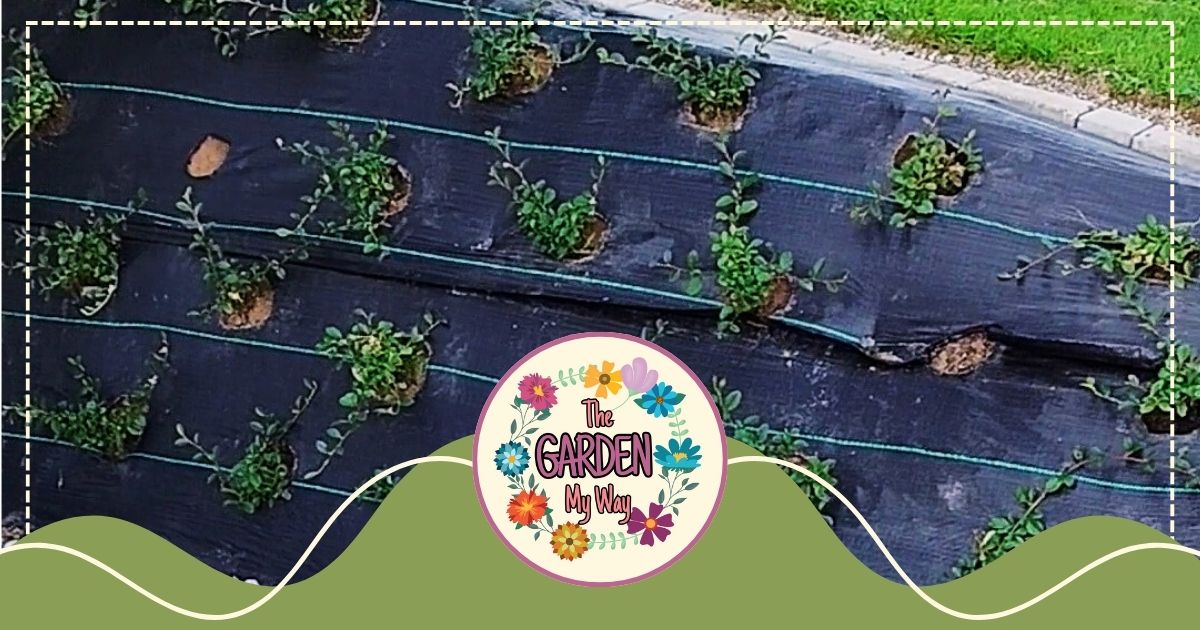
I covered the entire surface with garden fabric. It’s a simple but very effective solution: it limits weeds, helps retain soil moisture, and protects against sliding. I fixed it with metal pins so it would stay in place even during heavy rain.
Step Two – Choosing the Plants
I decided on Cotoneaster Dammeri. Why this one?
First – it’s low, dense, and resilient.
Second – I love its year-round charm: white flowers in spring, red berries in autumn, and green leaves in winter.
Third – it roots perfectly on slopes, stabilizing the soil.
And fourth – I had it for free! Last year, I started propagating plants, and cotoneaster was my first experiment. Taking semi-woody or green cuttings is super easy — they root quickly and reliably. This year I’ve taken even more cuttings.
Step Three – Planting
I started by marking out the planting layout. I decided on a spacing of 40 cm, staggered in rows. With a marker, I made small marks, then used a gas burner to make 10 cm holes in the garden fabric (about the size of nursery pots). I dug small holes carefully to avoid soil slipping down the slope. Into each one, I placed a young shrub. It might seem dense, but I wanted them to spread fast and form a solid carpet. Each plant got a bit of compost to start.
The Result?
I check on the slope from time to time. Cotoneaster is tough and adapts well, so I’m not worried about the plants taking root. I didn’t even water them — water would just run down the slope anyway. But since it’s the rainy season, nature handles the irrigation for me. I can’t wait for the next season — I know most of the slope will be covered quickly, as cotoneaster is a vigorous ground cover. A year from now, there’ll be no trace of bare soil!
Summary
Arranging a slope doesn’t have to be difficult. All you need is a simple method (garden fabric), dense planting, and the right ground-covering plants. Cotoneaster Dammeri works perfectly here — beautiful, hardy, and stabilizing.
My example shows that even a seemingly problematic spot — like a slope after an old manure pit — can become a practical and eye-catching part of the garden. If you face a similar challenge, don’t hesitate — go for ground covers, and ideally, the reliable Cotoneaster Dammeri.