

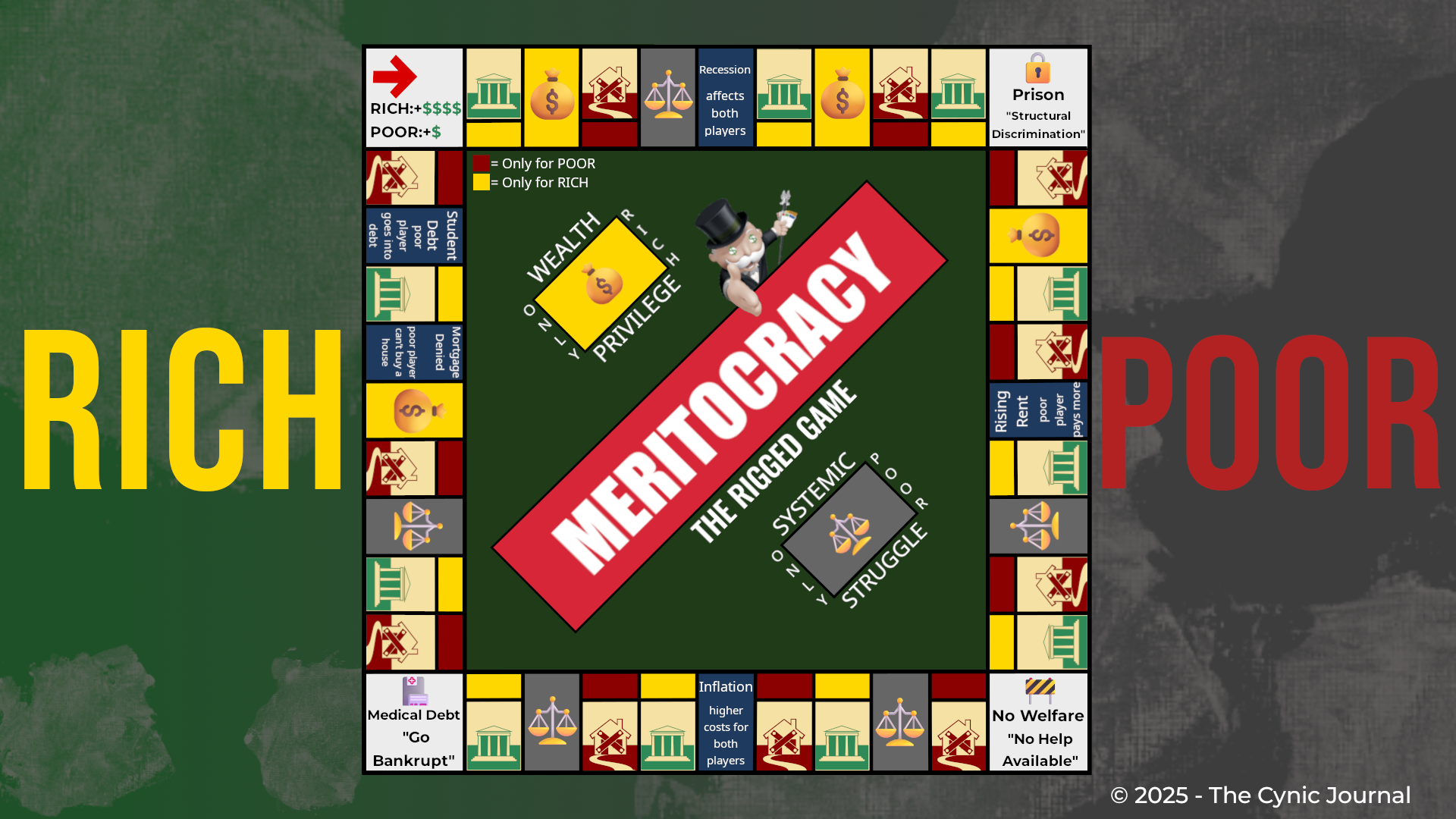
Welcome O' Dreamer
Ah, social mobility—the grand illusion that if you work hard enough, you too can move up in the world. It’s a comforting notion, isn’t it? The idea that talent and effort alone determine success is so deeply ingrained in modern societies that we rarely stop to ask: does it actually work that way? Spoiler alert: not really. While meritocracy should, in theory, fuel social mobility, in practice, it often serves as a convenient smokescreen for entrenched inequalities.
Social Mobility and Inequality: A Love Story
According to the Global Social Mobility Report 2020 from the World Economic Forum, social mobility varies dramatically between countries. In the fairest societies, individuals have roughly equal chances to succeed—unless, of course, they don’t. The report makes it painfully clear: income inequality and social mobility share a toxic, codependent relationship. When the rich get richer, they also get more entrenched, and the rest can enjoy the view from below.
The Scandinavian countries (Denmark, Norway, Finland, Sweden, and Iceland) top the social mobility charts, as they have miraculously managed to create fairer societies where your last name doesn’t dictate your destiny. Meanwhile, countries like India, South Africa, and Brazil struggle under the weight of their histories, economic disparities, and policies that are about as effective as a band-aid on a bullet wound.
Comparing Countries: Who's Winning the Rigged Game?
The Global Social Mobility Index ranks 82 economies based on 10 crucial factors: health, access to education, education quality, lifelong learning, technology, job opportunities, wages, working conditions, social protections, and institutional inclusiveness.
The "Winners" (Or at Least the Least Inept):
Denmark - 85.2
Norway - 83.6
Finland - 83.6
Sweden - 83.5
Iceland - 82.7
Netherlands - 82.4
Switzerland - 82.1
Belgium - 80.1
Austria - 80.1
Luxembourg - 79.8
Meanwhile, down in the trenches:
United States - 70.4 (Land of the Free, Home of the Stuck)
Italy - 67.4 (Meritocracy? Cute.)
China - 61.5 (Try harder, comrades.)
Mexico - 52.6 (Tough luck.)
India - 42.7 (Better luck next century.)
South Africa - 41.4 (Structural inequality at its finest.)
Meritocracy vs. Social Mobility: A Reality Check
In theory, meritocracy should be the golden ticket to social mobility. In practice, it often serves as a feel-good excuse to ignore the structural barriers that keep people exactly where they started. Education? Sure, it helps—if you can afford a good one. Hard work? Lovely, but it won’t erase nepotism, systemic bias, or wealth hoarding.
The "Great Gatsby Curve" and Why It Sucks
One of the more poetic pieces of economic research, the Great Gatsby Curve, beautifully illustrates how economic inequality and social mobility are inversely related. Countries like Denmark and Finland enjoy high social mobility and low inequality, while places like the U.S. and Brazil offer a masterclass in how to keep the poor in their place.
What Can Be Done? (Other Than Shaking Our Heads)
To make meritocracy more than a comforting bedtime story, policymakers could:
Fix education: Not just any education—accessible, high-quality education that isn’t a glorified sorting system for the privileged.
Raise wages: Revolutionary idea, really. Maybe people should be able to afford to live.
Invest in lifelong learning: Because "just get another degree" doesn’t work when retraining is a luxury.
Reform labor markets: So that job opportunities don’t hinge on the right connections or blind luck.
Final Thoughts
Meritocracy as a concept is charming—like a fairy tale. But until structural barriers are addressed, it remains just that: a story we tell ourselves while inequality thrives. Countries that invest in actual social mobility don’t just create fairer societies; they also build stronger economies. But hey, why let facts get in the way of a good illusion?
Sources (a.k.a. “Stuff We Didn’t Just Make Up”)
📊 World Economic Forum – Global Social Mobility Report 2020
Because it’s nice to have data when pointing out that the game is rigged.
👉 Read it and weep