

I bought the DeepCool Assassin IV in September 2023 and used it with my AMD Ryzen 9 7950X3D for about two years. It never gave me any major cooling problems, but after using the same CPU cooler for that long, I decided it was time for a change. I picked up a Noctua NH-D15 G2 LBC when I found it on sale and decided to see how much of a difference it would actually make.
There are plenty of comparisons between high-end CPU coolers, but I couldn't find many direct tests of the DeepCool Assassin IV and Noctua NH-D15 G2 LBC using the same Ryzen 9 7950X3D system and testing conditions. The newer DeepCool Assassin IV VC also makes the comparison less straightforward. So, I tested both coolers on the 7950X3D to compare their CPU temperatures, fan speeds, noise levels, and overall cooling performance, while also looking at installation and component clearance.
TLDR:
Given the nearly $40-50 price difference, the Noctua NH-D15 G2 LBC was clearly superior in both cooling performance and quietness. It was able to keep the 7950X3D at full load at a constant temperature of around 65 degrees Celsius.
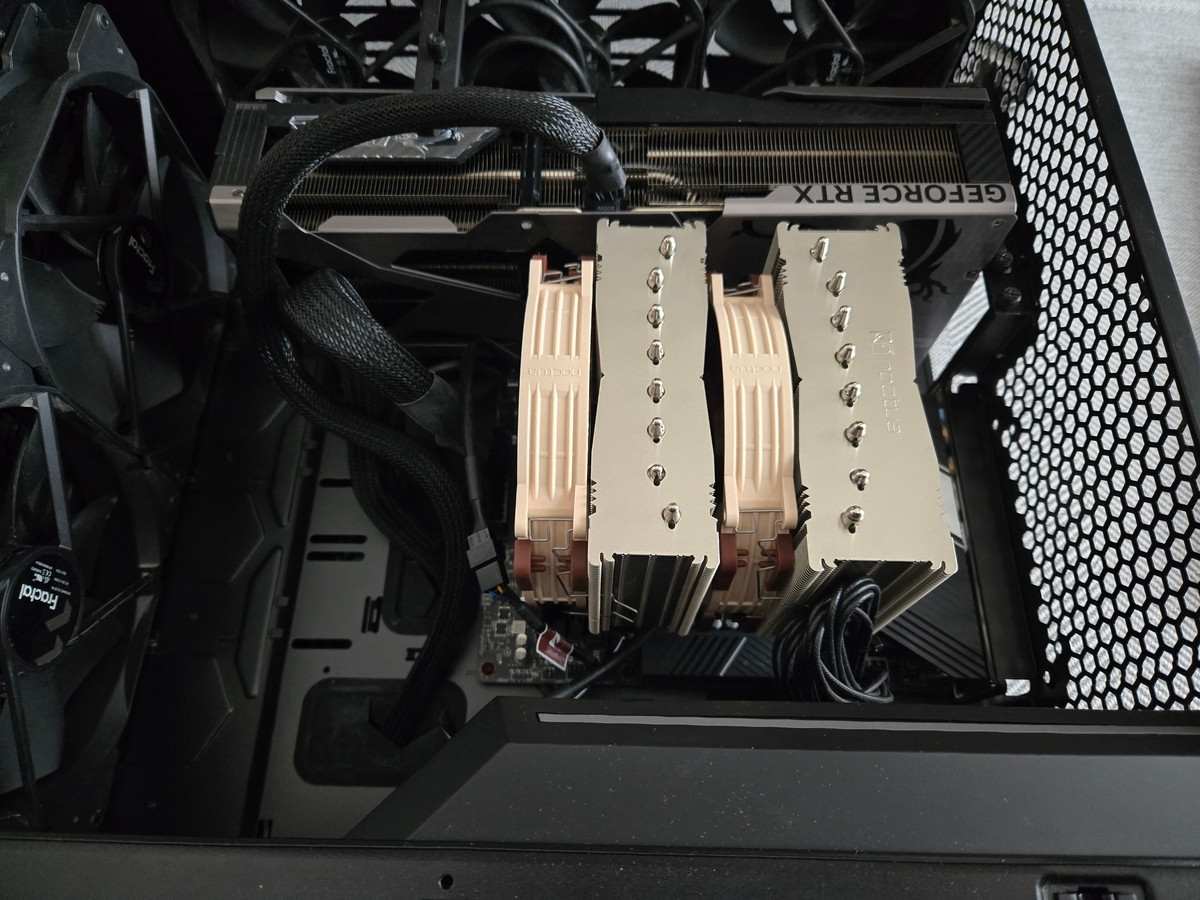
The Noctua NH-D15 G2 LBC is quite deep and positioned towards the memory side, which might cause interference with other components. In my setup, I couldn't use the L-shaped 12V-2x6 cable designed for the RTX 5090.
Since I'm using a 140W 7950X3D, the DeepCool Assassin IV cools it sufficiently, so considering the cost-performance ratio, I think it's not a bad option.
Visually, the Assassin IV is more stylish. Both are large, but the Noctua NH-D15 G2 LBC seems to have a thicker heatsink.
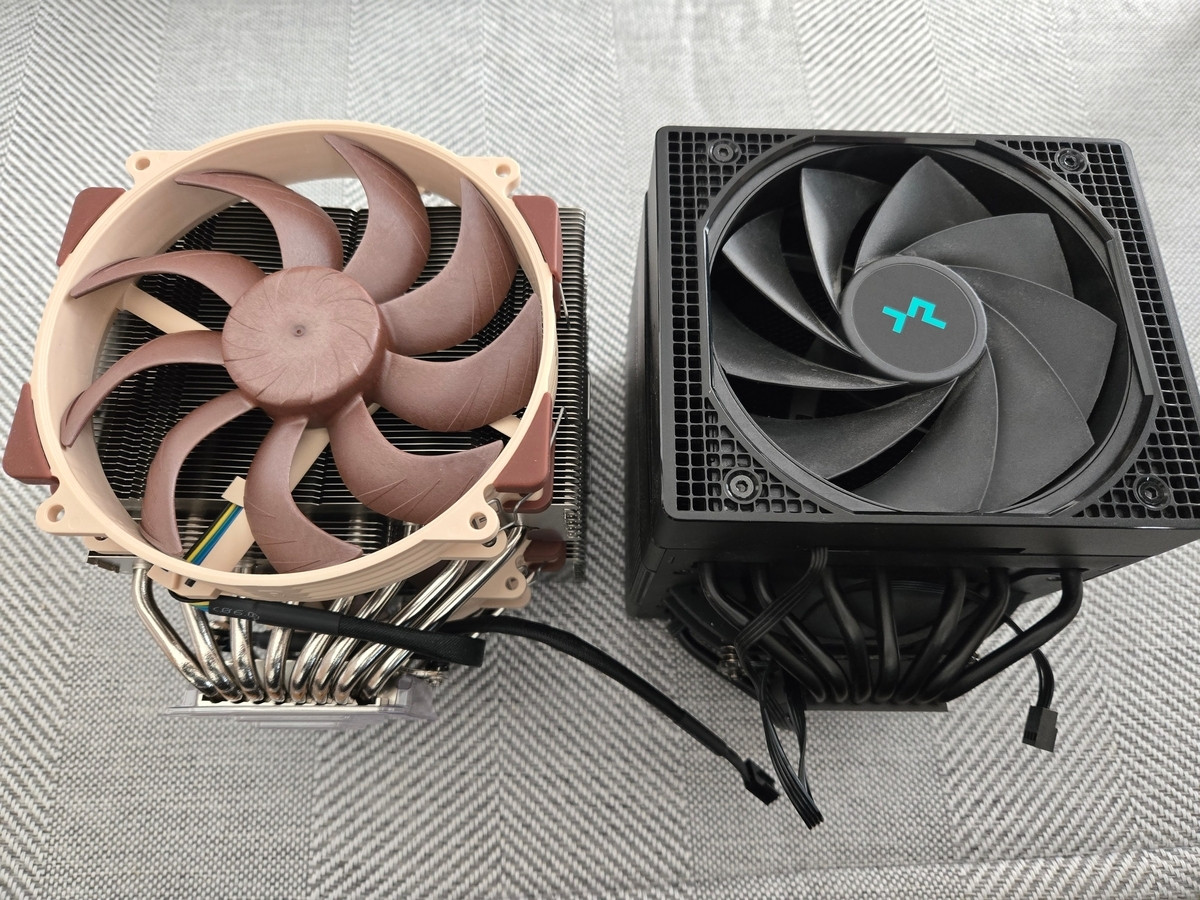
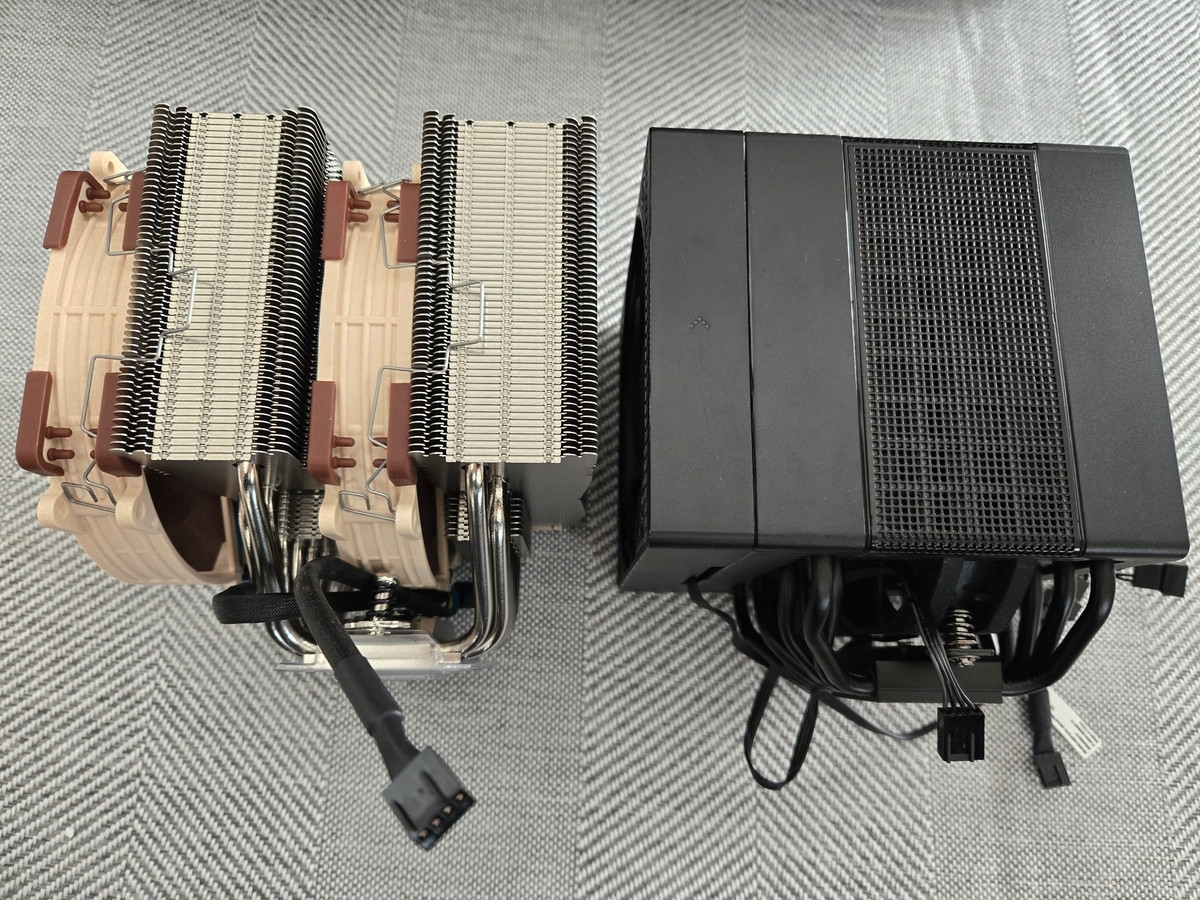
Installation is similar and easy for both. With AM5 motherboards, a metal mounting plate is attached to the default backplate, and the cooler is then secured on top of that, so there's no need to remove the motherboard or access the back (Intel is an exception). Both come with the necessary tools for installation; Noctua uses Torx screws, while Assassin IV uses Phillips screws.
The following is a photo of the Fractal Design Torrent actually installed. I did not use the included LNA (Low-Noise Adapter) cable for noise reduction. It is positioned closer to the memory than the Assassin IV, and there is ample clearance for outward movement, but this causes interference with the 12V-2x6 L-shaped power cable , rendering it unusable, so I had no choice but to switch back to a straight-type cable.
Comparison conditions
CPU: AMD Ryzen 9 7950X3D (140W TDP)
Motherboard: MSI X670P WIFI (Amazon renewed is around $130 I feel cheated because I spend 3.5X on it when it came out)
Memory: Crucial Pro DDR5-5600 32GB x 2
Storage: WD Black SN850X 4TB
GPU: MSI RTX 5090 Vanguard SOC (Here I won big so I don't feel bad about X670P)
Power supply: Asrock PG-1300G
Case: Fractal Design Torrent
Thermal paste: To ensure consistent conditions, Arctic MX-6 was used for both CPU coolers.
The free version of OCCT was used to continuously apply a CPU load for 30 minutes. CPU temperature and fan speed were logged and graphed using LibreHardwareMonitor.
The room temperature was 10-15 degrees Celsius. The noise level was measured using a sound level meter placed on the floor approximately 20 cm away from the front of the case.
Benchmark results
The results are shown in the graph. It can be seen that the Noctua NH-D15 G2 LBC is superior in both CPU temperature and fan speed (although a direct comparison is not possible as the Assasin uses 12cm + 14cm fans).
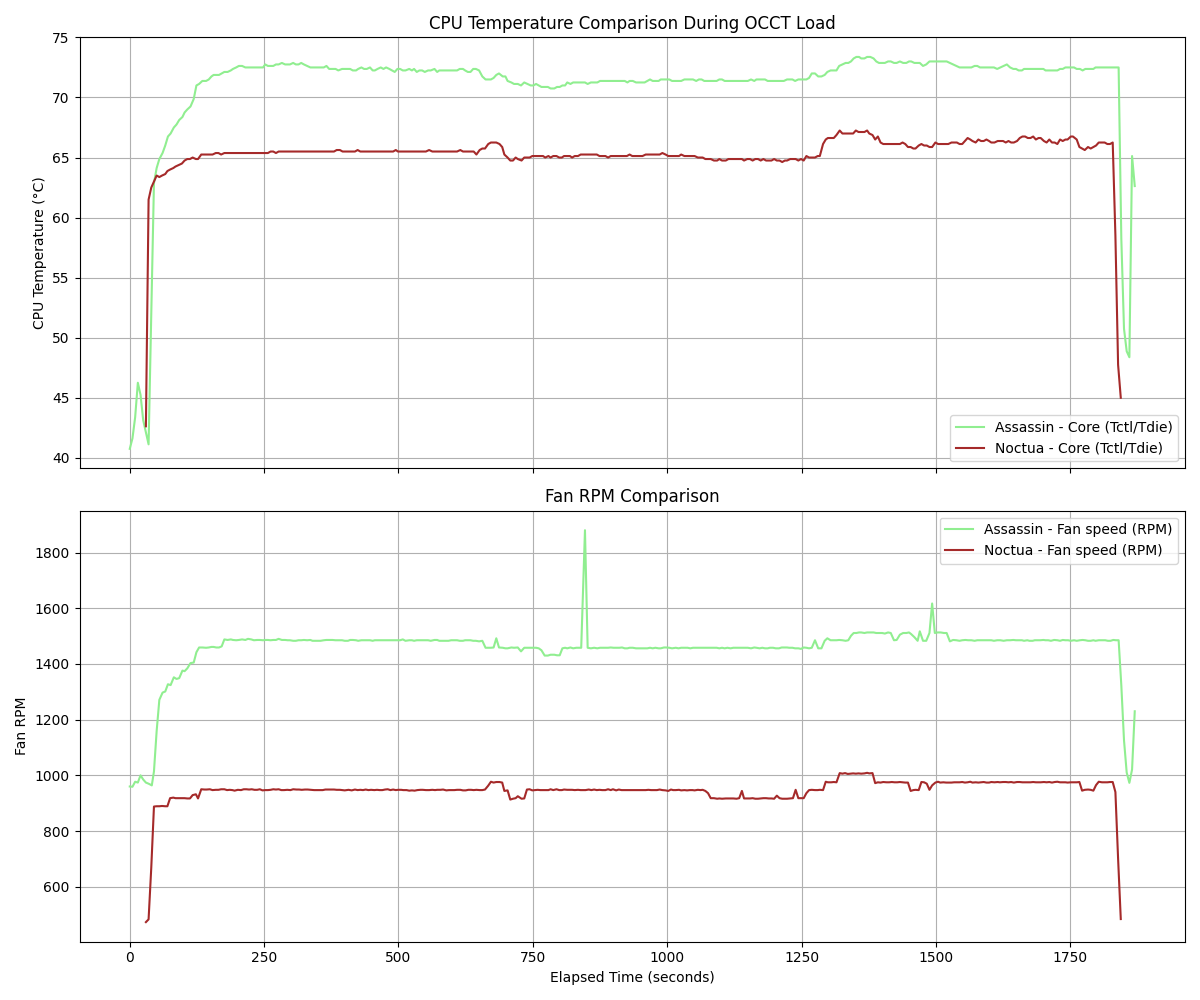
The noise meter readings were as follows, with the Noctua NH-D15 G2 LBC being about 4dB quieter. However, I suspect the noise from the Torrent case fan contributes more to the noise meter reading, so take this with a grain of salt.
coolerNoise level (dB)DeepCool Assassin IV56 dBNoctua NH-D15 G2 LBC52 dB
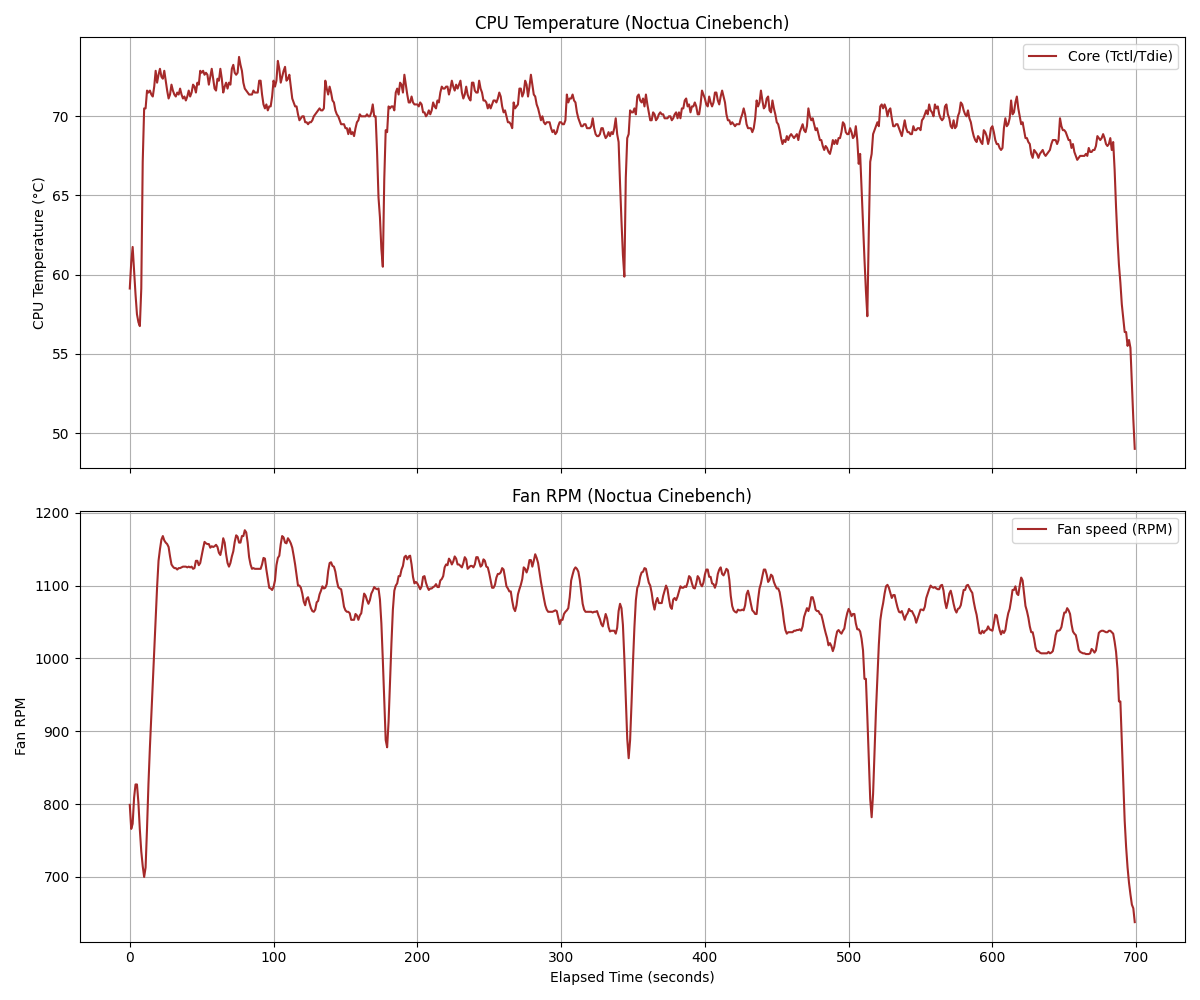
Since the OCCT settings were on auto, it seemed that the load wasn't being applied sufficiently, so I also checked the temperature when applying load with Cinebench.
Since I used Cinebench 2026, I can't directly compare it to the previous test, but the temperature was kept to a maximum of around 73 degrees Celsius, and the fan speed was kept below 1200 rpm (the sound level meter reading was around 55 dB), with plenty of headroom left. The score was 7291.
Recently, CPU TDPs have increased, making water cooling a necessity, so it's very welcome that Noctua is releasing a solution that can cool them sufficiently with air (although it's expensive).
Based on these results, it seems that the 7950X3D can be cooled with some headroom, suggesting that even more powerful CPUs like the 9950X can likely be properly cooled in a home environment. It looks like I will be using this for a long time. You can check the prices here.