

‘Writer's block is a non-medical condition, primarily associated with writing, in which an author is either unable to produce new work or experiences a creative slowdown.’ Wikipedia
I mean if it’s non-medical, the easiest thing to do is to call on the Muses, the way writers in antiquity did, right? If it worked for Homer, surely it will work for me.
Speak to me now, you Muses who hold the halls of Olympus! Goddesses, you are there, and you have knowledge of all things, we hear only legends, and we have knowledge of nothing.The Iliad, Book 2
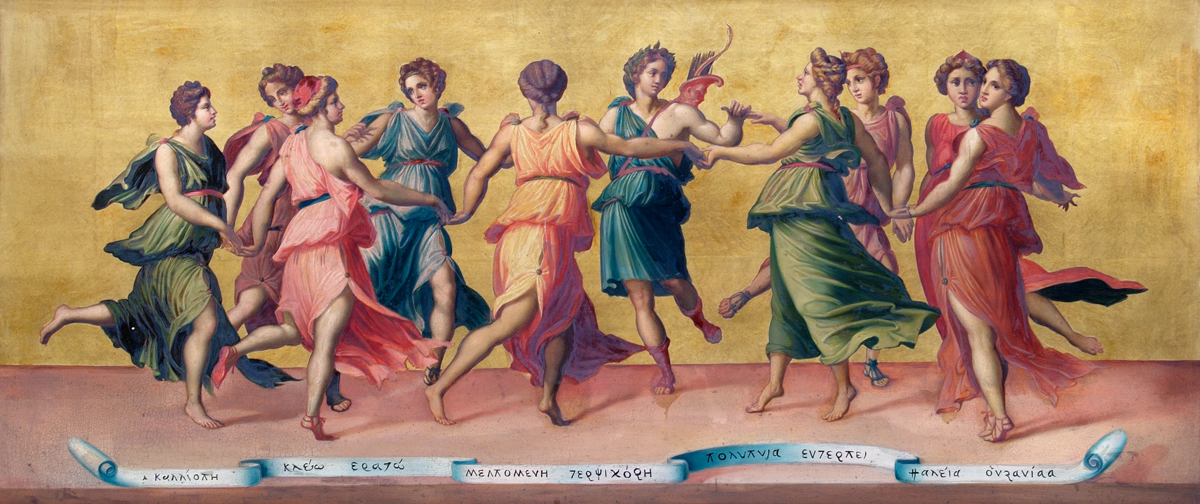 (The Muses by Baldassare Peruzzi (1481–1536)- too busy dancing to bother with me)
I pray and wait and then of course, the muses don't deign to visit, inspiration doesn’t arrive, and I sit in front of the blank page, feeling as though I can sit here forever, the clichéd image of the blocked writer, chained to my desk, unable to produce.
For most of my life I’ve been battling with procrastination which, over time, I’ve come to understand, is really about fear of failure and humiliation. This is what I discovered about a year ago:
Inside my brain, there’s this tiny individual, seated at a white desk, pencil at the ready. He’s a quite nondescript man with carefully combed hair and a quite meticulous approach. His job is to look over my creative texts and decide if they’re up to scratch. Whenever I begin a new project, it will invariably end up on this little man’s desk. As he examines my writing, his main objective is clear – he wants to spare me shame and humiliation in the wider world. If he deems the work not good enough, he will simply place it in his desk drawer and wait for the next papers to arrive.
Of course this little man doesn’t actually exist, and those of you who’ve watched Being John Malkovich may find my scene draws heavily on that film: a small person in my brain, a white desk, a bland corporate setting. Themes of shame and creativity.
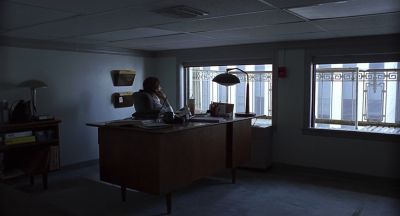 (A still from Spike Jonze's 'Being John Malkovich')
But thinking of my writer's block as a small, censoring office worker has been a helpful way of identifying and trying to understand what often stops me putting pen to paper.
So I'm surprised when Geoff says to me: There’s no such thing as writer's block.
We're walking by the canal, and I’d just brought up the unfinished Prometheus episode for the hundredth time. As Geoff's a great trouble-shooter, I'd been expecting his response to be, as it often is, practical: try a different perspective, begin by thinking about the soundscape, collaborate with someone.
‘What do you mean there’s no such thing as writer’s block?’ I exclaim.
‘It was invented by Mary Shelly’s husband.’
‘Percy Bysshe Shelley? What? Seriously? You know Mary Shelley's Frankenstein is also called The Modern Prometheus?'
'Yes.'
'And you know Percy Shelley wrote a sequel to Prometheus Bound - Prometheus Unbound?'
‘Right.'
‘It’s a bit weird though.’
‘Yup.’
‘Not at all what Aeschylus would have written.’
‘Uhuh.’
‘I’ve told you this already?'
‘Yup.’
‘Oups. So what’s this writer’s block thing?’
Turns out he’s been listening to a podcast interview with his old guru, Seth Godin. Back in the day Geoff climbed the corporate ladder and Godin was someone who's approach he always admired. In the podcast Godin tackles creativity and getting stuck: for instance, you want to write and then you feel resistance because it's going to mean hard work and so procrastination turns up as a reaction to that. That's when you must ask yourself: what is the work that needs to be done that I'm afraid of?
And then you just get on with it.
Because basically Godin says that things can be broken down into two categories: problems and situations. Problems have solutions and situations don’t. A situation is something that you can’t change or control. Well, in that case, writer’s block is a problem and it can be solved. Of course Godin goes into much more detail in the podcast and offers excellent strategies. Interesting.
But hang on a second, did Shelley really invent the term writer’s block? Back home, I look it up. In fact the expression was first coined in 1947 by Dr Edmund Bergler. His take on the subject centres around self-sabotage. He suggests a way forward with psychoanalysis. Whereas Shelley explores the difficulty specific to writing poetry, and as a poet, ultimately believes some kind of external inspiration is needed. It's back to the Muses with him.
‘Poetry is not like reasoning, a power to be exerted according to the determination of the will. A man cannot say, 'I will compose poetry.' The greatest poet even cannot say it; for the mind in creation is as a fading coal, which some invisible influence, like an inconstant wind, awakens to transitory brightness…’
That's not really helpful. I can't wait for the gods to fan the flames. I need to believe in an internal locus of control: that I have the capacity to change my inner landscape; understand what my existing beliefs are and then shift them. I like Godin's no-nonsense approach to problems and solutions. I think CBT and even EMDR can be effective. Lately I've found Internal Family Systems to be very helpful too. That’s where the image of the man behind his desk came from.
And actually what's helped me even more is creative accountability. Finding a friend whose work I really admire and checking in with each other on a weekly basis. In my case the check-in happens with the brilliant Chloe Dunn every Thursday. And it was Chloe who, during one chat, told me that what gets her creativity flowing is enjoying the project she's developing, not feeling obliged to do it.
I decided to try this with writing and seek what brings me joy, putting aside my own expectations and the imagined judgement of others. Over time, this approach has worked. It hasn't yet allowed me to crack the Prometheus story, but I've noticed the little man in my brain has been replaced by a creative woman with unruly hair who's too busy trying to write down all her ideas to worry about what others might think.
 (Rome Felice Zacchia Rondinini by unknown painter. The woman in my head has much crazier hair than this)
______________________________________________________________________________________
What about you dear listener or reader? How do you tackle a creative block?
The podcast Geoff listened to is here: https://podcasts.apple.com/fr/podcast/the-mel-robbins-podcast/id1646101002?l=en-GB&i=1000754712135