Can the goddess of health explain why there's a canine in my GP's office?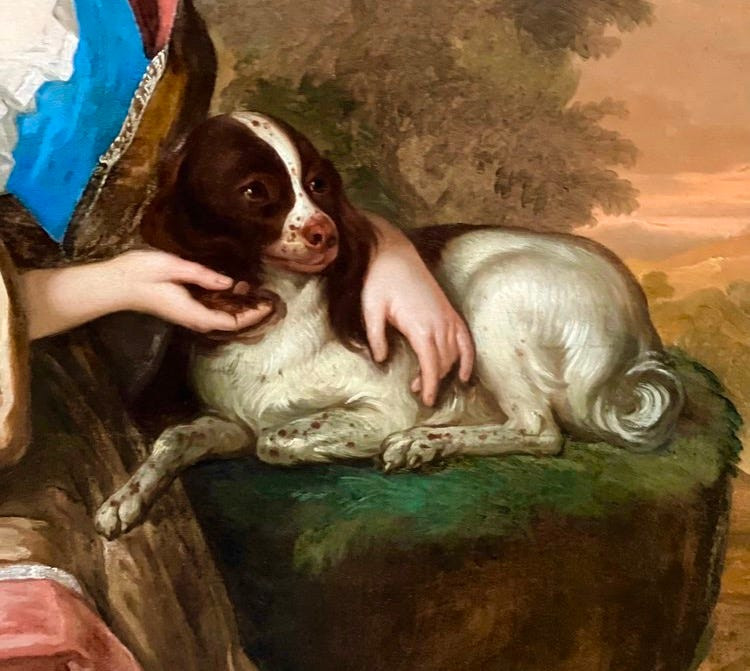
Portrait of a young girl with her spaniel, attributed to Robert Byng
My GP’s office is crammed full of dolls, stuffed toys, statuettes and paintings. Dozens of novelty pens sit jammed in pots on her desk. There are old metal tins balanced on the shelves. Wooden trains near the skirting board. Lace doilies on the chairs. All this should be old-lady-creepy, but it isn’t. And the reason is simple: it’s the dog.
She’s a Cocker Spaniel with great globular eyes and long, slightly tangled ears. This office with all its memorabilia is her kingdom and it’s her presence that makes sense of all the clutter here, because most of the images and objects are simulacra of her.
Before you can enter this inner sanctum, you must sit in the tiny waiting room beneath the gaze of a large papier mâché hen, as terrible contemporary classical music clashes from a small radio on the floor. You do all you can to avoid meeting the eyes of other patients. It’s far too small a space to engage with anyone. You’re relieved when the doctor finally opens her door and quietly ushers you in. At last, you may enter the dog’s realm. All will be well.
When I visited the Louvre earlier this year, I hadn’t yet understood the importance of the dog. I stood in front of a statue of Hygieia, feeling a little baffled. Hygieia is the goddess of health (yes, the word hygiene is derived from her name). You can find her in the first lines of the Hippocratic Oath that physicians swear, alongside her father Asclepius and sister Panacea:
I swear by Apollo the physician, and Asclepius, and Hygieia and Panacea and all the gods and goddesses as my witnesses, that, according to my ability and judgement, I will keep this Oath and this contract.*
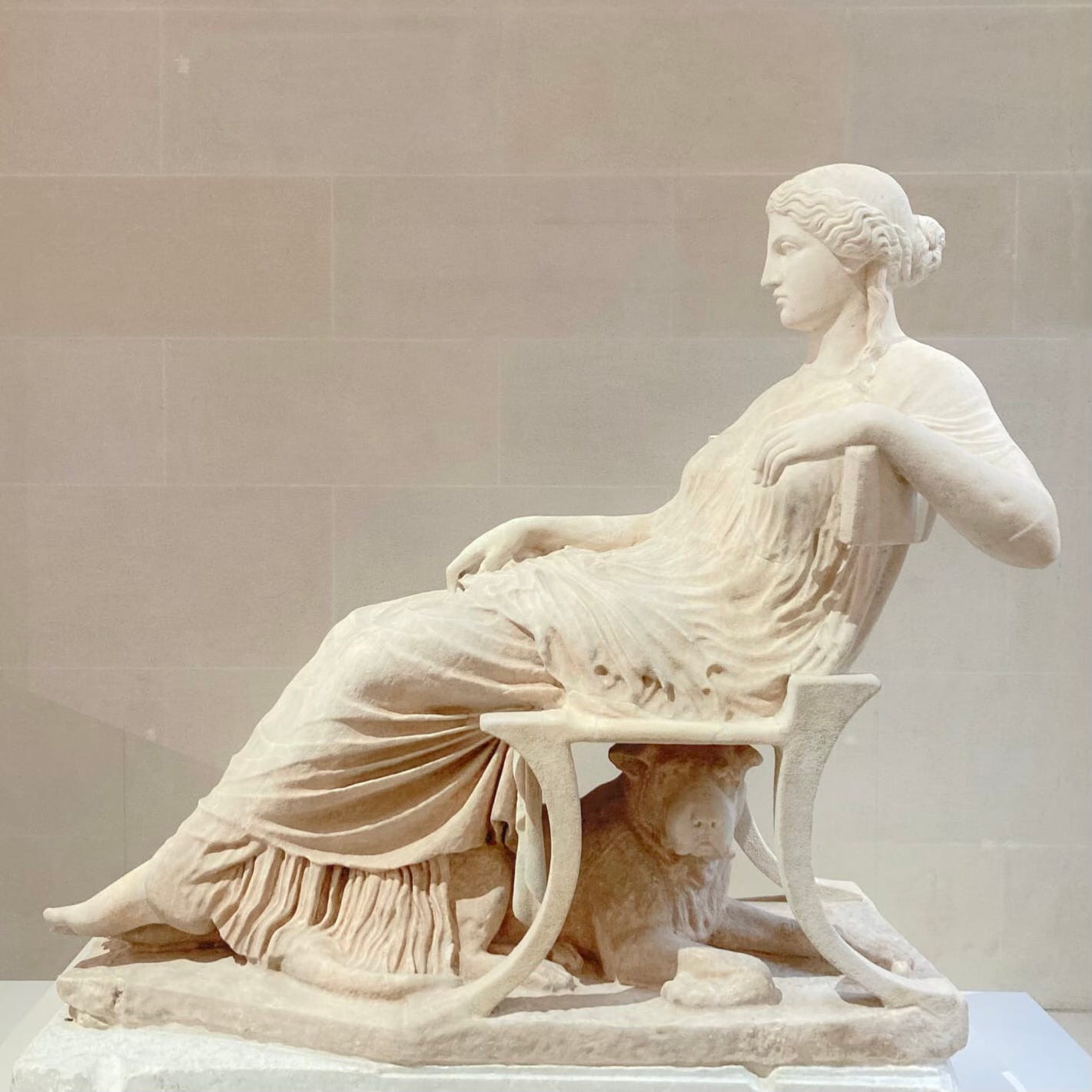
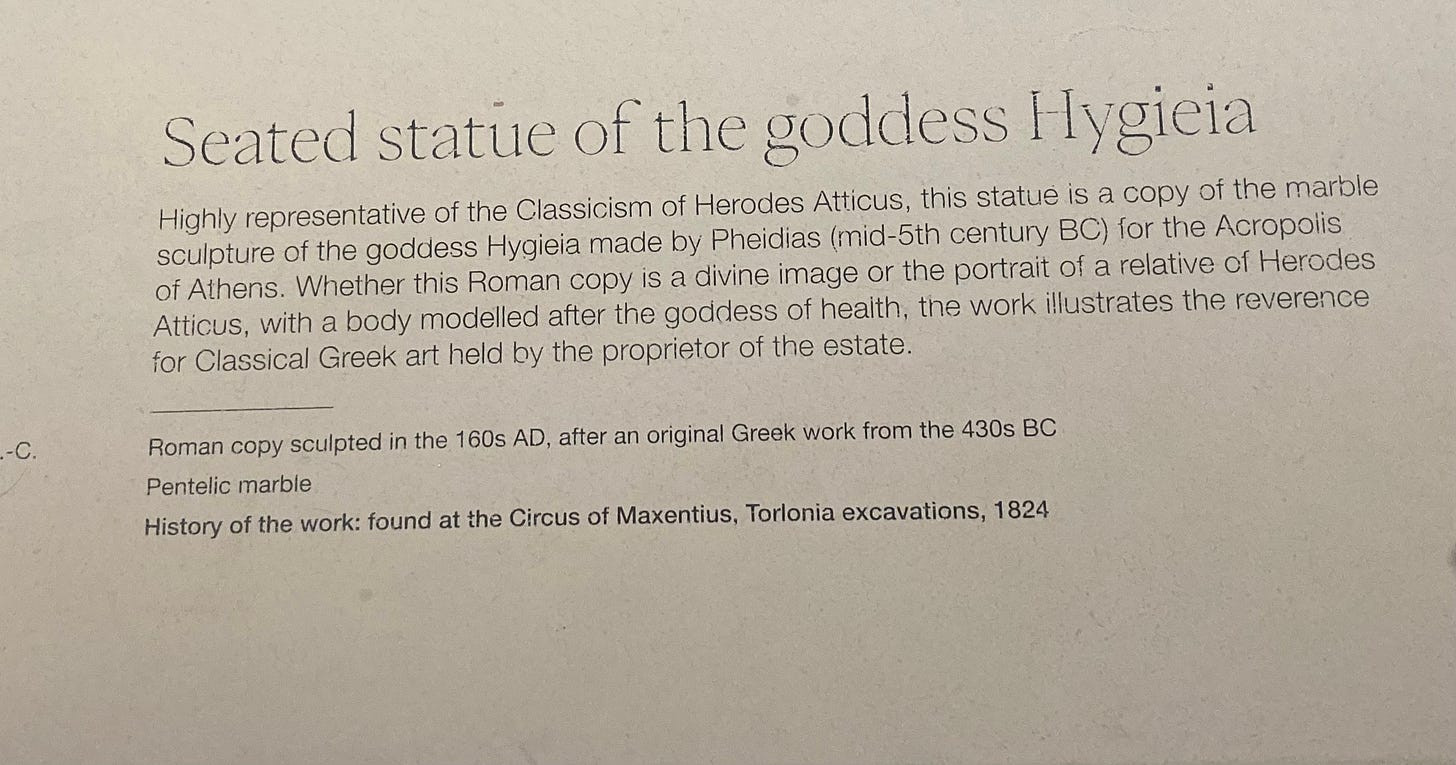
Seated statue of the goddess Hygieia**
The statue of Hygieia herself fascinated me. It’s a copy of a Greek original. But for me it held all the power of a masterpiece. Look at how relaxed the goddess is. She’s leaning back with perfect poise, one arm slung over the chair. No slouching or turtle neck syndrome for her. She embodies absolute wellbeing; everything about her is at ease. And underneath her chair is this large canine.
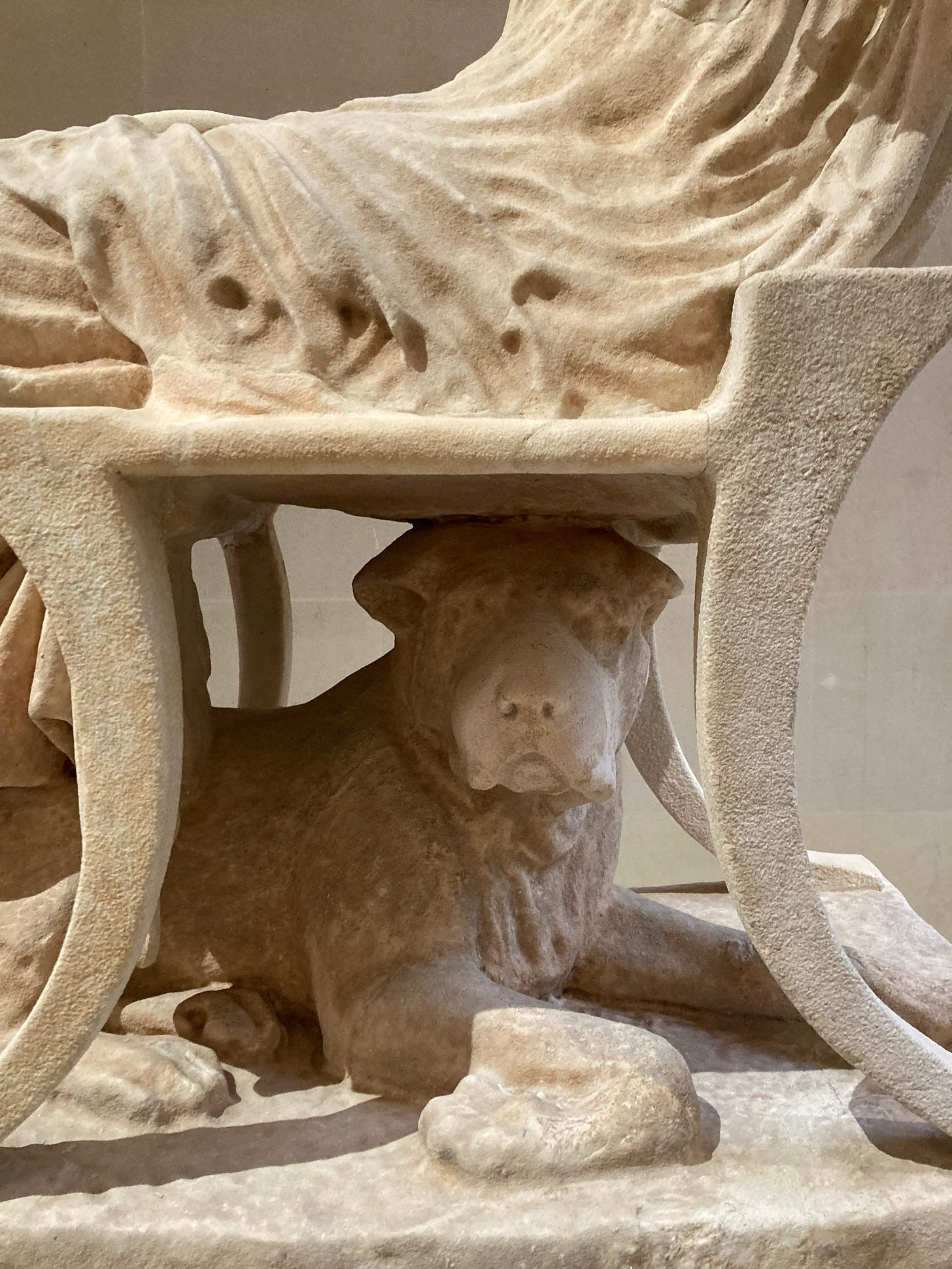
A big dog with a big head. He looks like a Molossus, the now-extinct ancestor of the mastiff. I imagined him as a sort of St Bernard, helping a poor lost hiker with a nice dose of whisky. Later I discovered my instinct was right: the St Bernard is a descendant of the Molossus.
Why then was I so perplexed by this gorgeous statue? Well, it just wasn’t Hygieia in her usual stance or with her usual animal. The statues of her, in countless temples across Greece, would have depicted a goddess seated upright or standing, ready to spring into action. There is almost always some kind of snake wound around some part of her body.
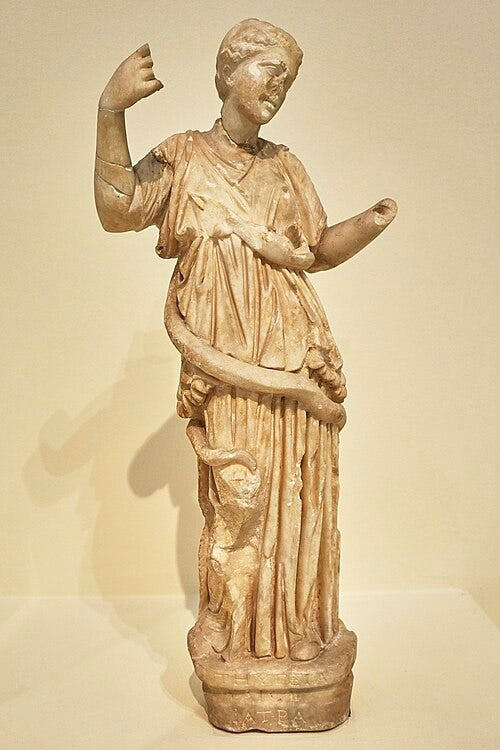
Statuette of the goddess Hygieia. Pentelic marble. Found in the sanctuary of Asklepios at Epidauros.
Some statues (copies of Greek originals again) depict her feeding a snake from a little dish. This all makes sense: snakes were used in the temples for healing, as indeed were dogs (I touched on this in my last post).
But, come on, this particular dog doesn’t seem to be about healing. His paws are folded back. His gaze is relaxed. His tail pokes out from under Hygieia’s dress. Might he, instead, be the secret to the goddess’ own equilibrium?
Here’s what I think: the statue I saw at the Louvre depicts the goddess off-duty, relaxing. The dog is there to bring her comfort and support. The dog is the very thing that allows her to stand, pick up a snake and be efficient when it’s required of her. But right now, she’s taking a well-deserved break.
Ultimately that’s what my GP’s dog is all about. She’s sustains the doctor through her long days and weeks. As the procession of infinite patients takes place.
Sure, I’m also delighted when the dog deigns to leave her regal basket to sidle up to me. I’ll pat her back and she’ll stare at me with those lovely bulging eyes. I may even bring her thin slices of ham from the local deli. An offering, because I’ve come to know her full worth.
She is the source of the doctor’s joie de vivre. After she’s examined me and the prescription is written out, the GP may open her cupboard and bring out her latest acquisitions for me to admire: a blue-striped doggy mariniere, a lovely Burberry style trench coat for canines. And the piece de resistance: a shiny black vinyl raincoat which she calls the ‘Belle de Jour’ coat, in homage to a very sexy Catherine Deneuve. She’s shown me videos of the dog racing across a beach or out at sea on a blow-up raft. By the end of most consultations my face is sore with laughter and I am truly happy to be living in France.
Sometimes, if it’s late, the many hours of work may dim the doctor’s sparkle. But even then, if you speak of the dog, her tired face will shine.
We’re usually too caught up in worries about our own health to pay attention to the practitioner’s wellbeing. My last GP was depressed and disgruntled. He was in a constant battle with his computer, a sticky door, no-show patients and a waiting room jammed full of masked people. He would greet me with a weary sigh. I’d wistfully remember what he was like years earlier when we’d discuss Russian Literature and music. He’d been concerned about my mental health back then. Now I was concerned about his. He confessed that he no longer had any time to read. No time for anything. I wished there was some way that I could help him. I knew how hard the world had become for doctors particularly post-Covid. But in the end I just sought out a new GP.
Well, now I know - it’s the dog that makes the practitioner well. The dog takes care of the doctor so she can take care of us, her patients.
This episode from our podcast features Hygieia. I play the goddess but she’s just a mortal at this point!
And in this episode I adapted a wonderful doggy myth (but, I must warn you, it’s also got a very very freaky part to it…)
· Let’s face it - pets are good for everyone’s well-being. A landmark study showed that stroking a dog for just 10 mins a day could help with stress. But it seems that doctors in the UK aren’t allowed pets in their office. A big shame. When I was a teen, my GP had a wonderful, squawky parrot.
· In France dogs can assist victims of crime who have to testify in court. They have a calming effect. Well of course they do!
· Personally I’m a bit more of a cat person (but please don’t tell the dogs)
*Translation by Michael North, 2002
** That statue is fascinating in every way! I saw it in a temporary exhibition at the Louvre this year. It’s may be a Roman copy of a Phidias - Phidias the master sculptor!! Yes! But actually, who knows…maybe, after all, it isn’t even depicting Hygieia haha.