

I’d always thought of feet as smelly, but when I reached my teens, Handel’s Messiah set me straight. My parents used to play it on a loop.
How beautiful are the feet of them
That preach the gospel of peace
How beautiful are the feet
How beautiful are the feet of them
That preach the gospel of peace
Well, this was news to me. It was also rather confusing. My father was a lay preacher and when I looked at his feet I used to think, he may preach the gospel of peace, but his feet are certainly not beautiful.
Years later I moved away from Christianity and its perfect Christian feet and grew obsessed with festering mythical ones instead. The story of the archer Philoctetes and his terrible foot obsessed me at university and decades later I still think about it.
Now, please don’t get me wrong: I don’t care for rotting feet in the real world. I don’t even care for stinky feet. My son, a committed climber, has taken me into bouldering gyms and I can tell you that the smell of all those sweaty feet is an abomination.
In the world of mythology though, it’s a different matter: you don’t have to smell the feet, just imagine them. And there’s something so terribly compelling about them. Tragedy is transgressive, disgusting, unthinkable and sublime.
So it is with Philoctetes’ tale. Initially things are looking good for him. He carries quite the symbol - Heracles’ bow and arrows - gifted to him by the hero as he was dying. This weapon, along with with his courage, makes Philoctetes a valuable member of the Achaean crew as they set sail for Troy. They make a quick stop-over on the island of Chryse where our man is bitten by a snake. It doesn’t kill him, just turns his foot nasty. Odysseus says:
His swollen foot groaned with a festering ulcer,
and we could not so much as sacrifice
in peace of mind, when all our camp was filled
with savage, sacrilegious screams of pain,
moaning and wailing.
Philoctetes, Sophocles
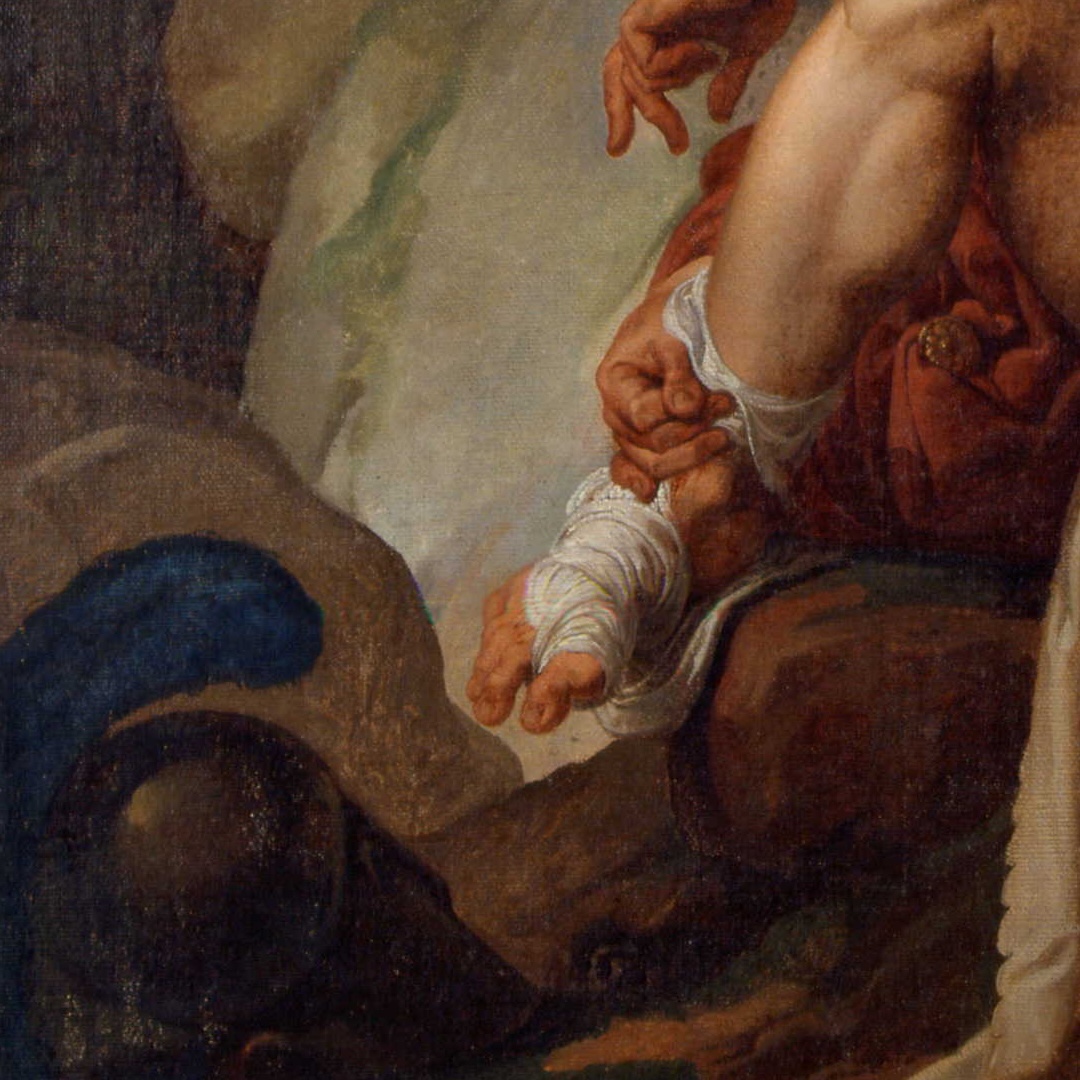
Back on the boat, the smell of the foot and the archer’s cries becomes unbearable. Ever the pragmatist, Odysseus convinces his crew to ditch Philoctetes on the island of Lemnos. The poor man can’t walk because of his putrid foot, which is now bloody and full of pus, he has to crawl around the island and use Heracles’ heavy bow to shoot birds for his supper. He lives in a cave and his clothes turn to rags. He's totally dejected, in extreme pain and far from home. Initially one of the gang, he's now become a total outsider. For me that’s part of the story’s appeal. I've always related to fictional misfits and Philoctetes is an extreme case – he becomes an outcast for almost ten years. Nancy Worman* sums up his state:
‘Philoctetes’ diseased body, fluctuating emotional states and tenuous hold on verbal control… serve to highlight the hero’s outsider status with a singular mix of physical deformity and mental distress.’
Although Chiron also has to deal with a terrible wound on his foot (or in some accounts his leg), he’s a very different character to the archer. An educator and healer, he’s brought up so many of mythology’s heroes and healers. As a centaur, Chiron also has a very particular body: he's half-man, half-horse.
Imagine my delight when my dear friend, Morag Cross, agreed to write our Centaurus episode which centres on Chiron. I assumed I’d found another rotten-foot-or-leg-obsessive in Morag but, when I got round to asking her, she told me it was simply Chiron's plight that made her engage with the theme. I was a little disappointed, though once I read her text, I forgave her. Her descriptions of the wound and its stench are wonderfully - or should I say horribly - vivid. Worthy of Sophocles!
It's a bitter-sweet episode. Chiron eventually succumbs to the poison from his wound. His plight is all the more terrible because, though his healing powers are great, he cannot save himself. He does, however, redeem the Titan Prometheus through his death.
Greek myths make up a great interconnected web and finding the links between characters and stories is always a joy. Both Heracles and the Hydra intertwine with the tales of Chiron and Philoctetes.
Out on the plains of Troy no one thinks twice about the archer they abandoned until the war reaches a stalemate. At that point Odysseus captures the seer Helenus who reveals that victory for the Achaeans depends on retrieving the bow of Heracles. Oh damn, they left it with Philoctetes and his smelly foot on Lemnos! Finally, they realise they'll have to return for him. Heracles may have inadvertently caused Chiron to die, but he does redeems Philoctetes posthumously.
And in a neat finish to the story, once he joins the Achaeans in Troy, Philoctetes is healed by the sons of Asclepius, whose father was taught by Chiron, of course.
There’s one other detail that I love about this story - once Philoctetes is whole again, he wields the great bow and looses a fatal arrow at Paris, the man many blame for starting the war. That very arrow is said to have been dipped in the Lernaean Hydra's blood by Heracles too.
For a Greek tragedy, Philoctetes has a surprisingly happy ending. Which makes a change! And it also inspired a beautiful Lieder by Shubert. Although I feel that he misses the point. There’s no mention of any feet, smelly or not.
_________________________________________________________________________________
Morag Cross' Chiron episode is here:
And Philoctetes appears in this episode:
*Infection in the sentence: The Discourse of Disease in Sophocles’ Philoctetes
The image is a detail from Philoctetes Wounded by Francesco Hayez