

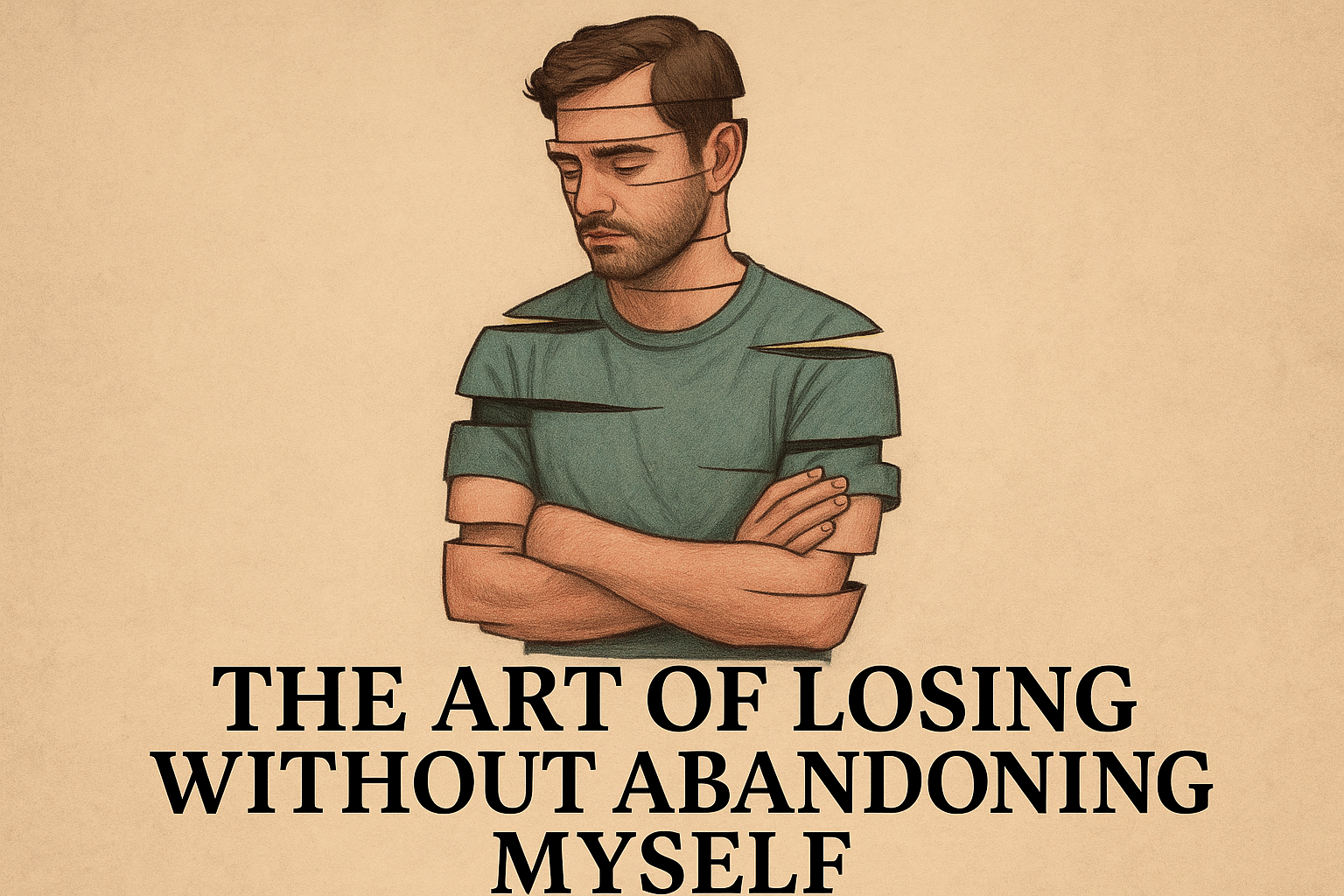
“Relapse is not a failure of will, but a fragmentation of coherence.”
I have relapsed more times than I can count, but fewer than I remember. The numbers blur. The blurring is not due to the events being small—each one felt like an earthquake—but rather because memory rearranges itself around shame. At times, my life has oscillated between clarity and chaos, between the serene stillness of sobriety and the seductive call of escape. And still, somehow, I write these words not as someone who is lost, but as someone who is learning how to be found, again and again, without disappearing entirely.
This is an essay about addiction, yes, but more deeply, it is about self-coherence. This essay explores the concept of the art of losing without resorting to abandonment. This essay explores how we can maintain our dignity even in the face of our darkest lapses, provided we learn to hold ourselves with compassionate self-accountability.
I. The Dopamine Tug-of-War: Between Wanting and Withering
Anna Lembke, in Dopamine Nation, speaks of the pleasure-pain balance. Every moment of indulgence in our brains tilts us towards an equal and opposite pain. The science is compelling: with repeated stimulation (be it cannabis, cocaine, social media, or even praise), our dopamine receptors downregulate. We feel less joy. We chase more. The reward becomes the remedy for a wound it helped create.
I came to learn that this state is known as anhedonia. Anhedonia is the absence of pleasure. Anhedonia is characterized by a stagnation of the soul. After quitting weed for the fifth or fifteenth time, I remember staring at a blooming tree and feeling nothing. No awe. No wonder. It was simply the echo of a sensation that I was no longer able to access. And the voice inside me whispered:
“See? Without the drug, you’re less alive.”
Relapse often isn’t a return to pleasure. It’s a negotiation with numbness. Desperation forces a compromise. I never lit up because I wanted to feel high. I did it because I couldn't feel myself anymore. And so, in chasing dopamine, I wasn’t escaping life. I was trying to escape the unbearable absence of life within.
II. Thought-Disorder and the Hypertextual Mind
I have what some therapists gently call a “hypertextual mind”—a thought disorder of sorts where one idea links to ten others before a single one is resolved. It resembles a neural browser with an excessive number of tabs open, each demanding attention. The digital age rewards this condition. We call it multitasking. Hustle. Creativity. However, it emanated from within; it represented fragmentation.
Andrew Huberman might call the phenomenon a dysregulated attentional loop—where the prefrontal cortex loses its ability to prioritize in the storm of limbic impulse. We end up chasing novelty, abandoning continuity.
“Imagine trying to build a cathedral while every few days you torch the scaffolding. That’s how recovery felt when I lacked internal coherence.”
This is where neuroscience meets storytelling. We are, as Antonio Damasio suggests, not just thinkers who feel, but feelers who narrate. The self is a story held together by neural glue. When that glue dissolves—under trauma, addiction, or collapse—the story shatters. I wasn’t just relapsing. I was fragmenting.
III. From Imaginary Friends to Adult Realism
As a child, I had an imaginary friend named Juno. She was my witness. My protector. She didn’t judge my messy bedroom or my emotional outbursts. As I grew older, Juno faded. Adult realism has replaced my childhood fantasy. By performance. I felt the urge to stand out in a world dominated by numbers.
Constructivist psychology teaches us that interaction builds identity. We reflect ourselves back through the social mirrors. But what happens when we shatter those mirrors? When do we perform for applause, curate for clicks, and measure our worth in productivity?
Chris Williamson, in his many conversations on Modern Wisdom, speaks of the modern condition as one of disembodied identity—where our sense of self is outsourced to the scroll. I recognized the danger in my addiction to productivity. I needed to be building, proving, and optimizing. Rest was failure. Stillness was self-betrayal.
“And so the drug was not always the substance. Sometimes, it was the doing. The addiction to effort. The high of control.”
IV. Addiction as Misaligned Essentialism
We live in an era of essentialism. Find your “why,” we are told. Find your niche, your core, your passion. But what if our behavior betrays our essence? What if we are fundamentally misaligned in our most vulnerable states?
This misalignment is not a failure of morals, but of neurobiology. Huberman explains that habit loops are embedded in the basal ganglia, which are resistant to conscious override. In other words, we repeat what we rehearse, not what we intend. Our behaviors shape our brains more reliably than our beliefs do.
“Relapse, again, is not simply a choice. It is a cognitive breakdown—a failure of neural integration.”
The impulse of the moment defeated my ideals of clean living, spiritual growth, and compassionate connection. This is not due to weakness, but rather a lack of embodiment.
Rick Strassman observed in his work on altered states: when identity dissolves, both demons and angels emerge. The question is not what we see, but what we integrate.
V. Humanistic Productivity and the Myth of Output
In recovery, I learned to redefine productivity. I redefined productivity not as output, but as coherence. As dignity. This is achieved by maintaining consistency between my values and actions.
Humanistic psychology, from Maslow to Rogers, speaks of actualization. But we’ve distorted it. We have transformed it into a performance. In my worst moments, I was still making spreadsheets, planning campaigns, and hitting deadlines. From the outside, I was thriving. Inside, I was rotting.
“To perform well while living poorly is not success. It is a quiet implosion.”
So I began a new form of productivity: making my bed while listening to my breath. I strive to write a poem without publishing it. Saying no without apology is a crucial aspect of my life. I view productivity not as a projection, but rather as a form of closeness.
VI. The Protocol of Compassionate Self-Accountability
Out of this fragmentation, I have crafted a model. I do not offer it as a cure but as a compass.
Compassionate self-accountability is the practice of staying connected to oneself even in the midst of disintegration. It is not soft. It is not permissive. It is rigorous love.
Here is what it looks like:
Track Without Shame: Every lapse is data. Record it. Reflect on it. But do not drown in it. Use Lembke’s framework: what was the pleasure? What was the pain? Where was the imbalance?
Re-story the Self: Write the day as a narrative, not a report. What did your nervous system feel? What did your inner child need? Integration starts with imagination.
Build Friction: Huberman emphasizes the importance of friction in behavior change. Make relapse hard. Hide triggers. Delay gratification. Create distance between urge and action.
Rehearse Coherence: Practice acting in alignment even when you don’t feel it. Neuroplasticity is loyal to repetition. Show up for five minutes. That’s enough to start.
Restore Dignity: This aspect is the most sacred. Remind yourself that you are resilient. You are becoming.”
VII. Losing Without Abandonment
There is an art to losing. It is not the art of winning less. It is the art of remaining whole while fragmented. It involves remembering who you are amidst the challenges.
In the Buddhist tradition, the self is a river. We are not static. We change constantly. But the current can remain consistent. In recovery, I found my current. It's not about achieving perfection, but about giving back.
I relapse less now. But more importantly, I abandon myself less frequently now. I let the sadness in without letting it redefine me. I let the cravings pass through without caging my joy. I hold myself like a parent, like a poet, and like a scientist: curious, compassionate, and committed.
“To fall is not to fail. To fragment is not to vanish. The art of losing is the art of staying.”
And I am still here.
Resources Referenced
Lembke, A. (2021). Dopamine Nation: Finding Balance in the Age of Indulgence.
Huberman, A. (2022).The Huberman Lab Podcast features episodes focusings on neuroplasticity, addiction, and stress.
Strassman, R. (2001). DMT: The Spirit Molecule.
Williamson, C. (2020-2024). The Modern Wisdom podcast features conversations about behavioral psychology and identity.
“Coherence is not a constant state. It is a repeated act of courage.”