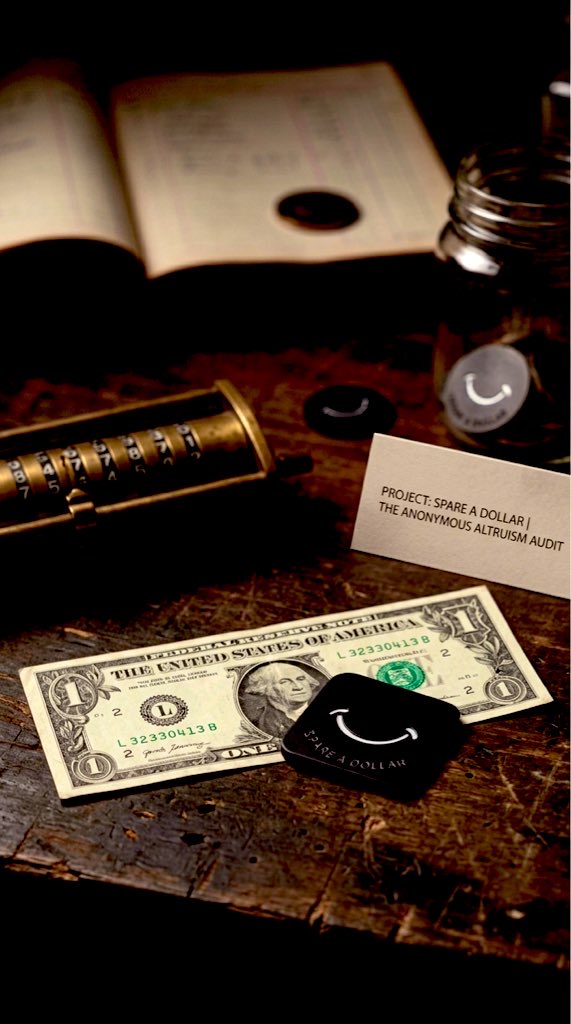

In the world of manufacturing, we measure the integrity of a part by its "yield point"—the exact moment it bends under pressure. I am a mold setter by trade, and I am applying that same industrial logic to the human soul.
Philosophers argue that "Pure Altruism" is a myth. They say we only help others to feel good about ourselves, to look good to our peers, or to "buy" our way into a better afterlife. They claim every good deed has a hidden invoice attached.
I am here to test that theory.
The Variables of the Experiment:
1. The Amount ($1.00): You cannot brag about giving a dollar. It is too small for a status symbol and too common for a tax break. It is the most "neutral" unit of value we have.
2. The Anonymity: Your name is not the data point. Your choice is. By keeping this study anonymous, we strip away the "Social Kickback."
3. The Trace: Every Sunday, I provide the proof. I declassify the "Trace Narrative"—the receipts and photos showing exactly where the collective "ones" landed.
The Hypothesis:
If 100 strangers give $1.00 knowing they will get zero credit, zero fame, and zero tax benefits—then Pure Altruism is not a myth. It is a measurable, industrial fact.
You aren't "buying me a coffee." You are contributing a single integer to a global proof.
Is trust dead? Or have we just stopped looking for it in the small things?