

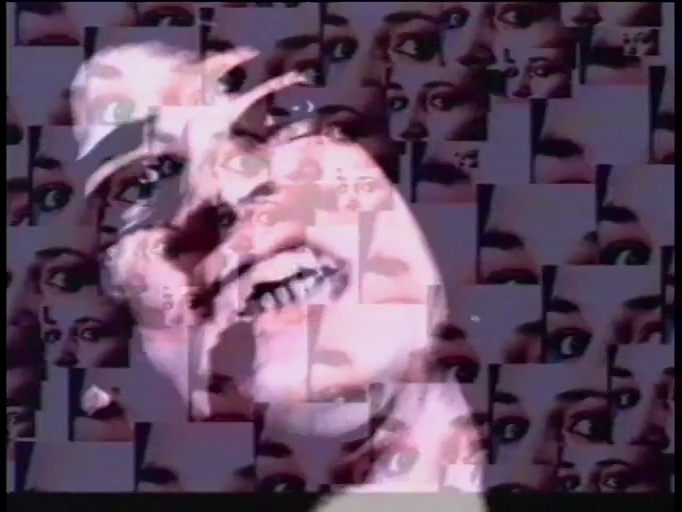
 Still from the music video "Discipline" by Borghesia. (c) Neven Korda
Yesterday (September 23, 2025), the festival was excited to screen Pietro Anton's seminal documentary Electronic Body Movie about EBM. It probably won't be the last screening.
EBM also attracted a considerable fanbase behind the Iron Curtain from the mid- to late 1980s onward. Thanks to the overspill of media (primarily radio) from neighboring Western countries such as West Germany, Austria and Italy into Western Czechoslovakia, most of the GDR and western Yugoslavia, shows on adventurous state-owned stations on Hungarian and GDR airwaves which played EBM tracks and increased cultural exchange across the Iron Curtain and lastly, West European and US labels like Mute, Play It Again Sam and Wax Trax releasing tracks from Eastern European industrial and EBM groups internationally.
This non-exhaustive EBM East clip selection (from bands that first appeared prior to or in the first years of the post-socialist transition) is an appetizer for further investigation. Some clips make use of EBM visual tropes (industrial imagery like gears, male homoerotic imagery, early digital age paranoia regarding surveillance and mind control, found footage referencing World War 2 and the Cold War, Soviet avantgarde etc.) However, a vantage point from the other side of the Iron Curtain shifted meanings – for
example, a Polish band making a video about the Wehrmacht occupation of its country might have a different context than a German one using similar imagery. Borghesia explicitly presented its ties to the queer community in its videos.
In the (former) GDR, acts like DAF, Die Krupps, Anne Clark and Depeche Mode plus their EBM tour support acts Portion Control, Front 242 and Nitzer Ebb (heard on adventurous youth radio station DT-64 and illicit West radio broadcasts and bootleg tapes made of them) inspired a thriving “black scene" which embraced post punk, industrial, EBM, more guitar-based Goth and darkwave in equal measure. Major darkwave festivals like Wave Gotik Treffen in Leipzig emerged. To this day, bands in Germany play EBM,
often along with other dark scene styles.
Ex-Yugoslavia
Borghesia was founded in 1982 as a music, performance and video art collective in Ljubljana, Slovenia (then Yugoslavia). The group was a driving force of a cultural scene that promoted queer rights (as co-organizers of Ljubljana’s first gay disco and the first queer cultural festival in Eastern Europe) and progressive social movements while exploring interdisciplinary media art practice. After independent releases in their home country and Italian label Totò Alle Prese Coi Dischi, Borghesia signed to Play It Again Sam. Originally based in Brussels, PIAS signed Front 242, Neon Judgement, Skinny Puppy, Cassandra Complex, Young Gods, Meat Beat Manifesto and other seminal darkwave/industrial dance acts. PIAS featured them (more or less accurately) on the 1988 genre-defining compilation This Is Electronic Body Music, which raised Borghesia’s profile in the West. To this day, Borghesia (after 1989 primarily a music group with core duo of Dario Seraval and Aldo Ivancic and other musicians) sporadically release albums of new material (most recently Proti Kapitulaciji in 2018) and are active in Slovenian political life.
Clip
Discipline (1989)
directed by ZANK (Zamira Albejgovic and Neven Korda)
Not a cover of the track of the same name by industrial pioneers Throbbing Gristle, although their exploration of politics and transgressive sexuality is an inspiration. The video mixes footage sampled from Leni Riefenstahl’s Olympia, former Serbian autocrat Slobodan Milosevic, Yugoslavian parades and other displays of Communist state pride with brightly colored early computer animation and the band engaging in gay, mild BDSM sexual activities. Part of Borghesia’s video album Triumf Zelje (Triumph of Desire).
Poland
Wieloryb - The band name translates as “whale” (literally big fish). Founded 1991 in Gdansk, Wieloryb fused EBM, punk and techno, later pursuing a more industrial-experimental direction with a persistent beat.
Clip
Vocoder (1995) is an early clip which foreshadows the band's more industrial direction.
Düsseldorf - Founded in 1989 in Katowice, the name is an obvious reference to the hometown of EBM pioneers DAF and Die Krupps (plus Kraftwerk) and links those two cities’ industrial age heritage. Their live debut was at the legendary Jarocin rock festival in 1990. Düsseldorf has since become one of Poland’s
leading EBM acts.
Clip
Flakturme (2024)
Visuals: Jakub Skowronski
Flakturme is a track from Düsseldorf’s concept album Buncker Musick. Upon first appearance, song titles, martial sound and visual samples of combat scenes indicate a paeans to the military, but the Polish-German project (in cooperation with Leander Rönick of Elektrokraft) aims for a more ambiguous statement about the human cost of war, also for those in the armed forces.
Hungary
Plasma Pool (name refers to David Cronenberg’s body horror classic The Fly) is an EBM project that Hungarian extreme metal vocalist Attila Csihar pursued when on downtime from 1980s Hungarian black metal band Tormentor, Norwegian black metal band Mayhem, US drone/doom metal outfit Sunn O))) and electronic duo ∏ III.XIV (P314). Plasma pool was originally founded in 1989 and is intermittently active to this day.
Clip
Unfortunately, actual music videos by Plasma Pool are widely available. To give a taste of the band's work, here's a track from the 1999 album Drowning.
Czechia
Vanessa, named after US pornographic actress Vanessa del Rio, Vanessa emerged around 1989 in Prague, with ties to the punk scene via former members of bands Michael’s Uncle, Plexis and Sunshine. In the late 1980s and 1990s dominated by a merciless EBM beat, have since veered more into a more guitar-heavy
industrial rock sound. Their lyrics tackle social and political themes head on.
Clip
Prokopat Se Ven (1992)
The title roughly translates as “dig your way out”. Dystopic vision of surveillance and oppression in the early digital age, Three years prior, Czechoslovakia rid itself of one police state; since then, the early utopian
promise of computers and cyberspace was curdling into something more sinister, a new prison?
Gun Dreams – founded in Pardubice (125 km east of Prague) in the late 1980s. Released music on cassette (collected on the self-released compilation The Old Gun (Rare Material 1988-92) ), then signed to Czechoslovakia’s upcoming indie label Globus, releasing their debut album Totem in 1993. Still
play live gigs here and there.
Clip
Der Mussolini (1993)
Sadly, no video exists of this cover version of one of EBM’s founding tracks, but worth a listen to bring things full circle.