

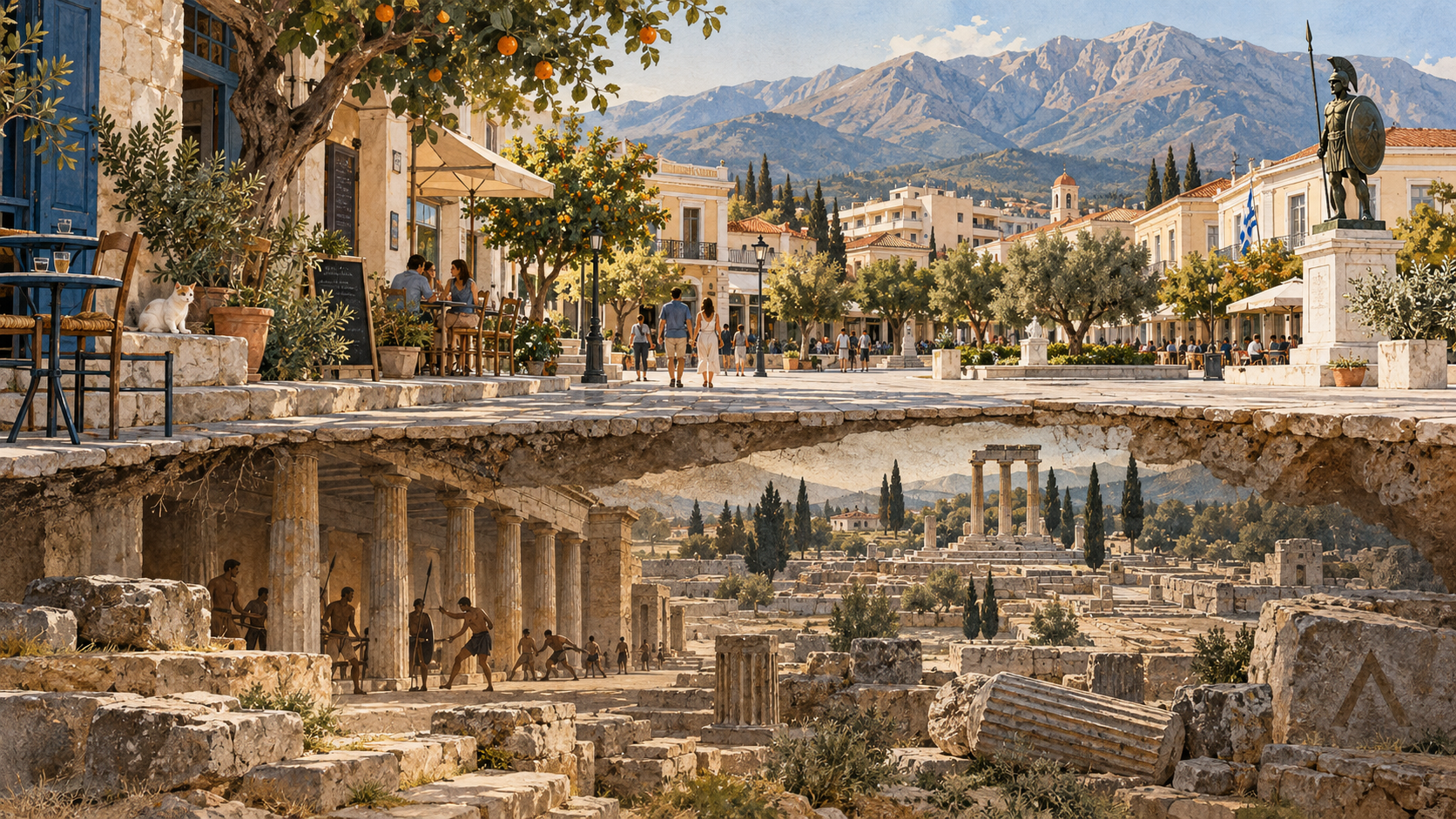
When people hear “Sparta,” they usually picture bronze shields, red cloaks and Leonidas at Thermopylae.
But modern Sparta is not an ancient city frozen in time.
The present-day town was founded in 1834, on and around the remains of ancient Sparta, after the creation of the modern Greek state. It was deliberately planned as a new city, with broad streets, squares and neoclassical buildings. Visit Greece
That creates a strange contrast.
Ancient Sparta was one of the most famous powers of the Greek world — yet today its archaeological remains are surprisingly modest compared with places like Athens, Delphi or Olympia. Even Greece’s official tourism site notes that Sparta does not have one huge archaeological complex that immediately conveys its former power. Visit Greece
And modern Sparta has another side people rarely associate with the name.
It sits in a fertile plain of olive, orange and lemon trees, with Mount Taygetus rising dramatically nearby. Visit Greece
There are also traces of a later, very different Sparta.
Roman Sparta was wealthy enough to produce elaborate mosaic floors. Two surviving examples — showing the Abduction of Europa and Orpheus charming animals — can now be seen in the House of Mosaics in the modern city. Visit Greece
So the Sparta that exists today is not really a continuation of the movie image.
It is a modern Greek town built over layers of ancient, Roman and later history.
The warriors are gone. The name stayed. And everyday life grew around it. 🇬🇷
Quiet Greece — small stories behind famous names.