

Rating: 8.5/10
Bryan Fuller’s 2026 release Dust Bunny is what I imagine would happen if John Wick stumbled into the world of Alice in Wonderland, where the Glock or sniper rifle would invariably be traded for a custom, heavy-duty machete or short, tactical sword.
A world where the protagonist needn’t tumble down a rabbit hole to find madness; instead, the surreal nightmare of Wonderland bleeds directly into the floorboards of her inner-city apartment, proving that the most terrifying ‘Other Side’ is the one we live in every day.
And terrifying is definitely one way to describe this twisted fairy tale, certainly for the opening chapters of the film, where you would be forced to question whether any of the material is suitable for young people.
These opening salvos aren’t terrifying due to the blood-stained action or introduction to a mysterious monster, but rather because on the face of it, the two-character leads appear to be governed by an inherent trauma, suspicions that are confirmed as the plot to this stunning movie gradually unfolds.
In film circles reference is often made to an actor’s eyes being the centerpiece of their performance, the feature most likely to determine the level of their skill, and in this particular movie the eyes are absolutely everything for Sophie Sloan, who takes on the role of Aurora, a girl whose family is killed by a monster under the bed.
While Sloan’s actual age is not widely publicized, her acting achievement in this movie remains remarkable for her age, which I can only assume ranges somewhere between 8 and 10 years old.
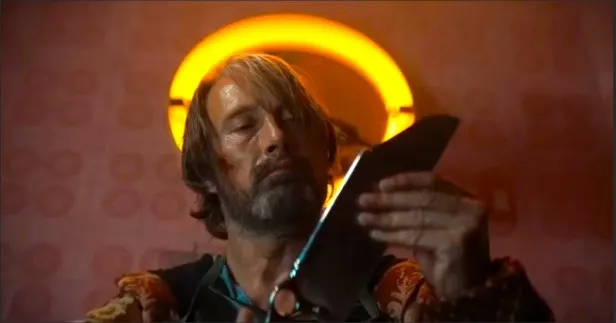
Sloan’s partner in crime for the 106-minute running of this spectacle is Mads Mikkelsen, an absolute master of acting with the eyes, and the extraordinary chemistry between the two is one of the things you notice immediately, which is what makes Dust Bunny work so well as a cinematic production.
While we could debate whether Dust Bunny would thrive in their absence, there can be absolutely no doubt that Mikkelsen and Sloan elevate it.
Mikkelsen, known simply as Resident 5B in Dusty Bunny, is essentially our John Wick, but oddly enough even more mysterious.
Beyond not being assigned a name, his entire hitman operation is shrouded in some mystery for sustained periods of the movie, which helps audiences buy into some of the fantasy.
Not only do we later learn that Resident 5B has a dysfunctional relationship with his industry peers, but that he also has a dysfunctional relationship with his own mother, both aspects being clear sources of the trauma, beyond the nature of the actual work.
You can also tell almost immediately in this film that Aurora is coping with a sense of loss, but that trauma is compounded by the implication of past abuse, and a sprinkling of guilt for the consequences of dealing with that abuse.
It is all a considerable amount for a young girl to cope with, but there is a fearlessness about Aurora that we can now conclude is brought on by a sense of not having anything to lose.
So, let us expand on this manifestation of trauma that drives Dust Bunny’s narrative.
The titular “Dust Bunny” — a 12-foot-tall, fluff-covered monster with rows of jagged teeth — is not just a creature under the bed; it is a literal representation of the chaos and grief following Aurora.
Among other things, Aurora has been moved through various foster families, and she believes the monster “ate” her parents.
The film later reveals that the creature was born from an accidental wish she made, representing the “unprocessed baggage” that follows a traumatized child — it is always there, lurking under the floorboards of her “safe” spaces.
The film also skillfully plays with the “Believe Children” trope, contrasting how kids and adults interpret violence.
We encounter several examples of this early in the film, but a notable development is Aurora watching her neighbor, Resident 5B fight a “dragon.” In reality, he is a hitman taking out a gang hidden under a parade costume.
However, Aurora filters the brutal reality of a professional assassin through the lens of a fairy tale, which helps create the ambiguity that keeps this film so interesting.
Conversely, the adults in the film (like the hitman himself and Sigourney Weaver’s character, Laverne, initially dismiss Aurora’s monster as a coping mechanism, failing to recognize that in her world, the threat of violence is very much a living, breathing beast.
The heart of the story, though, is the “Lone Wolf and Cub” dynamic created by Aurora and Resident 5B, where both characters are defined by their isolation.
Resident 5B is “the loneliest hitman alive,” and Aurora is an orphan the system has repeatedly failed, and their bond is cemented through a “shared monster” — he realizes the assassins coming for him are the very “monsters” Aurora is trying to hire him to slay.
By the end, the hitman moves from a reluctant neighbor to a surrogate father figure, providing the emotional protection that Aurora’s biological and foster families could not.
A final major theme, and perhaps the most important takeaway from this movie is that you cannot truly “kill” your monsters; and that you can only learn to live with them, which is what Aurora learns to do.
Throughout the movie, Resident 5B tries to kill the bunny, but it only grows in ferocity, the more he comes at it, and it is only when Aurora asserts emotional control and “claims” the monster that the violence stops.
The film concludes with the monster’s shadow still following her — a poignant visual metaphor that while trauma never truly leaves, it doesn’t have to consume you either.
The best thing you can ever do is sit down to a movie without any expectation whatsoever, and if you do that with Dust Bunny in particular, you will be absolutely blown away by the level of thought and creativity that has been put into the production.
In my experience, January is usually a slow month for the industry, that is still engulfed in Academy Award conversations, but all four movies I have watched thus far — The Bone Temple, People You Meet on Vacation, The Rip, and now Dust Bunny have been absolute knockouts, worth far more than the attention they have been getting.