

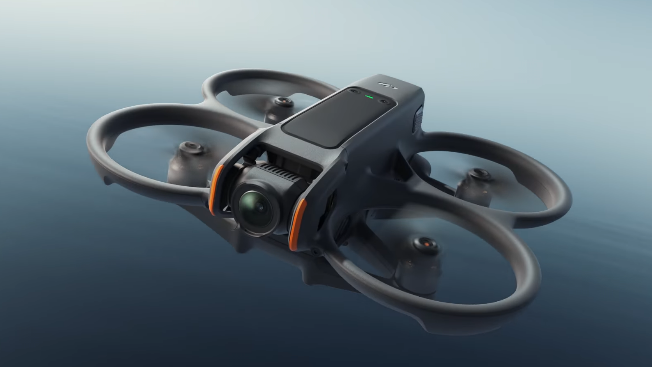
Traditional camera drones ask you to stand still and compose from a distance. Follow-me machines ask you to move while the aircraft keeps up. The DJI Avata 2 asks something else entirely: put the goggles on, take the controls, and fly from inside the aircraft. It is first-person view in a package designed to be approachable rather than punishing.
That makes it a different tool from every drone covered so far in this series. The Mini, Flip, Air 3S and HoverAir models prioritise stability, framing, or subject tracking. The Avata 2 prioritises immersion and the physical sensation of flight. For many pilots that difference is the entire point.
Key Specifications (Manufacturer Data)
Aircraft
• Takeoff weight: approximately 377 g
• Dimensions: 185 × 212 × 64 mm
• Max flight time: approximately 23 minutes (controlled wind-tunnel test at constant 21.6 km/h, photo mode, obstacle avoidance set to Brake)
• Max hovering time: approximately 21 minutes
• Max horizontal speed: up to 27 m/s in Manual mode (lower in Normal and Sport)
• Internal storage: 46 GB
• Class: C1 (EU)
• Built-in propeller guards
Camera
• Sensor: 1/1.3-inch CMOS, 12 MP effective pixels
• Lens: FOV up to 155°; 12 mm equivalent; f/2.8; focus 0.6 m to ∞
• Video: 4K (16:9) up to 100 fps; 4K (4:3) up to 60 fps; 2.7K and 1080p high-frame-rate options
• Colour modes: Standard and 10-bit D-Log M
• Stabilization: RockSteady 3.0 and HorizonSteady (can be disabled)
• Photo format: JPEG
Transmission & Control
• O4 video transmission (manufacturer figures up to 13 km FCC under ideal conditions)
• Designed to pair with DJI Goggles 3 (or compatible) and DJI RC Motion 3 or FPV Remote Controller 3
• Binocular fisheye visual positioning for improved downward and rearward awareness
Why FPV Feels Different
Watching a live feed on a phone or controller screen is still second-hand. Putting on goggles and flying the aircraft from its own perspective changes the emotional register of the flight. Turns become more deliberate. Speed becomes more tangible. Mistakes feel more immediate. That intensity is the product’s core appeal.
The Avata 2 softens the traditional barriers to entry. Integrated propeller guards reduce the consequences of contact. Motion control and simplified acrobatic modes lower the skill floor. The 1/1.3-inch sensor and RockSteady/HorizonSteady stabilisation produce usable footage even when the pilot is still learning. It is not a pure freestyle racer, and it is not trying to be. It is an accessible FPV platform that still delivers the sensation that makes people stay in the category.
The Practical Trade-Offs
Twenty-three minutes of laboratory flight time is respectable for a ducted FPV aircraft, but real sessions will be shorter once you factor in aggressive flying, wind, and continuous high-bitrate recording. Extra batteries remain essential for anything beyond short sessions.
The ultra-wide 155° field of view is immersive in the goggles and distinctive in the final footage, but it is a very different look from the more natural perspectives of a Mini or Air. HorizonSteady and RockSteady help, yet the aesthetic remains unmistakably FPV. Buyers expecting traditional cinematic framing will find the look specialised rather than neutral.
At approximately 377 g the aircraft sits above the sub-250 g threshold in many jurisdictions, which brings registration and operating rules that do not apply to the lightest models in this series. The built-in guards and visual positioning improve crash resilience and close-range awareness, but they do not replace pilot responsibility or full omnidirectional sensing of the kind found on higher-end camera drones.
What Customers Tend to Report
Feedback on the Avata 2 is generally strong among pilots who wanted an approachable entry into FPV. Praise centres on the fun factor, the quality of the immersive experience with Goggles 3 and Motion 3, the improvement in image quality and dynamic range over earlier Avata models, and the relative forgiveness of the guarded design. Many describe it as the drone that finally made FPV feel accessible rather than intimidating.
Criticism tends to focus on battery life under aggressive use, the learning curve that still exists despite the simplifications, and the specialised look of the ultra-wide footage. Buyers who expected a traditional long-range camera drone or a pure freestyle racing machine sometimes sound less satisfied. Those who wanted the FPV sensation without building a custom quad or learning Betaflight tend to sound more positive.
Who the Avata 2 Is For
The Avata 2 makes the most sense for pilots who want to experience first-person flight without committing to a full custom FPV build, who value the combination of immersion and relative safety offered by the guarded design, and who are prepared to accept the aesthetic and regulatory consequences of the platform. It is a strong starting point for cinematic FPV content, freestyle practice in open areas, and anyone who has watched traditional drone footage and wanted to feel the flight rather than merely observe it.
It is less ideal if your priority is long, stable, composed shots of landscapes or subjects, maximum portability under 250 g, or pure hands-free follow-me capture. In those cases the Mini 5 Pro, Air 3S, Flip, or HoverAir X1 PROMAX remain more logical choices. The Avata 2 is not competing with them on their own terms. It is offering a different experience entirely.
Verdict
The DJI Avata 2 remains one of the clearest and most approachable routes into immersive FPV flying. The 1/1.3-inch sensor, 4K high-frame-rate options, 10-bit D-Log M, and improved stabilisation produce more usable footage than earlier consumer FPV packages, while the integrated guards and simplified controls lower the barrier that has historically kept many pilots out of the category.
Its limits are equally clear: specialised ultra-wide aesthetics, modest real-world endurance under hard flying, and a philosophy that prioritises the sensation of flight over traditional composition. When that philosophy matches what you want, the Avata 2 feels purposeful and still relevant. When it does not, it will feel like an expensive detour from the camera drones that simply get the shot.
If you have never flown FPV and want to understand why people become obsessed with it, this is still one of the strongest places to start. If you only need reliable aerial footage without the goggles, look elsewhere in the series.