

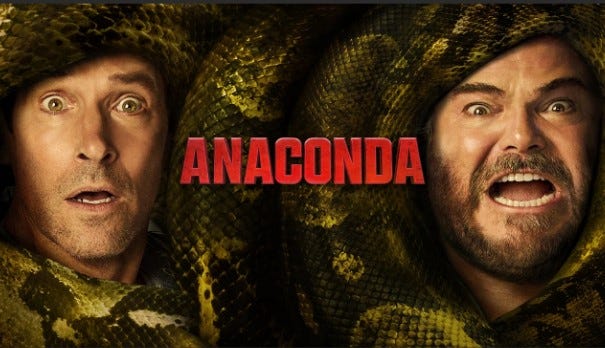
Rating: 7/10
Tom Gormican’s 2025 release of Anaconda is honestly hilarious, owing primarily to the exceptional chemistry of an ensemble cast featuring Jack Black, Paul Rudd, Steve Zahn, Thandiwe Newton, Daniela Melchior, and Selton Mello.
Any fears of a standard, “soulless” reboot evaporate the moment we meet Griff (Rudd).
He is a struggling background actor desperately clinging to a childhood dream, even as his professional reality turns sober.
His best friend, Doug (Black), is the more pragmatic of the duo, but while he has accepted the brutal difficulty of the film industry, his passion hasn’t died — it has simply been suppressed.
Anaconda is a dramatic pivot from the campy horror of the 1997 original, to a self-referential action-comedy, and the presence of Rudd and Black is all the confirmation you need of that.
While the 1997 version was about a documentary crew, the 2025 version is about the act of movie-making itself, spearheaded by Doug and Griff.
But, beyond the comedy, there are also compelling themes that are worth reflecting on in this film, and chief among them is the suffocating weight of unfulfilled potential, which explores the “midlife crisis” not as a desire for sports cars, but as a desperate need to reclaim a lost identity.
Doug is a wedding videographer in Buffalo who “adds horror elements” to weddings just to feel creative, while Griff is a background actor who lies about his success, whenever he finds an opportunity.
Along with a group of friends, they reunite to remake Anaconda, which they feel will prove they aren’t total “losers” at life, whatever that might mean in the 21st century.
In “Anaconda” we learn that Doug represents the “settled” man who is told he has a “B+ life,” while Griff represents the “dreamer” who has failed.
Along with their friends, their journey to the Amazon is a literal attempt to escape the mediocrity of their middle age, laying the perfect foundations for a comedic adventure, more so than an action horror — and thank the filming Gods for that!
Another fascinating theme explored by this movie is the heavy critique of Hollywood’s reliance on Intellectual Property (IP), by mocking the idea that the only way to get anything made in 2025 is to attach it to an existing “brand.”
Griff claims he “acquired the rights” to Anaconda, which is the only reason the group agrees to take out a bank loan and risk their lives, to entertain a childhood endeavor.
The film later reveals they encounter a real high-budget reboot crew in the jungle, who are also being attacked by the infamous reptile, so the characters ultimately act as mouthpieces for the “originality vs. reboot” debate.
Doug wants to make an “indie-style” artistic snake film, while the reality of the industry forces them into a generic monster-movie structure.
Similar to the themes in Send Help, which I have just reviewed, Anaconda also explores how specialized knowledge becomes the only valid currency in a crisis, particularly in the wild.
Once in the Amazon, the group hires Carlos (Selton Mello), a quirky snake handler with a pet anaconda named Heitor, to help them with their film making enterprise.
His “expertise” is initially mocked by the Americans, but he becomes the only reason they survive the first act of this movie.
Steve Zahn’s character, Kenny, for example, is the “ne’er-do-well” cameraman.
In the civilized world, he is a screw-up, for all manner of reasons, but in the jungle, his ability to keep a cool head behind a lens (and his surprising knowledge of toxins) shifts the group’s hierarchy a little, in the face of adversity.
The film also uses the Amazon as a metaphor for the characters’ own lives: beautiful on the surface, but treacherous underneath.
The “Anaconda Flower, “ for example, is introduced to us as a symbol in this movie, a stunning plant that suggests the Amazon is a place of wonder, but it often leads the characters directly into the snake’s territory.
Ana (Daniela Melchior), who is actually the first person we are introduced to in this movie, serves as the human embodiment of this theme.
She presents herself as a simple riverboat captain, but she is actually a fugitive involved in a gold-mining scheme, beautiful but deadly attractive, mirroring the anaconda itself.
In the final act of this movie, the snake serves as a “truth serum,” where the life-or-death stakes force Doug and Griff to admit they aren’t actually remaking the movie for the fans — they are doing it because they are terrified of being forgotten.
Unlike the 1997 film, which was a standard “kill the monster” ending, the 2025 film ends with the characters using their amateur filmmaking gear (lights, reflectors, and a prop boat) to trap the snake.
The irony being that when they return to civilization, their terrible movie finds success by selling the “behind-the-scenes” footage of the actual attack — proving that in 2025, reality content is more valuable than artistic intent.
The film mocks the generic monster-movie structure, yet the characters find success through raw, authentic footage.
If you’re looking to capture your own ‘indie-style’ projects with that same professional polish, the DJI Osmo Pocket 3 is the exact kind of high-tech tool that bridges the gap between amateur and artist.
As an Amazon Associate, I earn from qualifying purchases. This review contains affiliate links that support my film analysis and reporting.