

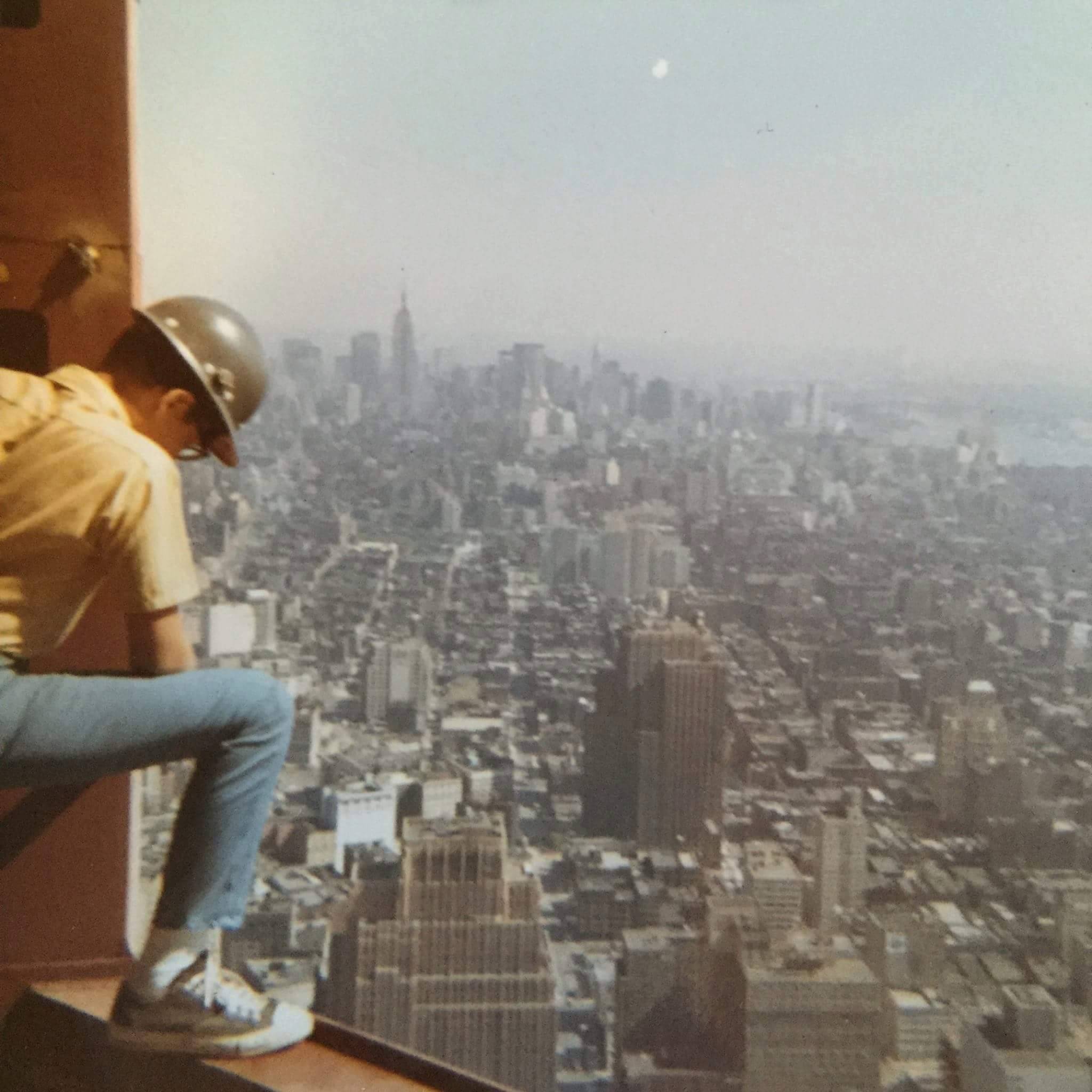
 Cook, standing without a harness on a beam, works on the World Trade Center in New York City, circa 1970s. (Photo courtesy Ray Cook)
RAY COOK, DONNG A RED Marine Corps hat and matching scarf draped at his neck, sauntered down a dirt road, like a man taking a leisurely stroll in a park, which was an unusual sight that day as a cadre of at least 50 to 75 sheriffs, each clad from head to heel in the latest riot gear, armed to the teeth with rifles and tear gas, stood pat some 50 yards away as a crowd of water protectors (not “protesters”) blocked the road in North Dakota in opposition to the construction of yet another pipeline that would threaten the drinking water and the overall well-being of everyone and everything within its leaky, toxic reach.
It was November 12, 2016, and Cook, who is Mohawk, swung a cane in his right hand as he eyed the sheriffs. He wanted them to see him, and they did. He didn’t wear goggles or a facemask or earplugs. He wanted them to know he’s a Marine, as tough as they come, and he is. Cook comes from a long line of fearless Natives. The Mohawk are renowned for hopping from beam to beam forty to fifty to sixty stories above Manhattan, without a harness in the early days of the sprawling city. The Mohawk, who are a part of the Haudenosaunee Confederacy, or “People of the Long House,” as they call it, are also responsible for inspiring the American eagle as the logo of the United States (which the U.S. took without asking) as well as the clasped arrows within its illustrated claws, and for providing this settler-state with its governmental structure. People like to say the Greeks gave the world democracy. Fine, but it was the Mohawks, Oneidas, Onondagas, Cayugas, and Senecas, which is the whole of the Haudenosaunee Confederacy, that first demonstrated it to the royal subjects who blundered our way.
There were no kings and queens and gentry within the Haudenosaunee Confederacy, and there wasn’t majority rule either. There was, however, consensus, Cook said, as well as the Great Law of Peace (which is exactly as it sounds: objectives are far more easily achieved when peace and kindness and harmony are paramount), which is at the foundation of their confederacy. And unlike the invaders, also falsely known as “pilgrims” and “settlers,” Indigenous women played an imperative role in politics and everyday happenings of their people, which white men found perplexing, even infuriating. They hated to have to sit alongside Native women at meetings between us and them; they fumed at the sound of their voice even if they didn’t know what was being said, but no matter how much they protested and demanded they be ordered to leave, our leaders knew that it would be wrong and disrespectful. White men didn’t think so.
Along with bringing smallpox and tuberculosis and their value of greed, the white invading males also brought with them from their ancestral Europe the belief that a woman’s role was in the home, in the kitchen, completely subservient (today, some sadly still do), and these men wouldn’t consider Native men “men” because women made many – if not most – of the decisions. Democracy in the U.S. only became a semblance of democracy when white women like Susan B. Anthony blew down the door and demanded a seat at the white man’s table. Little do people know, though, that Anthony bore witness to Native women in action, making decisions, calling shots; she saw that their voice and opposition to something, anything, carried tremendous weight, and she wondered why white women lacked what Native women had. In Indian country, we know that this was the source of her inspiration, but because this is Native oral history, it is much ignored by scholars who pen American history texts.
It shouldn’t take a white man with a beard and a doctoral degree to publish Native oral histories for the rest of academia to consider them fact. And it shouldn’t have taken 70 years for Native women to finally get the right to vote. In November, two Native women, Deb Haaland and Sharice Davids, were elected to Congress for the first time in U.S. history. Yet for thousands of years before the great invasion, Native women ran the show because men knew then, as we still know today, that the best judge of a man’s quality and character is a woman.
Well, not a single sheriff dared to approach Ray that day on that dusty road in North Dakota, even as he tipped his toe across the line in the sand, goading the masked badges, showing them he is the modern iteration of the fearless Mohawk floating above beams. The cops ordered the subject of the Great Law of Peace to “leave the road or be arrested!” Cook chuckled at the order, continued unfazed, swung his cane into the frigid air, and called out to me: “Let’s eat.”
The Haudenosaunee Confederacy has lasted for more than 1,000 years, Ray said. “Rome didn’t even last a thousand years. Let’s see how long the United States lasts.”
By Simon Moya-Smith
Written November, 2018