

This blog post explores how adopting ISO 8601, particularly its week date format, can harmonize time management in the workplace, foster positive change, and boost overall productivity. We'll draw on practical resources and tools we have developed, including two dedicated notebooks designed specifically for this format.
Understanding ISO 8601
ISO 8601 is more than just a technical specification; it's a framework for unambiguous communication of dates and times. Established by the International Organization for Standardization, it defines formats like YYYY-MM-DD for dates and extends to week-based representations. The week date format is particularly powerful: it numbers weeks from 1 to 52 (or 53 in leap years), with each week starting on Monday by default.
This standardization eliminates ambiguities common in regional formats—think MM/DD/YYYY vs. DD/MM/YYYY—which can cause errors, and it simplifies scheduling, reporting, and project tracking.
ISO 8601 ordinal date format represents dates as YYYY-DDD, where YYYY is the year and DDD is the day number from 001 to 365 (or 366 in leap years). This compact format eliminates confusion from regional date conventions and is especially useful in scientific and technical contexts.
The ordinal format excels in applications requiring sequential day tracking, such as astronomical observations, environmental monitoring, and software logging. Because it's internationally standardized and machine-readable, it reduces date interpretation errors when exchanging data between systems across different time zones and regions.
Your ISO 8601 Companions
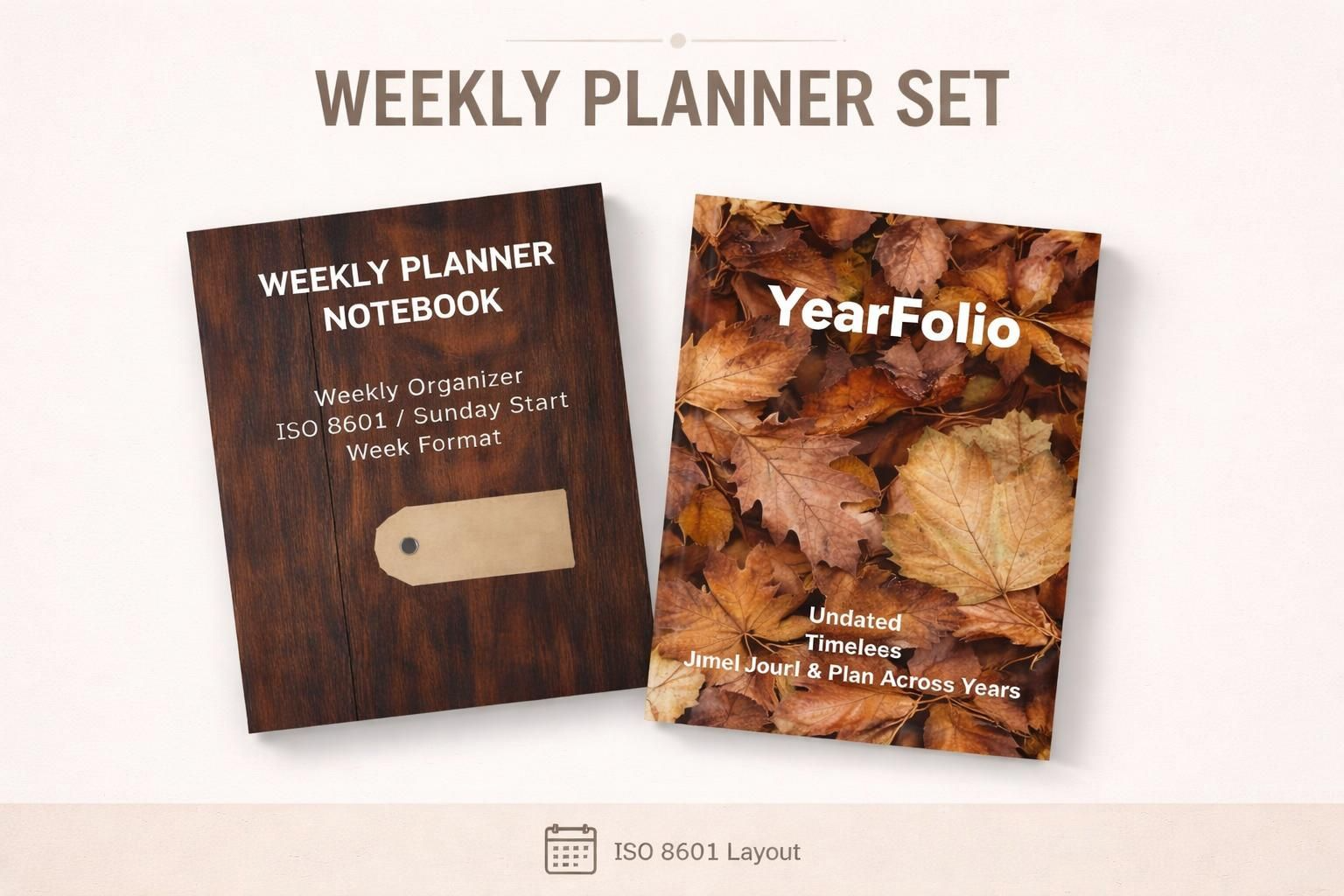
Many software applications and operating systems have the ability to change the time format to ISO 8601 for enhanced clarity and standardization. For those seeking to embrace these principles in analog form, these two thoughtfully designed, undated notebooks bring ISO 8601 principles into daily practice—one focused on the powerful week-date format, the other on ordinal day-of-year structure for flexible, long-term use.
First is the Weekly Planner Notebook (available on Amazon, ASIN: B0FY56JLLR). This 110-page gem is built entirely around ISO 8601's week numbering system, where each week is clearly labeled as YYYY-Www (e.g., 2026-W11). Every spread dedicates two facing pages to a full week, with generous space for to-do lists, notes, and priorities.
Complementing it is YearFolio (available on Amazon, ASIN: B0FY56JLLR), a robust daily planner that embraces an ordinal approach inspired by ISO 8601's emphasis on unambiguous, sequential timekeeping. Each of its pages represents one day of the year (numbered 001–365/366).
 The Challenges of Traditional Time Management in the Workplace
Many organizations struggle with fragmented date systems—local formats that vary by region, physical planners with inconsistent conventions, and project management software that doesn't align.
This leads to:
Miscommunication: A date like 03/04 could mean March 4 or April 3, depending on where you are.
Inefficient Planning: Without a unified week structure, tracking progress across weeks becomes cumbersome, especially for recurring tasks or quarterly reviews.
Poor synchronization between personal and professional tools can result in double-booking or overlooked breaks, eroding work-life balance.
Creating Change: Implementing ISO 8601 in Your Workplace
Harmonizing time management requires a cultural shift, but it's achievable with the right approach. Start by educating your co-workers on ISO 8601's benefits: consistency, ease of sorting and searching in databases, and compatibility with international standards. Then, integrate it into daily workflows:
Update Digital Tools: Configure calendars and software to use YYYY-MM-DD. For note-taking apps like Logseq, adjust settings to display ISO formats and install plugins for week numbers.
Adopt Hybrid Systems: Combine digital and analog methods for a balanced approach. Digital tools handle complex queries, while physical planners provide tactile satisfaction and quick overviews.
Time Blocking and Week Structuring: Use the week format to block time for tasks, meetings, and downtime. Label projects by week (e.g., "Project X - 2026-W12") for easy reference.
Team Training: Host workshops to demonstrate the system, emphasizing how it reduces errors and enhances collaboration.
This shift not only streamlines operations but also empowers employees, leading to a more engaged and efficient workforce.
Conclusion: Embrace the Change for a Productive Future
Adopting ISO 8601 in the workplace isn't about rigid rules—it's about creating harmony in how we perceive and manage time. By consolidating digital tools like Logseq with physical resources such as my weekly planner notebook, you can drive meaningful change, enhance collaboration, and reclaim control over your schedule.