
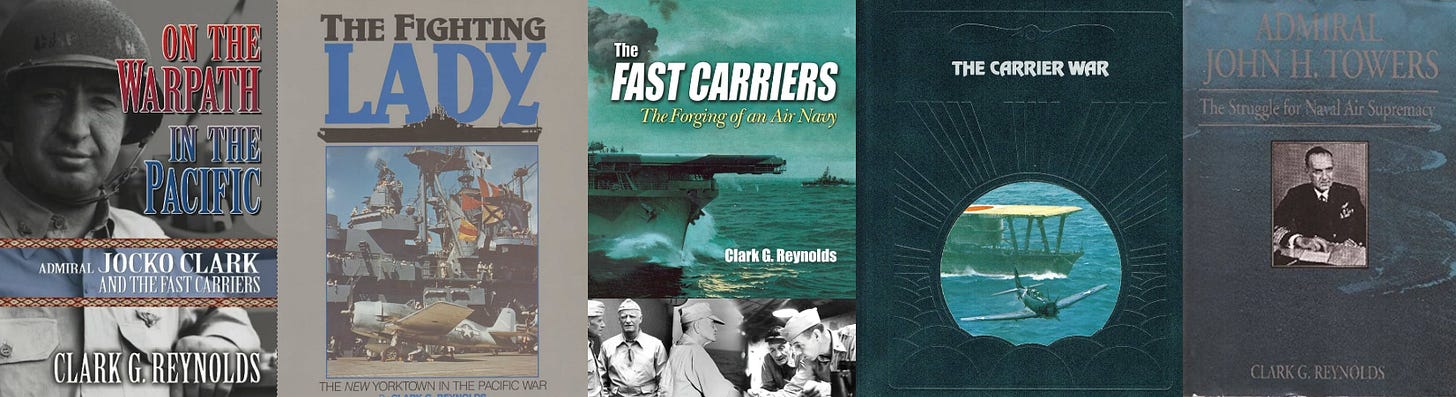
 Dr. Clark G. Reynolds is certainly not as well-known a World War II historian as Stephen Ambrose or John Keegan, but is one of the most important to the Pacific. In many ways, he is the godfather of World War II American naval aviation history. He wrote only 13 books, but many were incredible contributions to the field and laid the foundation for many Pacific War scholars who followed. He also published fifty-seven journal articles over his career on the same subject and remained active almost until his passing in December 2005. He also had a personal connection to his subject. His uncle had served aboard the original Yorktown under Joseph “Jocko” Clark and later became Clark’s flag lieutenant. He earned a doctorate at Duke under Theodore Ropp, taught at the Naval Academy, the University of Maine, and the Merchant Marine Academy, and eventually joined the College of Charleston, where he chaired the history department and later became Distinguished Professor Emeritus.
Unsurprisingly, with the personal connection, he ghostwrote Jocko Clark’s 1967 memoir, Carrier Admiral, before turning to more independent scholarship, and at the end of his career wrote a full biography of Clark, On the Warpath in the Pacific, published the year he died. But his most important contribution to the field was his 1968 book, The Fast Carriers: The Forging of an Air Navy. The book traces how the Navy dragged itself out of a battleship-centered worldview and into one built around the carrier task force, and how that fight played out among admirals in Washington as much as it did in the Pacific. The Naval Institute later rated it one of the ten best English-language naval books of the 20th century.
The book matters because it tells the war story from the aviator’s perspective. One of the chief criticisms of Samuel Eliot Morison’s 15-volume The History of United States Naval Operations in World War II was that he was too biased against the “brownshoe navy,” or the aviators. There is some truth to that; Morison spent all of his time during the war on battleships, cruisers, and destroyers and only interviewed a handful of carrier admirals for his books. If you read some of the books in the series, there are indeed some biases, and Morison does favor ship-to-ship engagements over air engagements.
 He also wrote a very important biography of John Towers which was published by the Naval Institute Press in 1991. At 676 pages, it’s Reynolds at his most exhaustive, and it’s the biography of the man most responsible for building naval aviation into an institution in the first place. Towers was the Navy’s pioneer aviator who spent the interwar decades fighting the “black shoe” battleship establishment for resources, promotion, and simple legitimacy, and who earned real animosity from men like Ernest King, Chester Nimitz, and Raymond Spruance along the way. Reynolds had access to something Towers’s own detailed log of meetings and conversations, kept from 1939 to 1947, which lets the book work as both a life and an inside history of how naval air power actually got built, procured, and defended bureaucratically through two world wars. It’s not a battle narrative, and it has almost no tactical color, but it’s essential background for understanding why the fleet Jimmy Flatley and the others flew from in 1943 looked the way it did, and why aviators still had something to prove. The book won both the Samuel Eliot Morison Award for Naval Literature and the K. Jack Bauer Award.
It’s worth saying something here about why a historian’s work from 1968, or 1991, still matters to a book being written in 2026. There’s a temptation, especially in a field where new archival material and scholarship keep surfacing or become available, to treat older scholarship as something to be superseded rather than built on. Reynolds is a good case against that instinct. He wrote close enough to the events that he could still interview the men involved and draw on private diaries and papers that have since been dispersed, donated, or lost track of entirely. Unfortunately, that kind of access doesn’t exist anymore, and no amount of new archival digging on my end will recover it. What’s changed since Reynolds wrote isn’t so much the underlying facts as the tools: better indexed NARA finding aids, digitized Japanese sources, and a mountain of other scholarship. So the honest way to use him isn’t to treat The Fast Carriers or the Towers biography as settled and final, but as the doctrinal and institutional bedrock that squadron-level primary sources come from and, occasionally, to notice where a claim he made in good faith in 1968 doesn’t hold up against a document that’s since come to light. Older scholarship like his earns its keep by telling you what the consensus was and why, which is exactly the thing you need to know before you can say where it was wrong.