

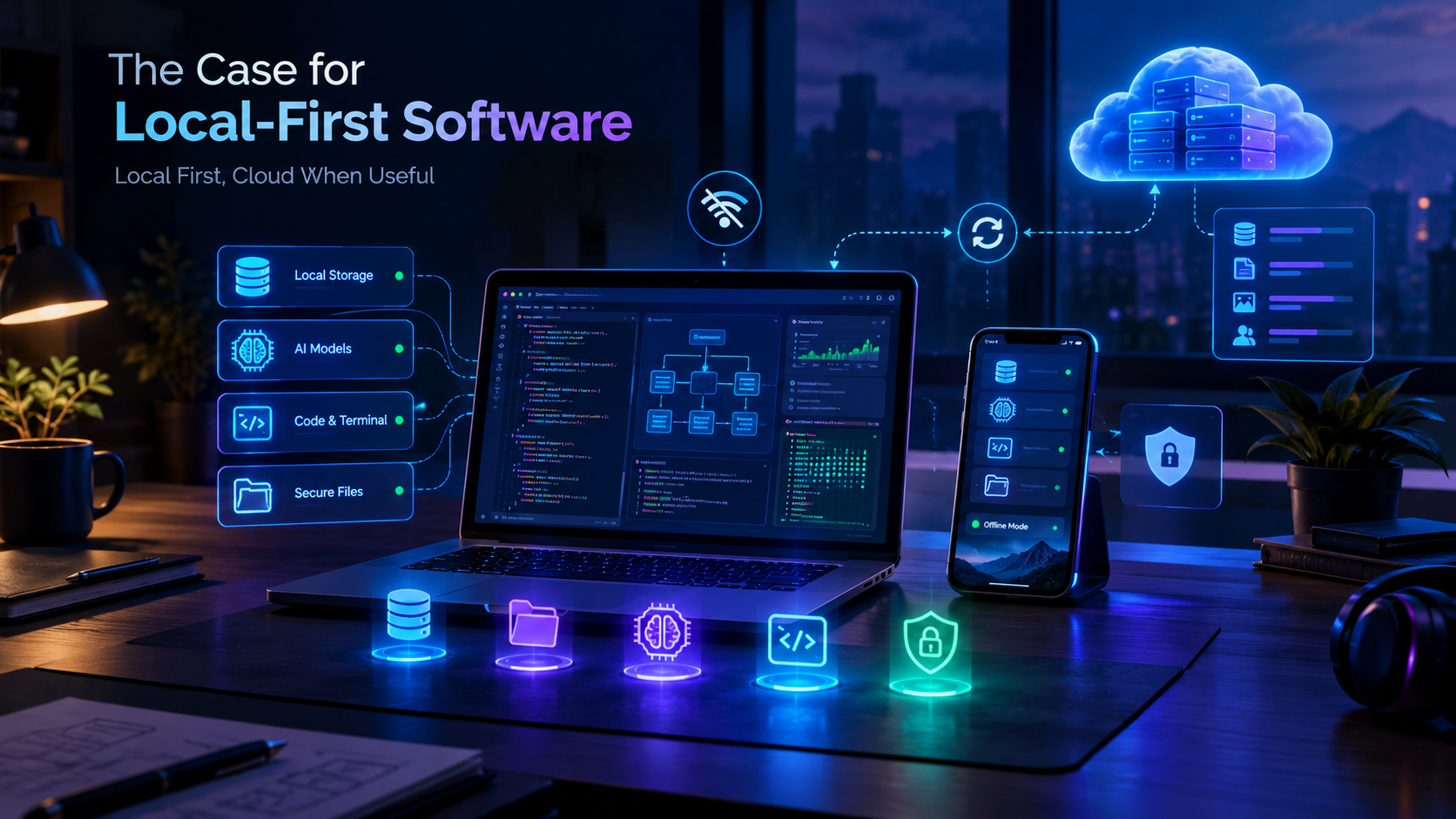
We’ve spent years moving almost everything into the cloud.
Photos.
Documents.
Notes.
Messages.
Projects.
Passwords.
Workflows.
AI conversations.
Personal data.
The cloud made software incredibly convenient. Open an app on one device, sign in, and everything appears. It solved a huge number of problems that existed when our data lived on individual computers.
But there is another question worth asking:
Do all applications really need to depend on a remote server to work?
I think the answer is increasingly becoming no.
That is where the idea of local-first software becomes interesting.
What does “local-first” actually mean?
Local-first software is built around the idea that the user's device should be capable of doing as much as possible locally.
Instead of:
You → App → Server → Database → Response
the architecture can become:
You → App → Local Data
with optional cloud services used for synchronization, backup, collaboration, or additional capabilities.
The difference might look small from the outside, but architecturally it can be enormous.
Imagine opening a notes application while travelling on a train.
There’s no signal.
There’s no Wi-Fi.
The cloud server is unreachable.
With a traditional cloud-dependent application, you may suddenly discover that basic functionality has become unavailable.
With a local-first application, the experience can remain almost completely unchanged.
You open the application.
Your data is already there.
You create a note.
It saves immediately.
You close the application.
Later, when connectivity returns, synchronization can happen automatically.
That is a fundamentally different relationship between the user and their software.
Your application should work even when the internet doesn't
The internet is incredibly reliable compared with the past.
But “usually available” is not the same thing as “always available.”
Networks fail.
Servers go offline.
DNS breaks.
Cloud services have incidents.
Subscriptions expire.
Accounts can become inaccessible.
APIs change.
Companies shut down products.
Services get acquired.
Pricing changes.
And sometimes the simplest reason is the most important:
You just don't have an internet connection.
Software shouldn't necessarily stop functioning simply because a network connection disappeared.
A calculator doesn't need a server.
A text editor doesn't need a server.
A personal task manager doesn't necessarily need a server.
A drawing application doesn't need a server for every brush stroke.
A personal database doesn't inherently need a remote database.
An offline-capable development tool can often be much more useful than one that continuously waits for network requests.
Local-first isn't anti-cloud
This is an important distinction.
Local-first does not mean:
“The cloud is bad.”
It means:
“The cloud should not automatically be the foundation for everything.”
There are plenty of situations where cloud infrastructure is extremely valuable.
Large-scale collaboration needs synchronization.
Teams need centralized systems.
Businesses need shared databases.
Backups need redundancy.
Distributed applications need infrastructure.
AI systems sometimes require enormous computational resources.
The point is not to eliminate the cloud.
The point is to make the architecture more intentional.
A useful application might work like this:
Local storage first.
Cloud synchronization second.
Cloud backup optionally.
Remote computation when necessary.
That model can offer users much more control.
Performance is another major advantage
Local software can also feel incredibly fast.
When an operation can be completed on the device, you don't necessarily need to wait for:
a network request,
server processing,
database queries,
API responses,
retries,
or connection timeouts.
The difference becomes especially noticeable when an application performs many small interactions.
A user interface that reacts instantly can feel fundamentally better than one that constantly communicates with a backend.
This becomes even more interesting when combined with modern hardware.
Today's computers and phones can perform tasks locally that would have required specialized infrastructure years ago.
CPU performance has improved.
GPUs have become dramatically more capable.
Mobile devices have dedicated AI acceleration.
Storage is faster.
Memory capacities are larger.
Local databases are extremely capable.
Developers have an increasingly powerful computing platform sitting directly in the user's hands.
Why not use it?
Privacy changes the architecture
Another major reason to think about local-first software is privacy.
Consider a personal journal.
Why should every private entry automatically need to travel to a remote server?
Consider a personal finance tracker.
Why should every transaction necessarily be uploaded?
Consider private development notes.
Why should everything be processed remotely?
There are legitimate reasons to use cloud systems, but data collection should not be the default architecture simply because it is convenient for the developer.
A local-first design can reduce unnecessary data transfer.
The user's information stays closer to the user.
That can make privacy easier to reason about.
It can also simplify compliance discussions for certain applications because less data may need to leave the device in the first place.
Ownership becomes a software feature
This is one of the most interesting ideas behind local-first applications.
When your data primarily exists inside someone else's infrastructure, your access can depend on that company's continued operation.
But when your data exists locally in a format you can understand, export, copy, back up, and migrate, the relationship changes.
You aren't simply “using a service.”
You are using software that operates on your data.
That distinction matters.
Imagine an application that lets you export your complete database as a standard file.
You can back it up.
Copy it to another machine.
Inspect it.
Process it with your own scripts.
Move to another application.
Build tools around it.
That is powerful.
Local-first + AI could become especially interesting
Now add AI to the equation.
A traditional AI workflow might look something like:
User → Cloud API → Model → Cloud API → User
A local-first AI workflow could potentially become:
User → Local Application → Local Model
with cloud inference available only when needed.
That could mean:
private experimentation,
offline AI features,
reduced latency,
lower recurring infrastructure requirements for some workloads,
and greater control over personal data.
Local AI does have limitations.
Large models can require substantial hardware.
Cloud models can still offer greater capabilities for certain tasks.
But the important change is that the boundary between “personal computer” and “AI computer” is becoming less clear.
The device itself is becoming part of the AI stack.
What would the ideal local-first application look like?
Imagine opening an application for the first time.
You don't create an account.
You don't enter your phone number.
You don't verify an email.
You don't wait for an API response.
The application simply starts.
Your data is stored locally.
You can use the core functionality completely offline.
You can export everything.
You can create backups.
You can optionally enable encrypted cloud synchronization.
You can use multiple devices.
When connected, the devices synchronize.
When disconnected, each device continues working.
When connectivity returns, changes are merged.
That would feel less like renting access to software and more like owning a digital tool.
Developers also benefit
Local-first architecture isn't only about users.
It can simplify certain backends.
A traditional application may require:
frontend + authentication + API + database + caching + queues + monitoring + backups + scaling + infrastructure
A local-first application can sometimes reduce the amount of infrastructure required for the basic experience.
That doesn't eliminate complexity.
It moves some of the complexity from the backend into the client.
But for many personal and small-team applications, that trade can be worthwhile.
It can also dramatically reduce server costs for products that don't need constant remote computation.
There is another advantage: resilience
Software designed for unreliable environments becomes more resilient.
Think about developers working while travelling.
Students using unstable internet.
People in rural areas.
Emergency situations.
Remote teams.
Field workers.
Engineers working in restricted environments.
People simply trying to save mobile data.
A local-first application doesn't assume perfect connectivity.
It assumes reality.
And reality is messy.
The future may not be cloud OR local
The interesting future isn't necessarily one where everything becomes local.
And it isn't necessarily one where everything becomes cloud-based.
The more likely future is a hybrid architecture.
Local computing for:
responsiveness,
private data,
offline functionality,
instant interactions,
personal customization.
Cloud infrastructure for:
synchronization,
collaboration,
backup,
large-scale computation,
remote services.
AI can exist in both places.
Databases can exist in both places.
Processing can happen in both places.
The user should be able to benefit from both without becoming completely dependent on either.
Developers should start asking better architectural questions
Instead of asking:
“Can we put this in the cloud?”
we should also ask:
“Does this need to be in the cloud?”
Instead of asking:
“How do we collect this data?”
we should ask:
“Do we need to collect this data at all?”
Instead of:
“How do we make users sign in?”
we can ask:
“Does this product actually require an identity?”
And instead of:
“What happens when the server is unavailable?”
we can ask:
“Can the application continue working without it?”
Those questions can lead to dramatically different products.
Build software that respects the device
Computers and phones are no longer passive terminals connected to distant servers.
They are powerful computing systems.
They have storage.
They have CPUs.
They have GPUs.
They have specialized AI hardware.
They can run databases.
They can process large datasets.
They can execute sophisticated applications without asking a remote machine for permission at every step.
As developers, we should take advantage of that.
The next generation of software doesn't have to abandon the cloud.
It can simply stop assuming that the cloud belongs at the center of everything.
Maybe the better architecture is one where the user's device is the primary computer, the cloud is the supporting infrastructure, and the user remains in control of their data.
That is the direction of software I find especially exciting.
Local by default.
Cloud when useful.
AI where it helps.
Privacy by design.
Data owned by the user.
That isn't just an architecture choice.
It can become a philosophy for building better software.
☕ If you enjoy reading about software architecture, AI, developer tools, open source, and the future of computing, supporting my work helps me spend more time building and sharing these ideas.
You can support me here:
https://buymeacoffee.com/sanskarIN
And explore my development work on GitHub:
Thanks for reading, and keep building. 🚀
#SoftwareDevelopment #LocalFirst #OpenSource #AI #Programming #Privacy #CloudComputing #DeveloperTools #Tech #BuildInPublic