

A Four-Gram Ring Just Raised $70M to Become Your Next Computer
On September 3, Bengaluru-based Ultrahuman closed a $70 million round — $65M equity, $5M debt — led by Qualcomm Ventures, with Labcorp, Alpha Wave, Blume Ventures, Nexus Venture Partners, and Alteria Capital joining in. The round values the company at $365 million, roughly 3x its 2023 valuation.
But the money isn't the real story. The plan is.
Ultrahuman wants to turn its smart ring from a passive health tracker into a standalone computer that lives on your finger:
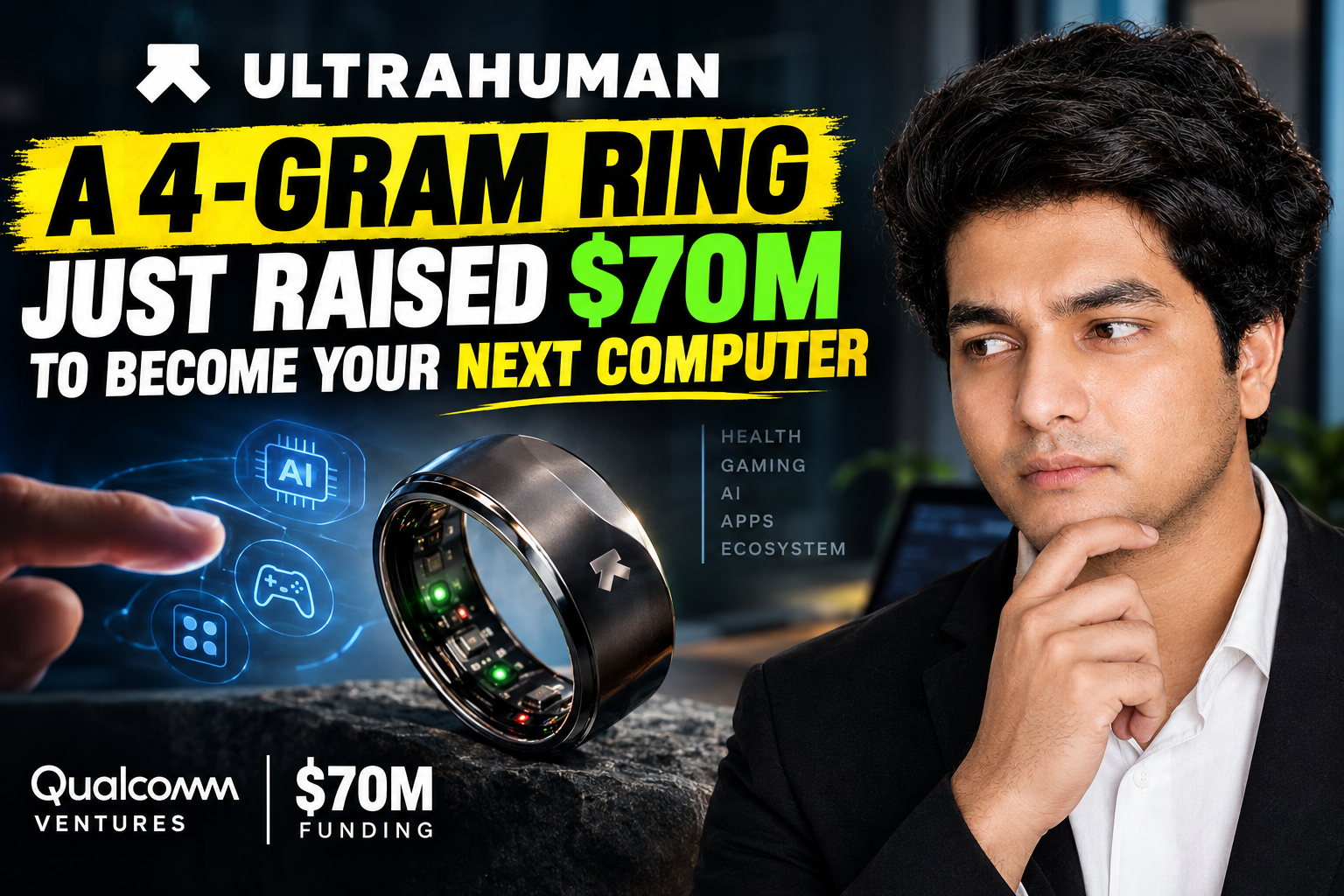 → A new ring is coming, built on Qualcomm's own silicon, replacing the current Nordic Semiconductor chips
→ Before that hardware even ships, a software update landing by end of September will add game-controller input, direct AI-app interaction, and a third-party developer platform — on rings people already own
→ CEO Mohit Kumar's framing: a smartwatch is "a phone on the wrist," but a ring sits on a finger — making it a natural pointing device for gaming and spatial input
→ The company is currently at a $140M revenue run rate, up 45% year-over-year, and is targeting $200M by January 2027
→ It's sold roughly 800,000 rings to date
There's real grit behind this raise too. Ultrahuman lost access to the US — its biggest market — last October after the US International Trade Commission ruled it had infringed Oura's patents. It went nearly a year without US sales before returning with a redesigned Ring Pro, which is now reportedly selling 18-20x faster than available supply.
Here's what stands out to me: Qualcomm didn't just write a check — it's co-designing the next-generation chip. That's a chipmaker betting that "ambient computing" (devices that sense and respond without a screen) is the next real interface war, and that a ring, not a watch or glasses, might be the smallest viable form factor to win it. Qualcomm Ventures' own framing was blunt: the future of AI is "personal, ambient, and always on."
The open question is whether a device with this little battery and compute headroom can do more than tracking without frustrating the people wearing it. Ultrahuman is betting the answer is yes — and it's not just talk, since real software ships this month, not just a hardware roadmap on a slide.
Would you trust a ring — not a phone, not a watch — to be your next AI interface?
#Wearables #Qualcomm #SmartRing #AI #Ultrahuman #StartupFunding #AmbientComputing