

Google’s Math: Building AI Data Centers in Space Needs 1,800 Starship Launches First
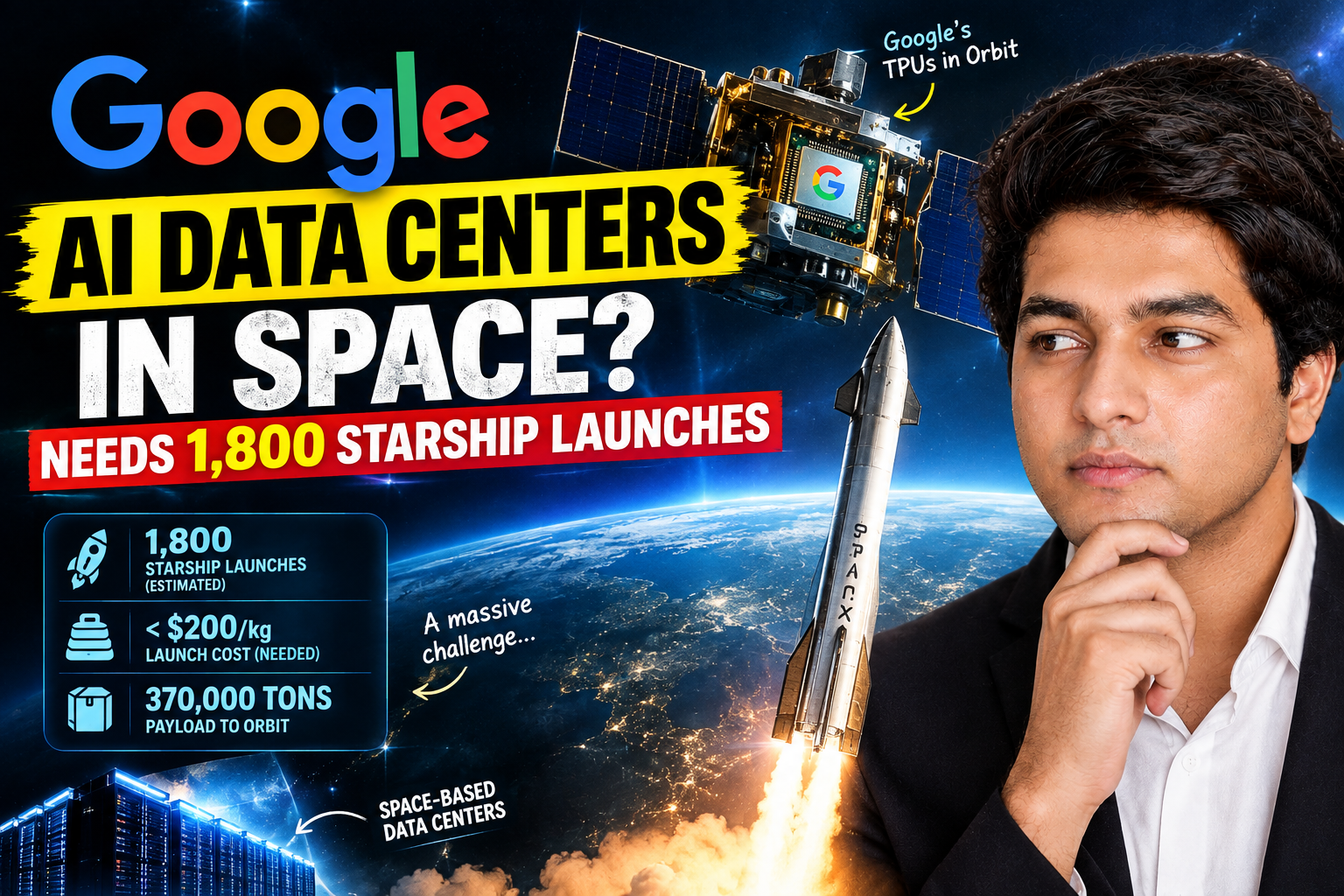
Google just put its first AI chips into orbit. Buried in the announcement was a number that puts the whole idea in perspective: before space-based data centers can realistically compete with the ones on Earth, SpaceX’s Starship needs to fly roughly 1,800 times.
 Here’s what actually happened and what that number means:
→ On October 1, a SpaceX Falcon 9 carried Google’s Project Suncatcher prototype — a satellite built with Planet, carrying four of Google’s own Tensor Processing Units — into orbit. Google confirmed contact was established and the satellite is operating as expected
→ The chips are unmodified, the same TPUs Google already runs in terrestrial data centers, now being tested for how they survive launch stress, space radiation, and vacuum-level heat management, with no air to dissipate warmth
→ “We’ve done testing on the ground, but there’s no test that’s completely as good as the real thing,” said Travis Beals, the Google executive leading the project
→ The TPUs will run Google’s open-weight Gemma model for just 15 minutes at a time, limited by onboard heat constraints — this is a survivability check, not a working data center
→ The economics are the real bottleneck. Google’s research, published in the journal Joule, says launch costs need to fall below $200 per kilogram before orbital compute reaches rough cost parity with data centers on the ground
→ To hit that price point at the scale Google envisions, the company estimates roughly 370,000 metric tons of payload need to reach orbit — which, assuming 200 metric tons per Starship flight, works out to about 1,800 launches over the next decade, or 180 a year
→ Google itself admits it doesn’t know exactly when, or if, this becomes economically viable — only that the direction is worth testing now
What makes this interesting isn’t the “AI chips in space” headline — it’s that Google is publicly quantifying just how far off that future actually is, in terms a skeptic can check. 180 Starship launches a year, every year for a decade, is an enormous operational cadence that doesn’t exist yet anywhere in spaceflight history. Google isn’t betting the farm on it either — this is one small, cautious experiment, not a data center under construction.
The upside case is real too: near-continuous solar power, no land or water use, and potentially a fraction of the operating cost per kilowatt. But getting there depends on a launch infrastructure buildout that’s still mostly aspirational.
Does space-based AI infrastructure feel like a genuine next frontier to you, or a moonshot distraction from the harder problem of building enough power on the ground?
#AI #Google #SpaceX #ProjectSuncatcher #SpaceTech #DataCenters #TechNews
— 𝔖𝔞𝔫𝔡𝔢𝔢𝔭 ℜ𝔞𝔦𝔷𝔞