
Since publishing Silent Winter and Beyond Winter's Silence, I've found myself thinking about the characters who inhabit Edrass and what it is they're actually there to do.
That might sound like a rather strange thing for a writer to say. After all, they're supposed to be people, aren't they? They have their own ambitions, fears, prejudices, loyalties and all the other things that make human beings such complicated and occasionally infuriating creatures. They make decisions, misunderstand one another and generally create problems that somebody else will eventually have to sort out.
At least, that's what I hope they do.
But I've also come to realise that the characters in Foundations of Edrass reflect something of the world in which they live. Not because I deliberately created each one to represent a particular idea, but because their circumstances shape the way they think and behave.
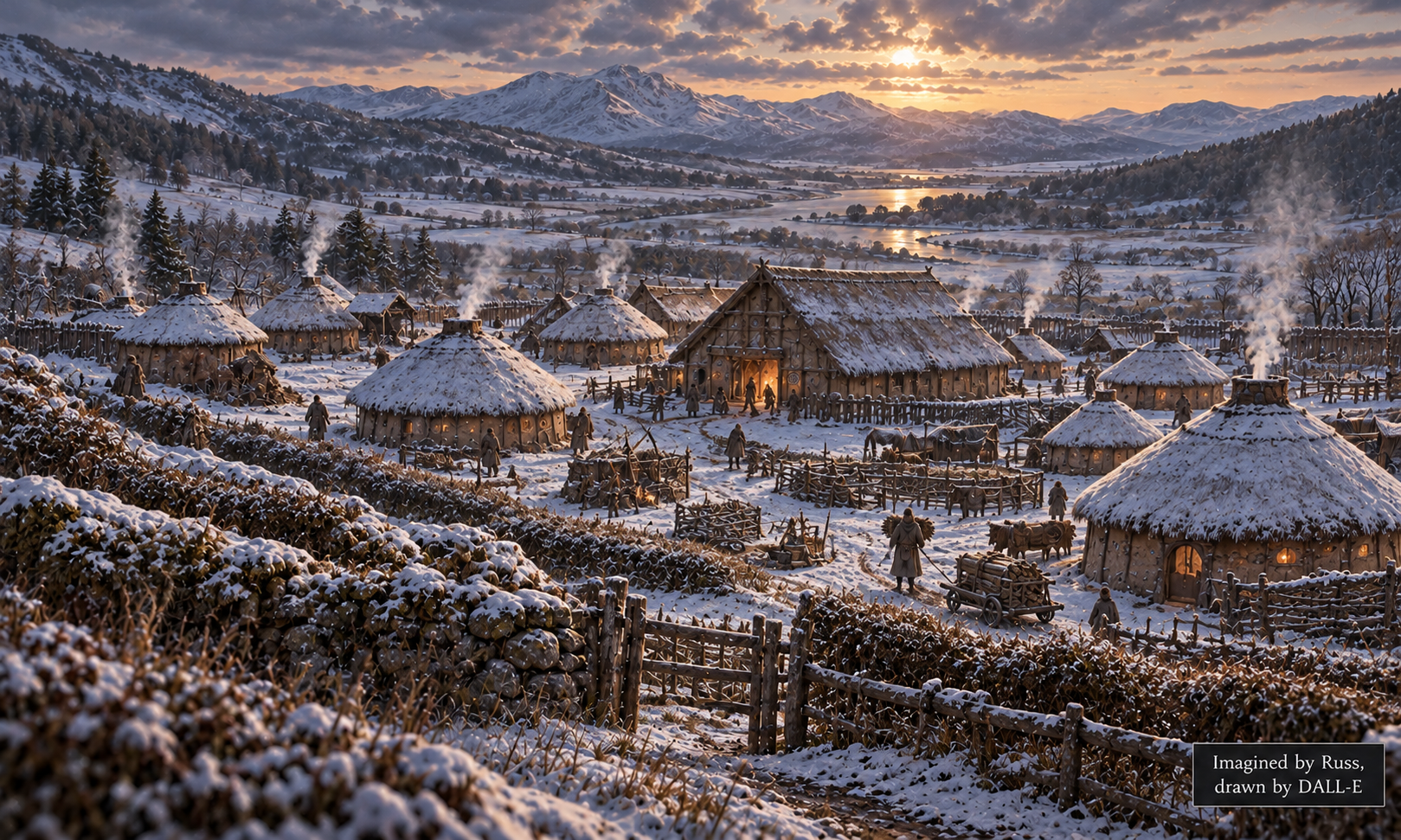
Edrass is not an especially forgiving place. The weather can be brutal, food and fuel must be carefully managed, and travelling between settlements is not always a straightforward affair. Kinship, law, obligation, reputation and the availability of resources all influence people's lives, often in ways that are considerably more immediate than the grand political ambitions we tend to associate with fantasy fiction.
Nobody gets to ignore these things simply because they're the hero of the story.
In fact, one of the things I wanted to avoid was filling Edrass with the familiar collection of fantasy characters who seem to exist primarily to occupy particular roles. The brave warrior, the wise elder, the scheming villain, the comic companion and so forth. There's nothing inherently wrong with such characters, of course, but I wanted mine to emerge from the circumstances of their world rather than simply arrive in it fully formed.
Looking back over the first two books, I can see how different characters have developed around the pressures Edrass places upon them.
Learning to See
Isenwynn is perhaps the most obvious example, partly because so much of Silent Winter is concerned with his education.
But it's not education in the comfortable sense of somebody explaining how the world works and the young hero gradually becoming wiser. Isenwynn learns through observation, experience and occasionally discovering that the world is considerably less accommodating than he might wish.
He begins as someone close enough to events to witness them but not yet experienced enough to understand their full significance. Much of his development comes from learning to notice the things other people overlook, or perhaps prefer not to acknowledge.
Kett and Harvald are important influences, although neither is particularly inclined towards long lectures or comforting explanations. They expect him to pay attention, remember what he's seen and begin drawing sensible conclusions from it.
He learns that silence can indicate danger, that people can hear the truth and still refuse to believe it, and that failing to speak when something matters can be just as dangerous as speaking without thinking.
I never wanted Isenwynn to be a chosen one, marked by destiny or endowed with some extraordinary ability that sets him apart from everybody else. His importance develops because he learns to observe and understand a world in which failing to notice something can have very unpleasant consequences.
That seemed a more interesting foundation for his character than simply announcing that he was special.
The Unremarkable Business of Keeping People Alive
Harvald represents something else that interests me enormously: the practical nature of authority.
Fantasy fiction often presents leadership through grand speeches, impressive banners, heroic decisions and the occasional magnificent battle. And there's certainly a place for all of that. But I suspect that much of the actual business of leadership, particularly in a society such as Edrass, would be considerably less theatrical.
Harvald has to concern himself with stores, roads, repairs, watch rotations, tired men, damaged buildings and the countless small decisions that determine whether a settlement continues functioning. He needs to know which roof requires attention before winter, whether sufficient food has been stored, who can be trusted with responsibility and when an apparently sensible action might create a much larger problem further down the line.
None of that is particularly glamorous. A man checking a tally or ordering a gate repaired is hardly the stuff of heroic legend, but in Edrass these decisions matter enormously. I find that sort of leadership interesting because it involves accepting responsibility for consequences that other people may not yet recognise. Harvald cannot always afford to be popular, and being right doesn't necessarily mean anybody will thank him.
His authority comes from understanding what must be done and having the discipline to see that it happens.
Kett, meanwhile, approaches the same unforgiving world from a somewhat different direction. In many adventure stories, the experienced older fighter is there to provide a little colour, offer gruff advice, perhaps make the occasional amusing remark and eventually demonstrate how dangerous the enemy really is.
Kett certainly has some of those characteristics, but I wanted something rather more substantial from him. What interests me about Kett is his restraint. He's experienced enough to understand that many fatal mistakes begin long before the moment when their consequences become obvious. A young warrior might imagine that courage means charging towards danger, while Kett understands that courage without judgement can be remarkably effective at getting people killed.
He knows when not to chase, when to remain silent, when to wait and when the ground is telling him something that his instincts might prefer to ignore. There's a severity about him that I rather like. He's not unnecessarily cruel, but neither is he particularly interested in protecting somebody's pride when doing so might cost them their life.
A boy doesn't necessarily die when an arrow strikes him. He may have made the decision that killed him three choices earlier, when pride persuaded him to abandon caution. Kett understands that, and much of what he teaches Isenwynn comes from experience that was probably acquired at considerable cost.
The People Who Keep Things Working
Another character I find interesting is Dren, precisely because he's not usually standing at the centre of the dramatic action. He deals with records, tallies, stores and the everyday business of remembering what has been done, promised, received or owed. Now, I appreciate that a man keeping accounts is unlikely to feature prominently in most people's idea of an exciting fantasy adventure. But I've always been fascinated by the ordinary mechanisms that allow societies to function.
We tend to think of civilisation in terms of cities, monuments, armies, kings and great historical events. Yet much of it depends upon considerably less impressive activities. Somebody has to keep count of the grain, remember who owns what, maintain the buildings and ensure that agreements are honoured. Without those things, a community can very quickly become little more than a collection of people arguing over resources.
Dren represents that continuity. His records and memories help ensure that Dornric is more than a group of armed men living behind a fence. They provide part of the framework through which people can trust one another and maintain obligations beyond the immediate moment. That might not sound particularly exciting, but I think it's one of the most important aspects of creating a believable society.
Most civilisation isn't glamorous. Much of it consists of somebody making a mark on a slate, repairing something before it breaks or remembering what was agreed when everybody else has developed a rather more convenient recollection.
And I rather like that.
Strength, Pride and the Trouble They Cause
Ruan presents another side of life in Edrass. He's young, capable, physically strong and understandably eager to demonstrate what he can do. I don't consider him foolish, although he occasionally makes decisions that an older and more experienced man might regard as thoroughly ill-advised. His problem is not a lack of ability. It's learning when and how that ability should be used.
There's an important difference between courage and control, particularly in a society where the consequences of an impulsive decision may fall upon an entire community rather than simply the person making it. In another sort of story, Ruan's willingness to act, fight or challenge somebody might be presented as straightforward heroism. In Edrass, those instincts need to be tempered by judgement.
Strength is useful, certainly, but strength without discipline can be dangerous. A brave man who cannot wait may get other people killed, however admirable his intentions.
Drenmar, on the other hand, demonstrates what happens when authority becomes entangled with pride. I didn't want him to be a simple villain whose purpose was to behave badly whenever the story required somebody unpleasant. His failures are rooted in circumstances that he has come to misunderstand. He possesses good land, a substantial hall and the outward appearance of prosperity and strength. Unfortunately, those advantages have encouraged him to confuse his circumstances with his own virtues.
He mistakes advantage for wisdom and prosperity for evidence that his judgement must be sound. That's a very human failing, and hardly one confined to imaginary barbarian societies. People who inherit favourable circumstances can sometimes convince themselves that everything they possess is the result of their own abilities. Those who have never experienced serious shortages may regard the difficulties of others as evidence of personal failure.
Drenmar's tragedy is that his position makes it increasingly difficult for him to recognise his own vulnerability. He cannot easily acknowledge weakness because doing so would undermine the very image of himself upon which his authority depends.
Torrik is dangerous for rather different reasons, although I have to be careful what I say about him because some characters are best discovered as their stories unfold. From early on, however, he's someone who pays attention. He watches people, understands their weaknesses and recognises opportunities that others may overlook. What makes him interesting to me is that he understands enough about the systems governing Edrassian society to recognise where they might be exploited.
In a world where kinship, oaths, reputation, obligation and witness carry considerable importance, somebody who understands those arrangements without necessarily feeling bound by them can become a very dangerous individual. Torrik isn't dangerous because he fails to understand the society around him. Quite the opposite. And I'll leave him there for now.
What Happens After Everything Falls Apart?
One of the things I wanted to explore more fully in Beyond Winter's Silence was the practical business of rebuilding after disaster. Fantasy fiction is rather fond of conquest, destruction and the dramatic overthrow of established authority. I'm fond of those things myself, at least when they happen to fictional people.
But what happens afterwards?
A settlement doesn't begin functioning again simply because somebody new announces that he's in charge. Buildings need repairing, stores must be accounted for, fields brought back into use, disputes resolved and relationships rebuilt. People have to decide whether they can trust one another again, often while dealing with grief, resentment and the consequences of whatever caused the collapse in the first place. This is where characters such as Saera and Dorn become important.
They represent people who understand the everyday realities of keeping a community alive, frequently without possessing the formal authority or recognition that tends to attract attention in historical accounts. Somebody needs to know where the stores are, which buildings are sound, what the children require, who is sick, which families have suffered losses and what obligations remain unresolved. A hall requires considerably more than somebody sitting in the place of authority. It needs people who understand how the place actually works.
Saera and Dorn carry much of that knowledge, and through them I wanted to explore how a broken community might gradually become functional again. To me, that's every bit as interesting as deciding who wins the battle.
Characters and the Worlds They Inhabit
Looking back at these characters, I can see that each has developed around a different aspect of the pressures Edrass places upon its inhabitants.
Isenwynn is learning to observe and understand. Harvald must exercise judgement and responsibility, while Kett demonstrates the importance of restraint. Dren preserves the records and obligations upon which communal trust depends. Ruan has to learn to govern his strength, while Drenmar shows what happens when pride overwhelms judgement.
Torrik understands the weaknesses within established systems and knows how to exploit them. Saera and Dorn, meanwhile, demonstrate that rebuilding a community requires considerably more than simply replacing whoever was previously in charge.
I didn't necessarily sit down before writing the books and assign each character a particular quality to represent. That would have been a rather mechanical way of approaching things, and I suspect the resulting characters would have felt equally mechanical.
Instead, much of this became apparent as the stories developed. The circumstances of Edrass created problems, and the characters responded to those problems according to their personalities, experiences and positions within society.
Some responded wisely, others rather less so. Occasionally they surprised me, which is one of the pleasures of writing fiction. The important thing is that their decisions arise from the world they inhabit rather than simply serving whatever direction I happen to want the plot to take. That's why I keep returning to the importance of systems when discussing fiction and worldbuilding. Not because systems are more important than characters, but because they provide the circumstances against which those characters must act.
A person can reveal considerably more about themselves when circumstances become difficult. A society may appear perfectly stable while the harvests are good and the storehouses are full, but a hard winter can expose weaknesses that nobody previously wished to acknowledge. Likewise, a leader may seem impressive when everything is going well. It's when food becomes scarce, tempers shorten and difficult decisions must be made that we begin to discover what sort of leader they really are.
Edrass is a hard place, and I wanted the people living there to face questions that arise naturally from that environment. Who notices danger before everybody else? Who prepares for problems that haven't yet arrived? Who remembers what was promised, and who decides that an inconvenient obligation can safely be forgotten? Who has the discipline to wait, and who allows pride to push them into action before they're ready?
Perhaps most importantly, who does the necessary work when nobody is watching and there's no prospect of receiving any recognition for it? Those are questions about character, certainly, but they're also questions about the society in which those characters live.
And I think that's the point I've gradually arrived at through writing Foundations of Edrass. The world and its inhabitants shouldn't feel like separate creations, with one merely providing scenery for the other. The land, climate, history, customs and institutions of Edrass shape the lives of its people. In turn, those people make decisions that will eventually shape the history of Edrass itself.
That's what I hope readers discover beneath the immediate events of the novels. Not simply a collection of characters moving through an imaginary landscape, but people whose lives make sense within the world that produced them.
Whether I've succeeded is, of course, something readers will have to decide for themselves.
Russ.