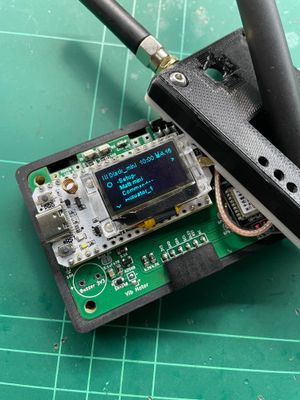


There's a growing conflict emerging around being 'Meshtastic compatible', which has really made me re-think trying to support the protocol.
Initially, I thought it should be a good thing to expand the ecosystem and widen the choice for you guys, which is what I've tried to do. I know the Meshtastic source is open, but GPL'd, so I thought if I was going to try this, I'd have to write it myself. I wasn't sure if that was going to be worth it, so just aimed for the simplest implementation, which is essentially the CLIENT_MUTE device role.
Anyway, despite my best efforts, I can't get some things to interoperate; like the PKC (public key) direct messaging, and TRACEROUTE, among others. And, to the finger-pointing accusers out there, if I was using the Meshtastic source, then all of this would (you'd assume) just work.
And, further to this, it seems to be apparent that the Meshtastic crew just don't want to play with others.
A lot of us got into this space because we foresee a need for an alternative, de-centralised, de-corporatised comms network. One that's resilient, private, anonymous, and free of government (or corporate) surveillance and tracking. Having corporations tip toe into this space and making centralising efforts is, probably, inevitable, but I think a lot of us got into this precisely because we oppose this trend.
What I see as the right way is for a capable and secure protocol to emerge, one that can resist bad-actor attacks, surveillance and censorship. And for this to be an open standard, like TCP/IP, and for anyone who has the skills to build firmwares and hardware in this eco-system, competing. Best products win. All too often we see the OpenAI's of the world pull a fast one--start out all 'community' oriented, but then just show their true colours. I'm a believer in the free market (but not 'free'. There's no free lunch). This is the only way things get better and improve over time.
So, practically, going forward I think I'll invest more time into studying Reticulum, and do more experiments with that protocol. It's got some really advanced cryptographic security, and can apparently really scale, and has principles I admire, like preserving privacy and being decentralised. The main downside it still seems to have is that it's got a big learning curve, and is not exactly consumer friendly yet. I also have a fascination with the mesh protocol space, and will still tinker with my R2 protocol. I enjoy the challenge and find it an interesting problem to work on.
regards,
Scott Powell.