
 My BFF’s 96-year-old aunt passed away recently.
She was wonderfully lively and talented, a woman from a time when Black women could not afford to spoil their children. There was too much at stake. Their love often arrived without cushioning—straight talk, no chaser, instruction meant to prepare you for a world they already understood would not always be kind.
That directness was remembered by everyone who spoke about her.
I sat near the back of the chapel during her homegoing service, where I could take everything in. It was a glorious celebration of a long life, and from my seat I could watch the family, the elders, the children, the people greeting one another across pews—the gathering before the gathering fully became itself.
And then an elderly woman walked to the microphone.
She wasn't introduced.
Her name wasn't printed in the program.
There had been no elaborate plan for what was about to happen. She had simply been divinely instructed to lead us in song. And she obeyed.
She opened her mouth and sang:
Blessed assurance... Her voice was clear and strong.
Jesus is mine... And from those first words, I knew we were in for a treat.
I began rocking gently in my seat. I closed my eyes. And there was my mother.
I could almost see her sitting over a cup of morning coffee, humming that same old hymn. I don't know how many times I heard it growing up. Probably more than I could ever count.
But before this woman had gotten very far into the song, something happened. Black magic was activated. Immediately. Fully.
The room joined her. Not politely. Not because someone gestured for audience participation. We joined her.
Voices rose throughout the chapel. Harmonies appeared. Bodies began moving. Hands lifted. Heads nodded. People sang and praised Jesus.
Now, on the surface, none of this is particularly unusual. It's what happens when Black folks gather. But I began noticing something that fascinated me.
Nobody had to teach us what to do.
Blessed Assurance is an old gospel hymn written in the 1700s (?) by a white woman, one that has traveled through generations of Black churches, homes and funerals.
But the music being sung that day didn't remain entirely inside the old arrangement. Contemporary gospel has taken familiar sacred music and expanded it—new bridges, new choruses, new interludes, new gestures and rhythms layered onto something our elders already knew.
And none of it threw anybody off. Not the elders. Not the young people. Not the church folks. Not me.
People from what looked like eight to eighty moved through the song together without missing a beat. Then came:
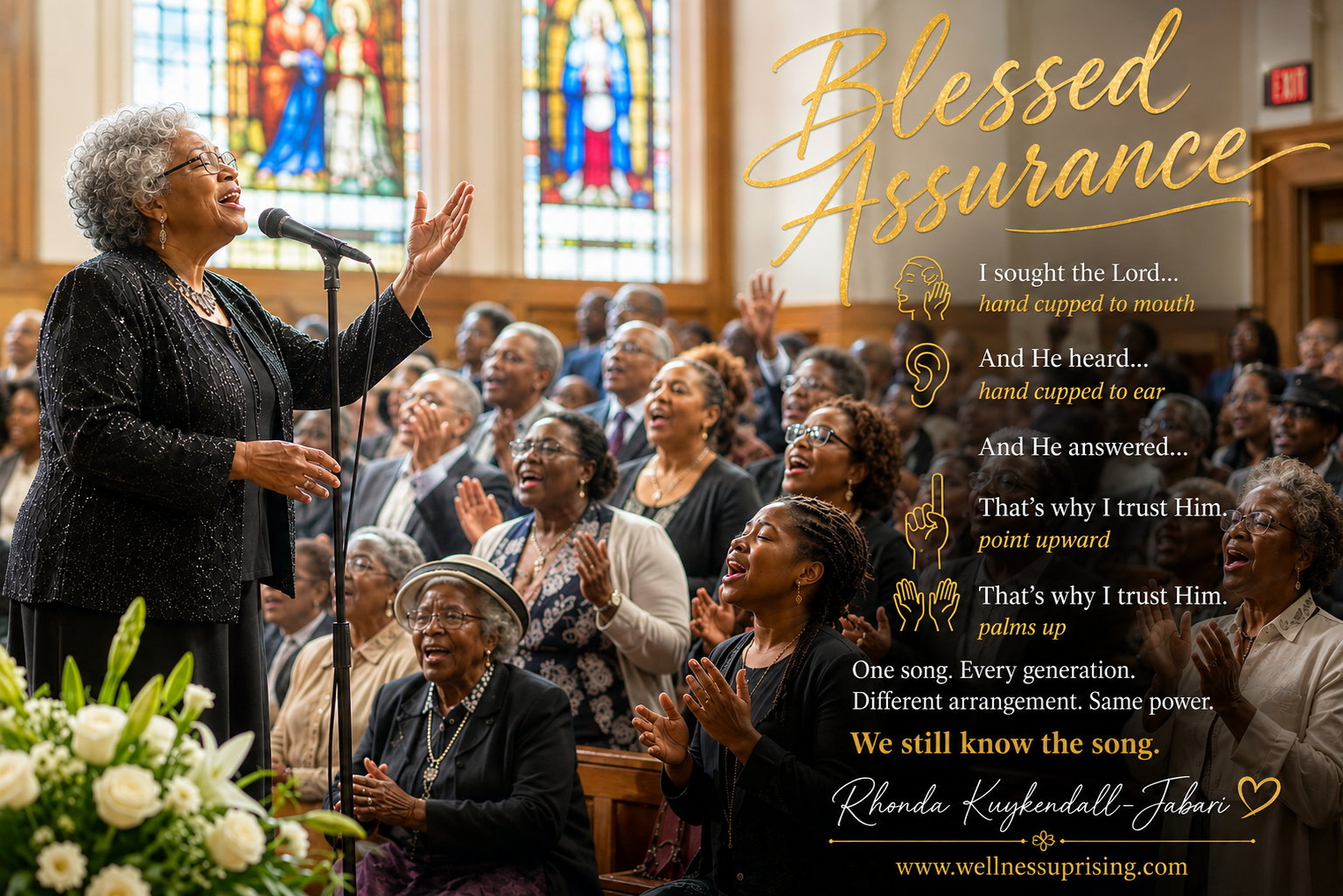
I sought the Lord... Hands cupped around mouths as though calling out.
And He heard... Hands moved toward ears.
And He answered...
And then:
That's why I trust Him. Fingers pointed upward. Some people held both hands open, palms toward the heavens.
Everyone sang. Everyone moved. Everyone knew. No rehearsal. No choreography. No instructions. No discussion about what came next.
For those few minutes, the room operated almost like a single organism. And sitting near the back watching it happen, I realized I was witnessing something much larger than a gospel song. I was watching cultural memory become visible.
How did everybody know?
Somebody's grandmother sang those songs. Somebody's mother hummed them while cooking. Somebody heard gospel while the house was being cleaned on Saturday morning. Somebody sat through funerals as a child, swinging little legs beneath a church pew while the grown folks sang.
Somebody heard those melodies while getting dressed for Sunday service. At repasts. At family reunions. In kitchens. In cars. During illness. During grief. During joy.
During those ordinary moments nobody thinks to document because they don't seem historically important while they're happening.
That is how culture gets transmitted. Not only through books and classrooms and formal instruction. Sometimes through repetition. Sometimes through observation. Sometimes through sound. Sometimes through the body.
And decades later, someone sings: Blessed assurance... And the archive opens.
There is another reason the room changed so quickly. Black sacred music has always been participatory. Call and response. Improvisation. Repetition. Harmonizing. Movement. Testimony. Gesture.
These aren't simply musical techniques. They are ways of creating community. The separation between performer and audience disappears. There isn't really an audience anymore.
Everybody becomes part of the ceremony. One person calls. Somebody answers. Another voice finds the harmony. Somebody begins rocking. Another person raises a hand. And suddenly dozens of individual people are participating in the creation of one experience.
That is a technology. An old one. And we know how to use it.
We have technologies for becoming collective. Song is one. Rhythm is one. Call and response is one. Testimony is one. Food is one. Language is one. Humor is one. Mourning is one. Spiritual practice is one.
Black people possess cultural technologies that allow us to recognize one another and become collective very quickly. That doesn't mean Black people are a monolith. We aren't. We have enormous differences among us—regional, generational, religious, political, economic, cultural.
Some of us are Christian. Some Muslim. Some practice African traditional religions. Some are metaphysical practitioners.
Some honor ancestors. Some believe in everything. Some believe in nothing. Some of us left the Black church decades ago and have absolutely no intention of returning.
Hello. My name is Rhonda.
And still... Blessed assurance...Something knows.
I thought I was observing. This may have been the greatest revelation for me. I had intentionally positioned myself toward the back of the chapel. I was watching. Observing. Taking everything in.
I am no longer a practicing Christian in the traditional sense. My spiritual life has expanded far beyond the Christianity in which I was raised. But when that room activated, I didn't remain an observer.
I sang. I rocked. I praised. I knew when and how to respond.
My body knew the rhythm. My memory supplied my mother's voice.
For those moments, there was no conflict between who I am spiritually today and what shaped me spiritually decades ago. I belonged to both.
Because ancestral inheritance isn't only what we consciously decide to carry. Sometimes it's what rises inside us before we've chosen anything at all.
My mind may have changed. My theology may have expanded. But something much older still recognized the call.
And then it came to me, imagine what had to survive for that moment to happen.
This is the part I cannot stop thinking about. Our ancestors endured systems deliberately designed to separate Black people from language, family, land, spiritual traditions and one another.
Then came generations of segregation, migration, displacement, assimilation and the constant pressure to abandon Black cultural practices in exchange for acceptance by dominant culture.
And yet here we were. Generations later. Inside a chapel.
A woman who wasn't even on the program walked to a microphone because something told her to lead us in song. She obeyed. She opened her mouth. And an entire room knew what to do.
Think about that.
Something survived. Something was passed down. Something remained recognizable enough that children and elders could inhabit the same rhythm.
The music had changed. New pieces had been added. The generations had put their own fingerprints on it. But the underlying language remained intact.
That isn't preservation under glass. That is living culture. Living things change. They adapt. They absorb. They respond to the time they're living in. And still carry something forward. This is what the world is witnessing.
I left that funeral thinking about far more than the beautiful woman whose life we had gathered to celebrate. I kept thinking about the room. About how quickly we became we. About what happens when Black people recognize something ancient in one another. About the cultural mechanisms we inherited for gathering, grieving, celebrating, surviving and remembering ourselves.
And I thought about this moment we're living through now.
Because something is happening. Black people are remembering. Not everyone in the same way. Not under the same religion. Not around the same politics. Not using the same language. But there is a growing recognition that our individual lives exist within something larger than ourselves.
And when that recognition becomes embodied—when people stop merely talking about collective power and begin feeling themselves as part of a collective—something changes.
That is what I witnessed in that chapel. Nobody organized it. Nobody rehearsed it. Nobody explained it. Nobody needed permission.
One woman received an instruction:
Lead us in song.
She obeyed.
And everybody knew how to answer.
This is what the world is witnessing today. And perhaps this is what they fear. Because you can disrupt an organization. You can dismantle an institution. You can remove a leader. You can rewrite a curriculum. You can discourage a language. You can even convince people, temporarily, to distance themselves from their own culture. It's being done as we live and breathe.
But what do you do with something stored in the body? What do you do with a people who can hear a call across generations... and still know how to respond?