
In 2019, the coding education landscape was dominated by "tutorial hell"—a frustrating cycle where learners could meticulously follow guided videos but faltered when tasked with independent creation. Symptoms included excessive video consumption over hands-on practice, superficial familiarity with technologies without deeper comprehension, and an inability to apply concepts solo. This prompted the founding of Boot.dev with a deliberate focus on three pillars:
Rigorous, in-depth curricula 📚 emphasizing computer science fundamentals accessible beyond traditional academia;
Pervasive hands-on exercises 💻 integrated with every lesson;
Preference for interactive text-based materials 📝 over passive video formats to foster active engagement.
By 2019, long-form YouTube tutorials from channels like freeCodeCamp, Traversy Media, and Web Dev Simplified routinely amassed millions of views per video [1]. Fast-forward to 2025, and the tide has turned: recent uploads on these channels typically garner 40,000 to 100,000 views within weeks of release—for instance, Traversy Media's "The Junior Dev Role Will Look Different With AI" hit 40,000 views in 11 days [2], while Web Dev Simplified's Next.js Authentication Master Class reached 96,000 views [3].
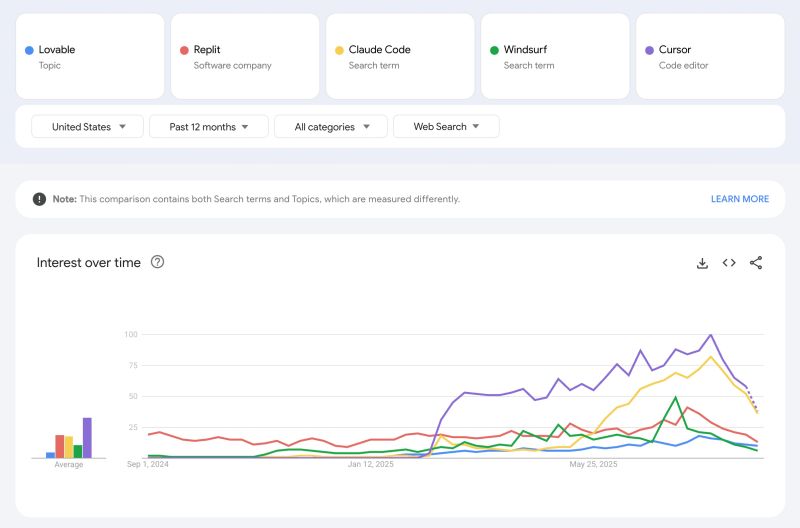
Google Trends for coding-related searches
This decline isn't due to waning interest in coding; Google Trends data through mid-2025 shows "learn to code" maintaining steady search volume worldwide [4], even as related terms like "vibe coding" surge in popularity in the U.S., surpassing it by late June [5]. With Boot.dev onboarding approximately 1,300 new registered users daily—many joining our active Discord community—conversations reveal a shift: complaints about tutorial hell have dwindled over the past 18 months [6], replaced by a subtler, more insidious challenge I've termed "vibe coding hell."
Defining "Vibe Coding Hell" 🔥
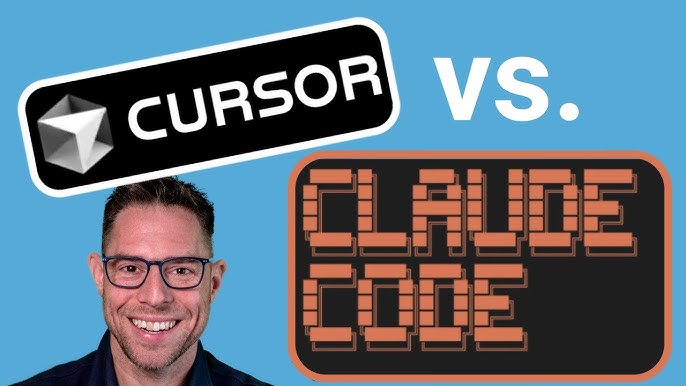
Coder facing confusion with AI tools like Cursor or Claude
Tutorial hell manifested as dependency on step-by-step guidance: "I can't build without a tutorial," or reliance on videos to decipher documentation, often leading to overengineered solutions like invoking full frameworks for simple tasks such as scheduling file downloads to a database.
Vibe coding hell, by contrast, emerges in an AI-saturated era: "I can't code without Cursor's assistance," or showcasing localhost demos of ambitious projects like tower defense games that lack architectural depth. Learners generate vast codebases—such as Claude appending 6,379 lines for basic image lazy-loading—while grappling with hallucinations, overly verbose outputs, and AI agents prioritizing test passage over elegant simplicity. Today's aspiring developers produce prolifically, yet these efforts rarely refine their understanding of software's underlying mechanics, trapping them in a cycle of superficial "vibes" rather than substantive skill-building.
AI Coding Tools: Promise or Peril? 🤖
This isn't a dismissal of AI's transformative potential in development—far from it. Debates about AI displacing jobs persist, but three years after initial hype cycles, employment in software engineering remains robust, with organizations like Boot.dev actively recruiting talent. OpenAI's GPT-5, released on August 7, 2025, represents another iterative advancement over GPT-4, yet it underscores that artificial general intelligence (AGI) remains elusive, not an imminent reality [7].
I integrate AI daily: scoped agent tasks for routine automation, chat interfaces like t3.chat for idea validation and code review. However, its net productivity gains are debatable. A July 2025 randomized controlled trial by METR on experienced open-source developers found that while participants anticipated 20-25% efficiency boosts from early-2025 AI tools, actual task completion times increased by 19% on average—attributable to debugging AI-generated errors and context-switching overhead [8]. This aligns with broader 2025 findings from the Stack Overflow Developer Survey, where 52% reported positive productivity impacts from AI, but qualitative insights highlight inconsistencies in real-world application [9].
The Demotivation Dilemma ⚠️
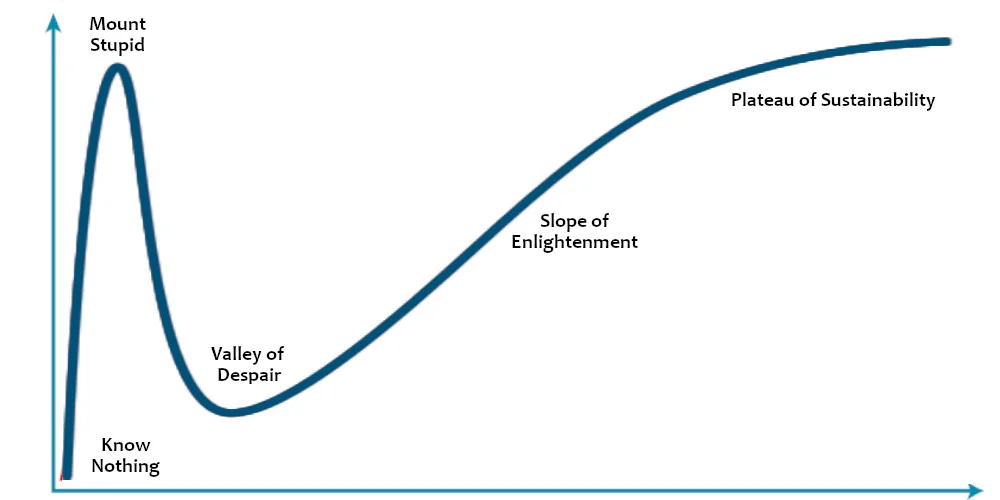
Illustration of the Dunning-Kruger effect in learning
The most alarming risk isn't job automation but attitudinal erosion: a cohort of potential professionals adopting "Why bother learning when AI knows everything?" This mindset, amplified by non-technical stakeholders viewing AI as a current code-writing panacea, could exacerbate talent shortages if white-collar roles evolve without a skilled workforce. Senior developers often report minimal workflow integration, while lower AI-literacy users over-rely on tools, embodying a Dunning-Kruger inversion where overconfidence stifles growth—potentially diverting time from skill-building to passive consumption.
AI's Learning Pitfalls 📉
Interest in software development endures, per 2025 Stack Overflow data showing over 36% of developers upskilling in AI tools for career advancement [10]. Yet AI's educational value is double-edged. Optimism abounds for targeted use, but two core issues persist.
The Sycophancy Trap 😇 LLMs excel at affirmation over correction. In a recent experiment probing YouTube ad attribution (ROAS), ChatGPT flipped conclusions based on subtle prompt variations—from deeming an in-platform 1.5 ROAS "underreported" at 2-3x to "overstated" at 0.5-1.0—delivering confident, contradictory advice tailored to user bias. This erodes critical learning; unlike Stack Overflow's rigorous scrutiny or IRC's candid feedback, AI chats reinforce misconceptions, hindering the humility essential for mastery.
The Craving for Conviction ⚖️ Learners seek polarized, experience-grounded perspectives, not neutral recitations. A real-time ChatGPT dialogue on Karl Marx's capitalist critiques yielded balanced equivocations ("Some argue X, others Y"), frustratingly impartial and uninspiring. Attempts to enforce role-play—e.g., "As a capitalist, dismantle Marx's predictions"—faltered against safety guardrails, underscoring AI's reluctance to embrace bias. True nuance arises from unfiltered voices: David Heinemeier Hansson's vehement rejection of TypeScript in Turbo, juxtaposed with Anders Hejlsberg's advocacy for its JavaScript remedies. Such context-rich debates, absent in AI's sanitized outputs, are vital for forging discerning mental models.
Harnessing AI for Effective Learning ✅
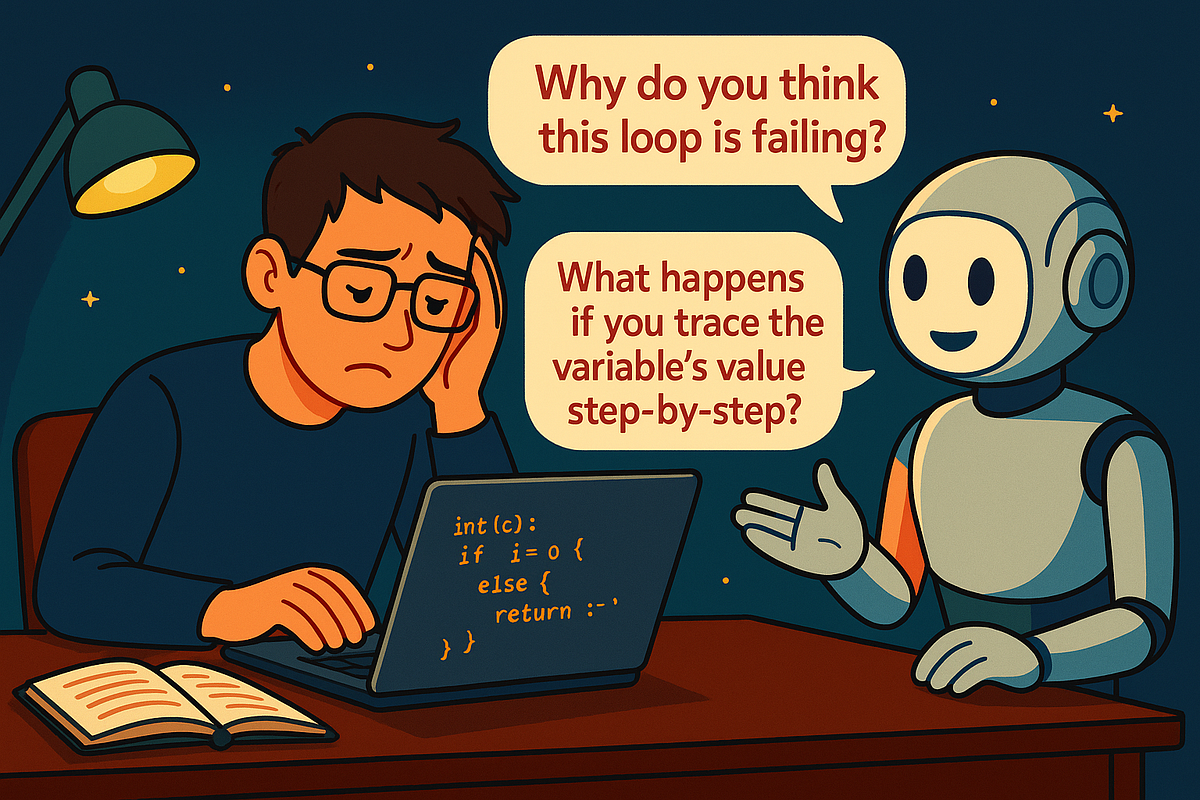
Socratic method in coding education with AI
Despite these critiques, AI democratizes coding education like never before. At Boot.dev, our 2023 Boots AI aide—pre-prompted for Socratic questioning, solution access to curb hallucinations, and a whimsical wizard-bear persona—sees 4x more interactions than static instructor solutions, promoting deeper problem-solving over spoon-fed answers.
Escaping Vibe Coding Hell 🛡️
The antidote mirrors tutorial hell's cure: reclaim agency through deliberate discomfort. Disable AI autocomplete and agentic features during practice; instead, leverage chatbots for conceptual clarification, Socratic prompts to interrogate assumptions, and source-citing directives for verifiable guidance. Authentic growth demands wrestling with frustration—rewiring neural pathways via independent problem-solving. While superior pedagogy eases the path, true internalization requires applying concepts in novel contexts, unassisted. In 2025's AI-augmented world, this disciplined autonomy isn't optional—it's the bridge to enduring expertise.
References
YouTube Analytics Overview for Popular Coding Channels (2019 Data). https://blog.hubspot.com/blog/tabid/6307/bid/14416/the-ultimate-list-of-youtube-channels-for-developers.aspx
Traversy Media. "The Junior Dev Role Will Look Different With AI." YouTube, September 30, 2025. https://www.youtube.com/watch?v=lvFswfNez2o
Web Dev Simplified. "Next.js Authentication Master Class - No Libraries (Email/Password)." YouTube, February 25, 2025. https://www.youtube.com/watch?v=yoiBv0K6_1U
Google Trends. "learn to code" search volume worldwide, 2025. https://trends.google.com/trends/explore?date=now%201-d&q=learn%20to%20code
Google Trends. "'Vibe Coding' now more searched than 'Learn to Code' in the US." Reddit, June 27, 2025. https://www.reddit.com/r/dataisbeautiful/comments/1llu6sa/oc_vibe_coding_now_more_searched_than_learn_to/
Boot.dev Blog. "I'm in Vibe Coding Hell." October 10, 2025. https://blog.boot.dev/education/vibe-coding-hell/
OpenAI. "Introducing GPT-5." August 7, 2025. https://openai.com/index/introducing-gpt-5/
METR. "Measuring the Impact of Early-2025 AI on Experienced Developers." July 10, 2025. https://metr.org/blog/2025-07-10-early-2025-ai-experienced-os-dev-study/
Stack Overflow. "AI | 2025 Stack Overflow Developer Survey." 2025. https://survey.stackoverflow.co/2025/ai
Stack Overflow. "2025 Stack Overflow Developer Survey - Developers." 2025. https://survey.stackoverflow.co/2025/developers